A Healthy Democracy Is Economic Infrastructure
By William Lebovics · 2026-09-08
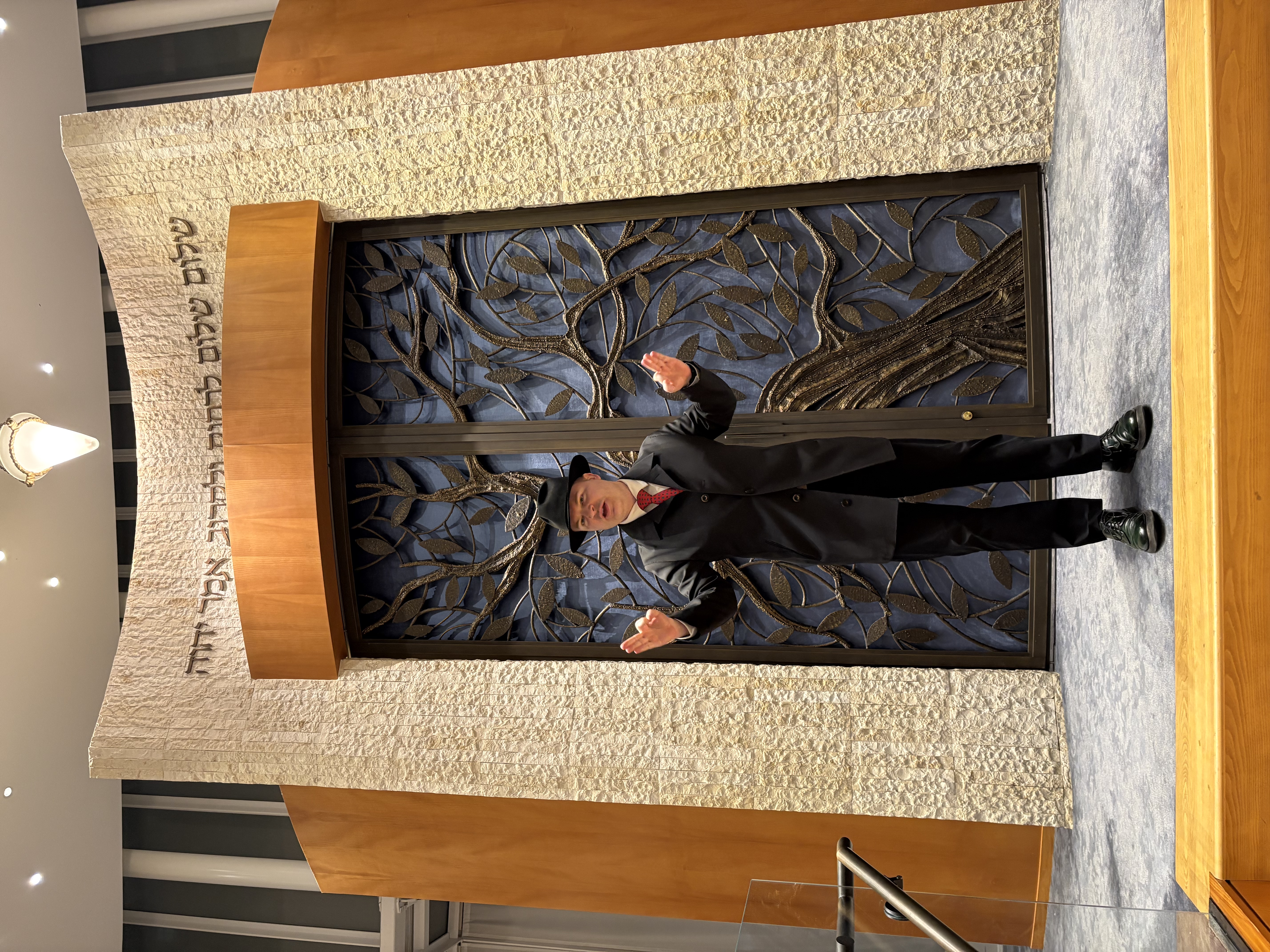
This is a great talk by my friend David Teten to MBA students.
Three facts you rarely hear from an investor.
First: I am not a billionaire. Embarrassing, but true. Now, if I apply a Palantir multiple to all of my portfolio companies, I probably am a billionaire. In fact, if you apply a Palantir multiple to most portfolios in this business, we are all billionaires. It is very helpful in the investment business to be a billionaire. Everyone wants to meet you. But there are real downsides. I have friends in that club, and many are frightened to say publicly what they think about sensitive issues. Fortunately, I am not that important, which has its advantages, despite the fact that I get invited to fewer parties in the Hamptons.
Second: past performance is predictive of future results. Every investor knows this. Every lawyer knows we're not allowed to say it. I'm going to share some lessons from history's most famous fund manager, Joseph, the viceroy of Pharaoh. More on him later.
Third: when I talk about politics with my friends or my colleagues, I feel like the adult in the room, and that's not the least embarrassing part. I'm old enough that my generation is running the country, plus the boomers who never leave. And I still feel ineffectual. I even invested in companies building rockets to space, and that didn't help.
A lot of people complain that America is run by the elites, for the elites. I know some folks in the alleged cabal, and they would tell you they don't even get to influence who is mayor of New York City. Elon Musk and George Soros have wildly divergent views but have learned the same lesson: money helps, but even billionaires can't get their every wish granted. That's probably a good thing. My friends on the left and the right all firmly believe that America's century as the wealthiest, most powerful nation on earth may be ending, and that the other side is at fault.
Our political system is under strain. In a recent Pew Research Center survey, 85% of Americans said politically motivated violence is rising, a view shared almost identically by Republicans and Democrats. Freedom House, a nonpartisan group that has rated every country in the world on political rights and civil liberties since 2002 on a scale of 0 to 100, reports in its 2026 analysis that the U.S. fell 3 points to 81, our lowest score ever, and a 12-point erosion over two decades under both parties.
Investors are taking notice. Net foreign direct investment into the United States declined last year and came in below the average for the previous decade. Non-AI business investment is running roughly $130 billion below its decade-long trend, contracting over the last four quarters at about 3% annualized, compared with 5% annual growth over the prior decade. And bond yields have been climbing in response to fiscal irresponsibility and, in some cases, incompetence. Complaining is not a strategy. So the question worth asking is: what is your comparative advantage here, and what would you have to do to be less embarrassed in front of your friends?
Partisanship is no party A major reason America feels so dysfunctional is partisanship. Paul Graham, who co-founded Y Combinator, wrote an essay called "The Two Kinds of Moderate." His argument: the defining quality of an ideologue, left or right, is acquiring opinions in bulk, your views on taxation become predictable from your views on same-sex marriage. What he calls "accidental moderates" not only choose their own answers but choose their own questions. It's possible in theory for one side to be entirely right and the other entirely wrong, and ideologues must always believe this is the case, but historically it rarely has been. I am an accidental moderate. I have voted for candidates labeled Democrat, Republican, and other. Many years ago I chaired what was then the only Jewish Republican PAC in the United States.
Fundamentally, I agree that one should vote on principles, not on party. I don't understand the argument against it. Politicians face enormous pressure to vote with their party. You, in the privacy of the voting booth, face none of it. If you want to vote on principle, I suggest three tests:
- Check for double standards. Whenever your side does something that makes you a little uncomfortable, ask how you would respond if the other side did exactly the same thing.
- Name your political bright line. What, specifically, would a candidate on your own side have to do to lose you? Write it down, so you can test yourself later, when they do it.
- Check your convictions for sudden repricing. The Republican Party was the party of free trade for two generations, until one leader changed his mind and everyone followed. The Democratic Party was fixated on microaggressions detectable in a single pronoun; then, when actual aggression arrived against Jews, too many of its members justified literal and verbal violence with "context." How sincere were those beliefs?
History's most famous fund manager Go back roughly 3,700 years. Pharaoh, king of Egypt, has disturbing dreams that no one can interpret. After exhausting every other option, he sends for Joseph to analyze this alternative data.
Joseph does what the best investors do: he converts ambiguous data into a falsifiable, dated forecast. Seven fat years, then seven lean ones. Like any good subordinate, he doesn't just bring his boss a problem. He brings a recommended solution, one that happens to require giving him more budget and authority. That's how you get promoted. He proposes the king take a fifth of the crop in the fat years and warehouse it against the famine. He invents the sovereign wealth fund, the GP seeder model, and the 80-20 carry split in a single meeting.
Pharaoh makes him viceroy, or as we say in Hebrew, consigliere. Over the course of the famine, a nation of independent farmers becomes sharecroppers. They're alive, but the wealth and power sit overwhelmingly with Pharaoh, and with Joseph.
And then: A new king arose over Egypt, who knew not Joseph (Exodus 1:8). The new king tells his people that the Israelites are too numerous, that they should be dealt with shrewdly lest they multiply and join Egypt's enemies in war. A minority that had saved the country is recast, in a single cabinet meeting, as a fifth column. The enslavement follows within three verses.
Joseph was brilliant, faithful, and he saved untold lives. He also built the most efficient apparatus of centralized control in the ancient world and handed the keys to a hereditary monarchy. His own descendants were crushed inside the machine he built.
The Talmudic scholars Rav and Shmuel dispute what actually happened: one reading is that Pharaoh died and his heir took over; the other is that this was the same Pharaoh, turning his back on an ally. The difference is largely moot. Either way, Joseph got thrown to the wolves.
Most of us manage political risk exactly like Joseph. We give money to a politician. We expect they'll take our call. That is a hedge with a single counterparty, no collateral, and a correlation of 1.0 to everything else we own. What actually protects us is structural: a constitution with a balance of powers, social trust, impartial rule of law, a free and aggressive press, a vibrant civil society, government employees hired on merit rather than loyalty, alliances, legal immigration. These are political hedges that let all citizens thrive, create healthy competition for power, and survive a change of counterparty.
By analogy: the timber and forest products industry spends roughly $500 million annually on stand establishment and replanting, plus $10–15 million on federal lobbying. Why? Because they'll be out of business if they don't plan for a future in which trees still grow.
Our capitalist democracy is to investing what rain, a healthy climate, and pest control are to timber. And yet philanthropic funding for U.S. democracy runs at roughly 1% to 1.5% of total U.S. philanthropy.
The tyranny of the majority As a Jewish American, I belong to a roughly 2% minority. Our community's entire security rests on a system in which winning 51% of the vote does not entitle you to 100% of the outcomes.
You might think you're not a minority. You have money, social status, power. You're safe.
But anyone can become the hated minority, including the elites who assume they're insulated from consequences. The elites of the French Revolution, the Bolshevik Revolution, the Cambodian genocide, the Iranian revolution, and the Chinese Cultural Revolution weren't safe either. Today, anger at the wealthy, at politicians, and at elites as a class is rising. If you think the United States is incapable of bloody upheaval, I will be the rare father who suggests you spend more time on social media.
That is why I'm so unfashionably attached to the brilliant, admittedly flawed democracy we have. It is the only thing standing between my children and the discretion of whoever holds power in 2029, which could be J.D. Vance, AOC, or, heck, Josh Shapiro.
What investors can actually do Look around at what the investor community is doing about the health of the American system and you find two things. There are groups representing the business community, but businesses answer to their investors, and have a harder time speaking out without investor backing. And there are investor groups lobbying for parochial concerns: lower capital gains taxes and the like. What's missing is anyone articulating a simpler fact. We cannot do our jobs well without a constitutional, capitalist democracy. We all benefit from the premium on American assets.
They say the fish doesn't see the water. I'm grateful for the water, the literal and metaphorical liquidity we enjoy in the United States, which we've been drawing down like an endowment with no principal left.
There are serious nonpartisan organizations already working on this: Better Together America, Braver Angels, PolicyLink, AllSides, Unify America, BridgeUSA, and Issue One, among others. They are worth knowing and worth funding.
Three actions: First, use your power. We have influence over our own institutions, over our portfolio companies, and over the politicians and causes we fund. Use it, to reduce polarization in the workplace, support healthier information ecosystems, increase transparency in political spending, strengthen anti-corruption practices, and engage in local civic life. It's in our self-interest if we want to keep drilling. Second, fund the plumbing. Many people on Wall Street face legal restrictions on donating to candidates. That doesn't restrict supporting civil society. Functioning independent courts, trusted election administration, a free press, these are the protective provisions on our democracy.
Investors are often hesitant here, worried that being publicly seen as red or blue will create enemies. But nonpartisan civic organizations aren't asking you to pick a side. They're asking you to support the infrastructure that lets both parties, and everyone in between, compete peacefully under the same rules. You will not get a call from compliance.
Third, you are not a Republican. You are not a Democrat. You are a citizen who can make your own decisions.
Individual and retail investors hold roughly half of total global AUM, according to BCG. Investors have bosses too, and for many of us that boss is collectively middle-class and working-class America. All Americans, regardless of where or whether they work, benefit from this system.
So here's an investment thesis worth adopting: a healthy democracy is not just a moral good. It is economic infrastructure.
Let's go to work.