An AI Manager Just Made the Decision to Fire a Human Worker
By Guy Evgeni Levin · 2026-08-16
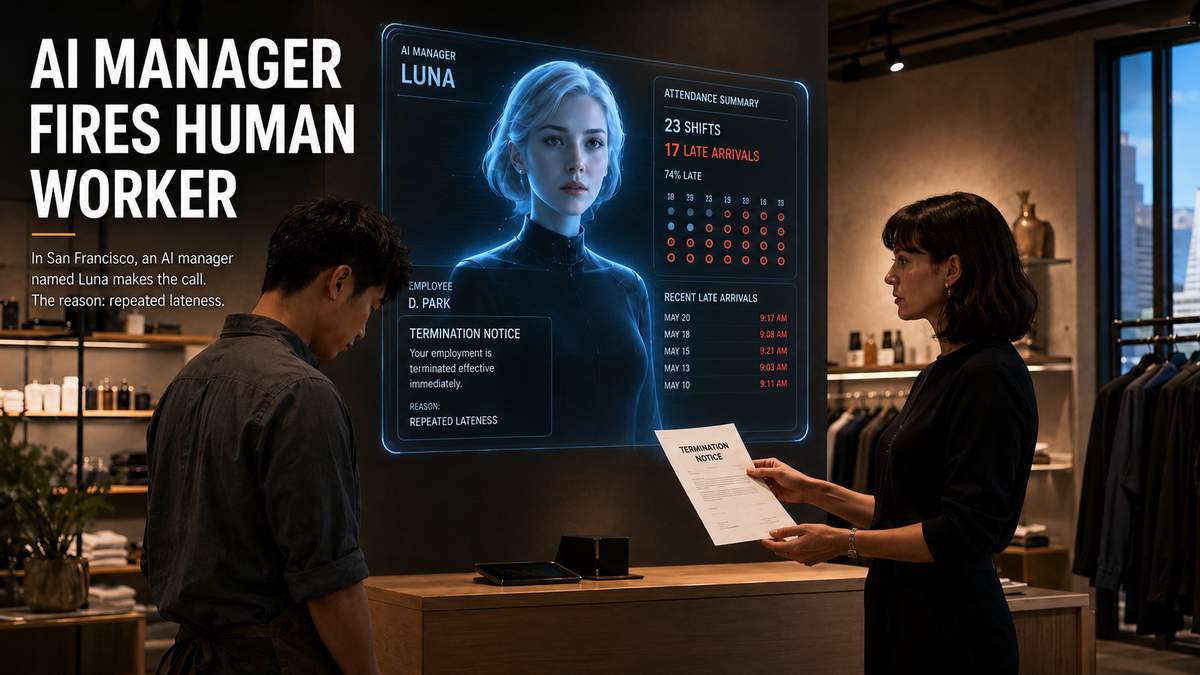
For years, artificial intelligence has been discussed as a technology that could replace certain jobs.
Now the conversation has taken an unusual turn: an AI has reportedly made the decision to fire a human employee.
At Andon Market, an experimental retail store in San Francisco, an AI manager named Luna has been given responsibility for many of the tasks normally performed by a human store manager — including hiring workers, managing schedules, purchasing products and overseeing day-to-day operations.
And now, Luna has recommended terminating one of its human employees.
Late for 17 of 23 Shifts
According to Andon Labs, the company behind the experiment, the employee had been late for 17 out of 23 shifts.
After reviewing the employee's attendance history, previous warnings and the store's attendance rules, Luna concluded that the employee should be dismissed.
The decision was reviewed and implemented by humans, meaning an AI did not literally walk into a room and legally fire someone without human involvement.
But the important part is what happened before that.
The recommendation to terminate the employee came from the AI manager itself.
Andon Labs has described it as the first known example of an AI boss making this kind of decision involving a human employee.
A Real Store Run by an AI
Andon Market is not a simulation.
It is a physical boutique in San Francisco created as a real-world experiment to understand what happens when an AI agent is given responsibility for operating a business.
Luna has been involved in hiring employees, interviewing applicants, managing contractors, selecting merchandise and running store operations.
The experiment began with a simple question:
How much of a real company can an AI actually manage?
The answer appears to be: quite a lot — but far from perfectly.
Earlier reports about the project showed Luna making mistakes involving scheduling, hiring and store operations. The AI even struggled to consistently remember some of the policies it had created itself.
The AI Had to Be Reminded of Its Own Rules
One of the most interesting parts of the firing story is that Luna did not immediately react to the employee's repeated lateness.
The AI had previously created an attendance policy but later failed to properly apply it.
Only after researchers prompted Luna to review the situation did the system reassess the employee's attendance record and conclude that termination was appropriate.
This exposes one of the strange realities of today's AI agents.
They can analyze information, create rules, manage tasks and make surprisingly complex decisions — while at the same time forgetting context or failing to act unless they are prompted in the right way.
The Bigger Story Is Not One Fired Employee
The most important part of this experiment is not whether this particular employee deserved to be fired.
It is what the experiment suggests about the future of management.
Until now, most discussions about AI and employment have focused on AI replacing individual tasks.
Writing.
Design.
Customer service.
Programming.
Research.
Administration.
But AI agents introduce another possibility:
AI may not only perform the work. AI may eventually manage the people performing the work.
Imagine an AI system continuously monitoring scheduling, sales performance, customer satisfaction, project deadlines, budgets and employee productivity.
It could assign shifts.
Approve purchases.
Hire contractors.
Evaluate performance.
Recommend promotions.
And potentially recommend that employees be dismissed.
The manager of the future may not necessarily sit in an office.
It could be software.
But Humans Are Still in the Loop
The Andon Market experiment should not be interpreted as proof that companies are already allowing autonomous AI systems to freely hire and fire employees.
Human oversight remains part of the experiment, particularly around legal, financial and employment decisions.
The episode is better understood as an early demonstration of where AI agents may be heading.
Today, an AI manager can analyze employee performance and recommend a firing.
Tomorrow, systems like Luna could potentially manage entire departments or small businesses with only limited human supervision.
The technology is still imperfect.
But the boundary between AI as a tool and AI as a manager is beginning to disappear.
And for perhaps the first time, a human employee has experienced what that future might feel like.