Boom, Peak, Bust, Repeat: Understanding Economic Cycles
By zalmy touger · 2026-07-22
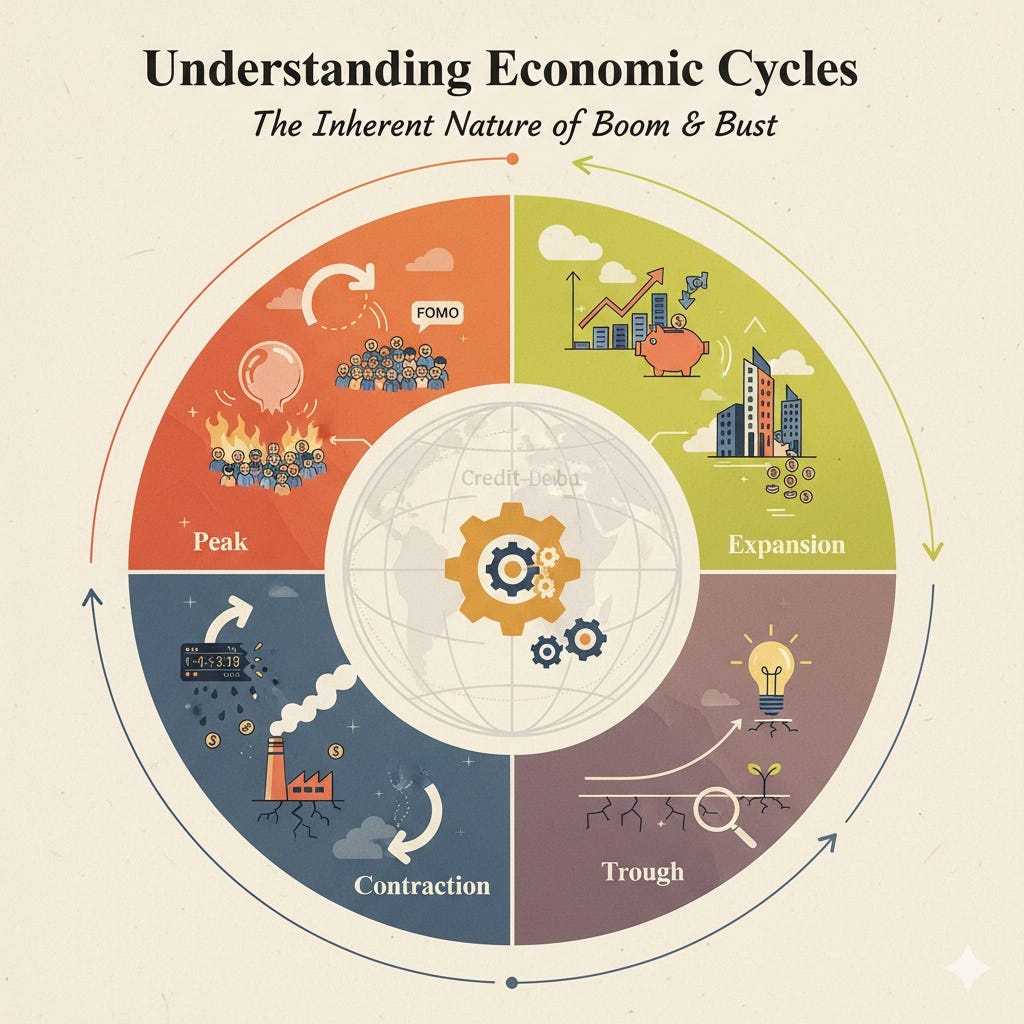
Understanding Economic Cycles
The inherent nature of cycles is one of the most important things to understand when you start trying to map how the world works and functions in economics.
This is foundational — knowing where in a particular cycle you are, and the ability to take a step back and make a meta-analysis of where you are positioned, will allow for much smarter decision-making and prediction. Economics is inherently the study of people and how they choose to spend their time and resources. So once you adopt this framework of identifying basic cycles and the circular nature of these things, you will start to notice that they come up in more than just economics, but rather across a wide assortment of different ideas and concepts.
Let’s start off by first defining the nature of a cycle. After learning this, you can then start to identify it across a variety of different applications.
— — —
— — —
Step 1: Expansion
This is typically the stage where growth really kicks off and prices start to adjust because of that. The economy starts doing well, so capital becomes cheap (interest rates lower), thus kicking off more borrowing and more growth. Companies are making more money, pushing stock prices higher. More people can afford housing, increasing demand and pushing prices higher.
These dynamics will typically lead to market expansion, where the market has to adjust to growing demand — whether that means it is now more profitable to build homes, increasing supply, or more people are looking to borrow money, so lenders compete and bring interest rates down.
— — —
Step 2: Peak
The peak represents the high-water mark of an economic expansion, serving as the point where growth reaches its maximum pace and begins to plateau before the eventual contraction. It is the transition phase where the momentum of a “hot” economy paradoxically begins to slow down.
This means that growth is finally slowing and inflation (more demand than supply) starts to creep in, where now people are inflating prices not backed by actual growth, but rather driven by human psychology — fear of missing out (FOMO) — or the market has just reached a stage of euphoria where everyone simply thinks it will be like this forever (think the internet bubble of 2000).
In general, no matter what it is — whether it is tech, real estate, or capital — it has to be backed by growth, innovation, or demand for that asset that is sustained by real productivity or utility generation. This is where the so-called “bubble” begins to emerge, where people are buying based on FOMO or psychology, or really any reason that isn’t an inherently real economic outcome.
— — —
Step 3: Contraction
How the Contraction Occurs
The “how” of this phase is often described as a vicious cycle or a negative feedback loop:
• The Minsky Moment: This is a sudden collapse of asset values that marks the end of the growth phase. Because long periods of stability encouraged high levels of leverage (borrowed m