Cantor Benny!
By William Lebovics · 2026-08-11
❦
There is a moment in every great cantorial service that cannot be notated. It arrives after the melody has been given and the congregation has settled into it — a suspension, a held breath, the sound thinning almost to nothing before it opens again. Musicians call it phrasing. In the world of chazzanus it has an older name: tefila b’regesh, prayer offered with feeling. It cannot be taught in the ordinary way. It can only be transmitted, from one voice to another, across generations that have agreed the transmission is worth the trouble.
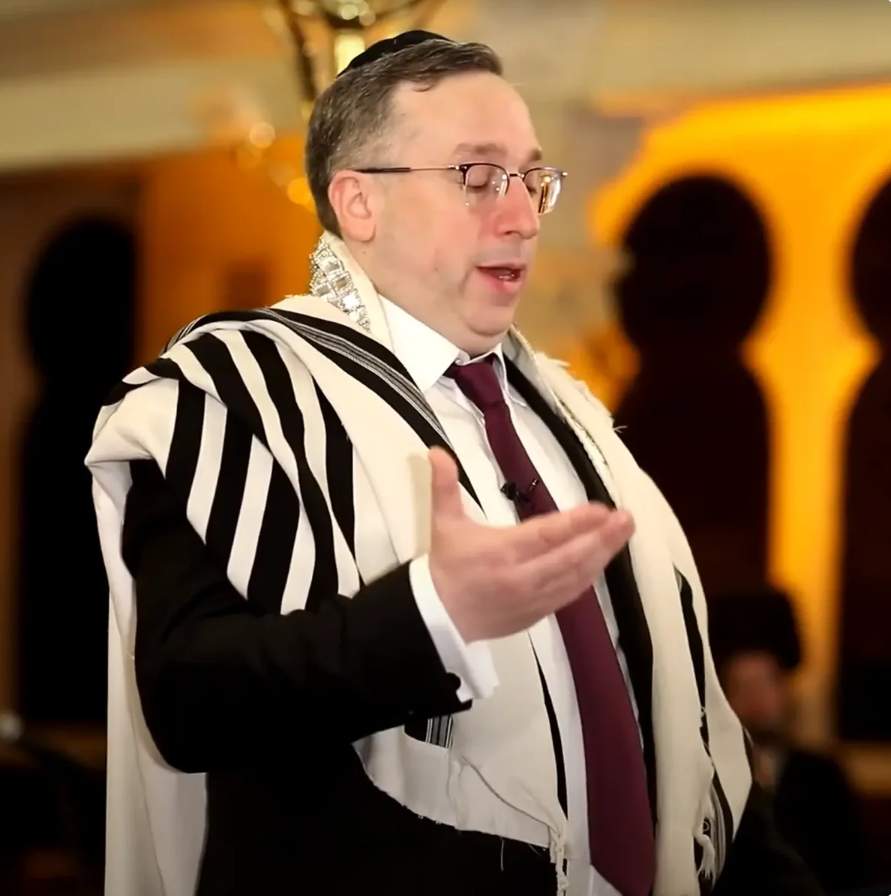
Cantor Benny Rogosnitzky has spent his life inside that transmission — receiving it, refining it, and handing it on. He stands at the amud of one of America’s most storied congregations, has sung in the Metropolitan Opera House and the White House, and has built, alongside the singing, a quieter architecture of institutions devoted to people who might otherwise be forgotten: the divorced parent, the lonely child, the immigrant looking for a room that feels like home, the survivor whose testimony must not be lost.
He is known affectionately, across continents, simply as Cantor Benny. What follows is the shape of a life given to a single conviction — that a voice is not an ornament placed upon a community, but one of the instruments by which a community is held together.
I
Liverpool, Johannesburg, and the Gift That Announced Itself Early
He was born in Liverpool, England — a port city with a long Jewish memory, where a boy’s voice carries down a stone corridor and someone always notices. When he was eight, the family moved to Johannesburg, South Africa, where his father, Rabbi Mair Rogosnitzky, served as a senior rabbi.
It is worth pausing on what that upbringing would have meant. A rabbi’s son does not encounter Jewish life as an extracurricular. He grows up inside its calendar — the weekday mornings, the Shabbat afternoons that stretch and slow, the High Holy Days that gather a whole year’s worth of feeling into ten days and then release it. He learns before he can articulate it that the liturgy is not a text to be recited but a season to be lived. And if he happens to have a voice, he learns something further: that the voice has a job.
In Johannesburg, his gift for liturgical music began to flourish, and it found the thing every gift needs, which is a teacher. He was mentored by the legendary Cantor Johnny Gluck, of blessed memory, who shaped his early training and — more consequentially — his appetite for authentic chazzanus, the real article, unsimplified.
Mentorship, in the cantorial world, is not a credential. It is a lineage.
This is a detail that recurs throughout his story and deserves emphasis at the outset. Cantor Benny does not present himself as a self-made talent. He presents himself, over and over, as a student — of Gluck, of the great ba’alei tefila he sought out over decades, of Chazzan Noach Schaul, of the recorded voice of Yossele Rosenblatt. It is a posture of humility, but it is also a t