Debt, Leverage, and the Cost of Money
By zalmy touger · 2026-07-22
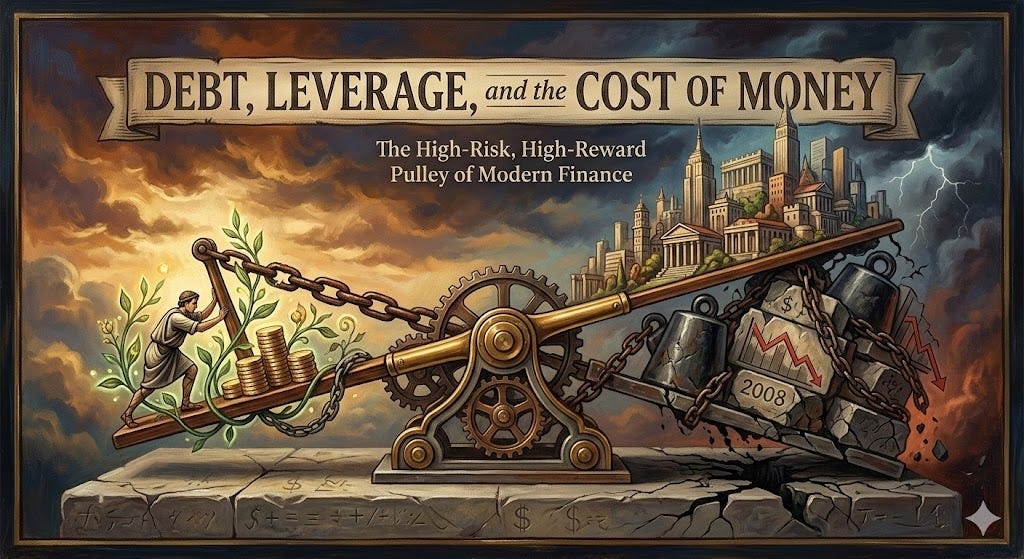
Debt, Leverage, and the Cost of Money
Debt is so common in the modern economy. Everything is constantly being financed, from your mortgage to car loans to credit cards—even the very currencies we use as money (see my earlier article on currency). But to truly understand debt and how and why it’s used, we must first understand the concept of leverage.
Leverage: The Financial Fulcrum
Leverage is a pretty simple idea commonly taught in beginner physics: utilizing a smaller amount of force to move a significantly bigger amount of mass using a lever.
The main idea is that you are trading force for distance. You are able to use less strength over a greater distance to move a heavy mass.
Let’s apply this idea to finance. We’ll use an example to show how we use debt as leverage (the lever) to “move the mass,” which in this case will be buying a house.
• Scenario 1 (No Leverage): Joe buys a house for $100,000 in cash as an investment. Three years later, the value of the house goes up to $110,000. He made a $10,000 profit, giving him a flat 10% return on investment. • Scenario 2 (With Leverage): Joe only has $20,000. He borrows $80,000 at 5% interest to buy that same house. Three years later, the house is worth $110,000. He pays back the loan plus interest (which totals $84,000). From his $110,000 sale, he is left with $26,000. On his initial $20,000 capital, that $6,000 profit is a massive 30% return on investment.
We just showed how debt can be effectively used as leverage, allowing you to create a bigger return on smaller amounts of capital. But, of course, it’s not all sunshine and rainbows.
What if the house went down in value to $90,000? In Scenario 1, you just lose $10,000 (a 10% loss). But in Scenario 2, after you are forced to sell the house at $90,000, you still have to pay back the $84,000 loan. You are left with just $6,000 from your original $20,000. That is a devastating 70% loss.
Debt is a high-risk, high-reward strategy. But how is this risk calculated? The person lending Joe the $80,000 (let’s call him Peter) knows that if the house drops in value, Joe might not be able to pay him back. That’s why Peter charges an interest rate. It adjusts for the riskiness of the loan and gives Peter a profit incentive.
To fully grasp exactly how these numbers are decided, we must dive into how the very value of money is calculated.
The Time Value of Money
A dollar today is worth more than a dollar tomorrow. Why? Because a dollar today can be used to invest in something that generates returns—whether that’s starting a business, investing, or even just buying yourself a new coat that provides immediate value.
To calculate the value of that money across time, we use two core formulas. (Note: For simplicity’s sake, we are not adding inflation into the calculation just yet, but you would simply plug those numbers into the equation).
- Future Value (FV): Answers the question, if I invest money today, what will it be worth later?
$$FV = PV \times (1 + r)^n$$
(Where PV is the present value you start with, r is the interest rate per period, and n is the number of periods).
• Example: $1,000 invested at 5% annually for 3 years becomes $1,000 × (1.05)³ = $1,157.63.
- Present Value (PV): Works in reverse. It answers the question, what is a future sum worth in today’s dollars?
$$PV = \frac{FV}{(1 + r)^n}$$
• Example: A $1,157.63 payment due in 3 years, discounted at 5%, is worth exactly $1,000 today.
When a lender extends credit, they’re giving up Present Value in exchange for a stream of Future Value payments. Interest rates are essentially the price of that exchange. The higher the rate, the more the borrower compensates the lender for waiting—and the more leverage costs.
So, now that we understand the fundamentals—that debt is a lever where we pull value from the future into today to maximize returns—let’s take a look at how this plays out in a broader economy.
A Note on Inflation
Inflation adds another layer to this calculation. When prices rise over time, each dollar you receive in the future buys less than a dollar today. To account for this, you can adjust the discount rate in the Present Value formula to include inflation. If your investment earns 5% annually but inflation is running at 3%, your real return is only about 2%. This is why lenders don’t just charge for the time value of money — they also build an inflation premium into their interest rates to make sure the dollars they get back are worth roughly as much as the ones they lent out.
Zooming Out: Credit Booms, Growth, and Crises
Credit booms, in short, are awesome. People find it easy to borrow money because lenders see less risk in the market. People borrow more to make more money, creating a cycle that boosts the overall GDP and total value created by the economy.
But this is only good as long as the cycle sticks to real growth, not speculative “fake” growth. What does that mean?
Usually, a house gets more valuable because the population increases faster than the home supply, or a neighborhood becomes highly desirable. That is real value being added. But in a speculative bubble, everyone is just buying because they think the next guy will pay more for it. “The number on the charts goes up,” but it’s not actually backed by any substantial added value.
The 2008 Financial Collapse: A Case Study in Extreme Leverage
This exact dynamic played out during the 2008 financial crisis, but it stretched far beyond just individual homes. Because mortgage interest rates were so low, loans became incredibly easy to take out. As a result, people who couldn’t actually afford it were taking out mortgages, which caused a surge of buyers to bid housing prices higher and higher. Seeing this, more and more investors and everyday people jumped in to take advantage of the easy credit.
You had lower-income couples buying multiple homes, becoming massively over-leveraged. They had no business taking on that much debt, because the second they couldn’t find a buyer to flip the house to, they would never be able to repay the loans.
On top of this, the banks giving out these bad loans—known as “subprime” mortgages—got increasingly greedy. (A prime loan is for a trusted borrower with a good track record, while a subprime loan is for a riskier, less-qualified borrower). Because these loans were being approved at record rates, Wall Street banks started packaging them together and selling them to other investors as Mortgage-Backed Securities (MBS).
An MBS acted like a bond that paid out a yield based on people paying their underlying mortgages. But the banks didn’t stop there. They took the worst of the bad loans and repackaged them again. Then, they created entirely new derivative investments based on those MBSs. Soon, all of Wall Street was heavily invested in these complex instruments, which were ultimately backed by a foundation of subprime loans given to borrowers who couldn’t be trusted to pay them back.
For a while, everything went smoothly. People kept borrowing and buying. As long as housing prices kept going up, the MBSs—the central financial instruments holding all this together—remained intact.
But then, the inevitable happened: people started defaulting on their subprime mortgages. The value of the MBSs held by these massive financial institutions plummeted, and all the derivatives built on top of them began to unravel. Panic set in, and banks stopped lending.
This triggered a vicious cycle in the opposite direction. Because the MBS market was crashing, fewer mortgages were given out. Because fewer people could get mortgages, housing prices fell. Because housing prices fell, even more people defaulted, and the cycle went on and on.
Eventually, all of this bad leverage and toxic debt had to unwind so the economy could finally begin to recover. However, in this case—like so many others—instead of letting the market run its natural course, the federal government intervened. They printed a massive amount of money to bail out the failing institutions. Even with the bailout, the economic unwinding was devastating, and the ripple effects of that extreme leverage are still felt to this day.
The True Nature and Price of Debt
This is how booms and busts play out. A credit boom starts as people become more productive, making borrowing less risky. Eventually, this leads to speculation—like buying a stock at absurd price levels not because of what the company is worth, but hoping a bubble pushes it higher. Then the bubble pops, and the cycle begins again.
The very nature of debt—reaching into the future with the hope that we can become productive enough today to pay it back plus interest—is what gives debt its extremely powerful effect. It supercharge or absolutely devastate an economy.
A unique quality about debt/capital is that it is arguably the best-priced product in the world. Think about a normal physical product, like a wooden chair. You buy it from a store, which bought it from a wholesaler, who bought it from a manufacturer, who bought the wood from a logger. Every person along that supply chain rightfully has to get paid for their labor. By the time you buy the chair, you are paying for many different markups far beyond the intrinsic value of the wood.
Capital, however, is different:
- Endless Competition: Almost everyone has some amount of money. If they can safely make a profit off the money they aren’t using, they will try to lend it out.
- Raw Economic Energy: With a regular item, you are paying for people’s time and raw materials. With capital, you are essentially only paying for the raw price of economic energy (time is money).
You are paying the Time Value of Money. From there, lenders simply adjust that raw cost based on risk. If a person has already failed at three businesses, lending them money for a fourth is highly risky. The lender will demand a massive potential upside (a high interest rate) to justify that risk. As long as the math works out, the capital flows.
The Double-Edged Responsibility of Debt
What we see here is that the process of borrowing and lending requires both parties to rigorously evaluate the “product.” If a lender miscalculates the risk, they take on a massive burden without being properly compensated; if that risk backfires, they lose a fortune. The same applies to the borrower. Before taking on debt, you must calculate the odds: “What is the probability of my business succeeding? Is it worth the risk of debt? Does the utility I get from this money today outweigh the cost of the interest I’ll be paying back for years?”
Debt is unique because its downside isn’t capped. If you buy a low-quality jacket or a fake designer bag, the most you can lose is the price you paid. But with a loan, the repercussions can be life-altering for both sides. When you buy a jacket, it is the company’s job to sell you on the value—the “fine materials” or the “gold buttons.” But while a loan might be the most “efficiently priced” product in a mathematical sense, it is only a “good” price for certain people.
The catch is that just because you can get a loan doesn’t mean you should. The ultimate responsibility lies with you—as the lender or the borrower—to effectively calculate the numbers and the odds to determine if the risk is truly worth the reward.
Conclusion: Harnessing the Power of Time
Debt is neither good nor evil; it is simply a tool. Like the physical lever it is named after, it can help you move mountains, or it can snap and cause the whole structure to come crashing down on you. In a modern economy, avoiding debt entirely is almost impossible, but understanding it is mandatory.
Whether you are a student taking out a loan, a couple buying a home, or a government printing currency, the rule remains the same: Respect the leverage. If you use it to build real value, you supercharge your future. If you use it to chase “fake” growth, the future eventually comes to collect.