Finance Basics 101 #1- Money &Currency The Basic Evolution of the modern money system
By zalmy touger · 2026-07-22
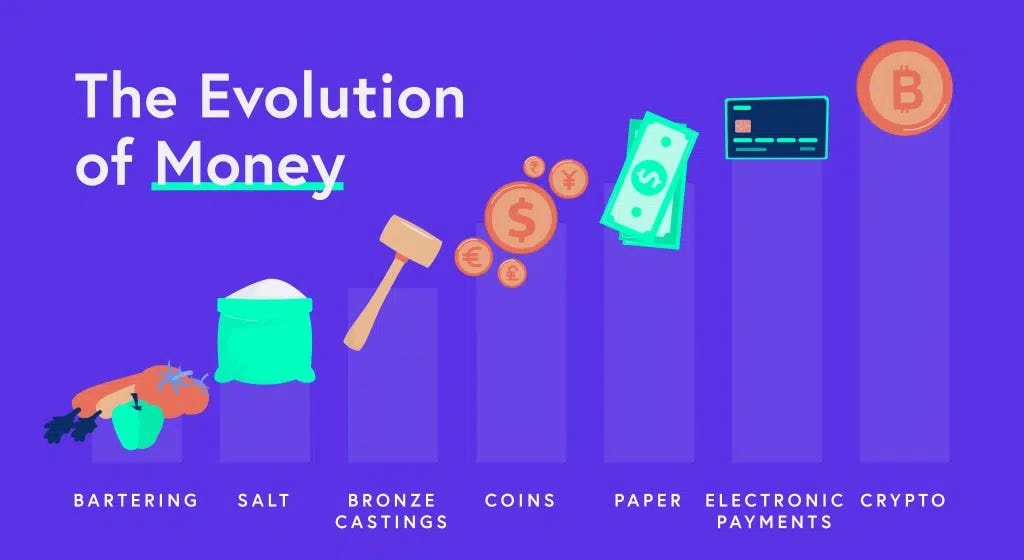
MONEY EXPLAINED: The Evolution of Value
To even try to understand finance, markets, or currency, we first have to understand what money actually is and what it does.
Money
Money is simply a technology we use to solve a problem. In economics, we say money serves three main functions: it’s a Store of Value (saving for later), a Unit of Account (pricing things), and a Medium of Exchange (buying things).
So, how did this work before paper and metal currency? Money is referred to as “the most marketable commodity,” which means that which is most “marketable” is usually that which most people want/find value in.
— — —
The Problem of Barter
People would literally exchange goods for other goods or services. Person A would give Person B a chair, and Person B would give Person A a bushel of grain. This is called barter. But people realized that as populations grew and more goods became available, this method didn’t really work at scale. You run into what economists call the “Coincidence of Wants” problem—if you have a chair but I don’t want a chair, we can’t trade, even if I have the grain you need.
Plus, the value in these items could decay over time (grain rots, chairs break). So, we decided to invent a new way of storing value. Instead of value being stored in the item itself, what if we paid for the item with a smaller, tangible asset like gold or silver? In fact, some of the earliest forms of money included salt, grains, beads, and livestock. Now, what is the common denominator you see here? It’s that these are items that are extremely marketable (most people want them) and relatively easy to store without degrading their value.
Gold and silver have inherent value because they are extremely rare, durable, and used in jewelry and decor. Since scarcity + demand = value, gold became the global “currency.” Now gold represented time and labor, so people could trade with it accordingly.
— — —
The Two Towers: Inflation and Deflation Explained
Imagine we have two towers representing all the resources in the world.
• Tower 1 (Money): All the gold currently available (e.g., 1,000 gold coins).
• Tower 2 (Goods): All the goods and services, represented here by wheat (e.g., 1,000 bushels).
If we try to measure the value of the wheat in gold, we can map 1 gold coin = 1 bushel of wheat.
Scenario A: Supply-Side Deflation (Good for buyers, bad for debtors)
Comes the next harvest, and there is a surplus. Now we have 2,000 bushels of wheat but still only 1,000 gold coins. This causes deflation because the supply of goods has increased relative to the money. Now, 1 gold coin buys 2 bushels of wheat. The money has become more powerful.
Scenario B: Supply-Side Inflation (Bad for buyers, good for debtors)
Imagine a worse harvest than usual. Now there are only 500 bushels of wheat. It would now take 2 gold coins to buy 1 bushel. The value of the money has been diluted because the goods are scarce.
Why does this matter for loans?
Let’s say you borrow 200 g