Finance Basics 101 #2-The Federal Reserve. The most important bank in modern economics and how it shapes the economy
By zalmy touger · 2026-07-22
To really get an understanding of the economy, or at least an idea of how it functions today, it is not just enough that we understand currency and its functions and origins (read the previous article in the series—https://fundamentalfinance101.substack.com/publish/post/184339756). We must understand arguably the most powerful economic force in the world—The United States’ Federal Reserve.
Before The Fed
Before the Fed, which operates as a central finance command center (more will be explained) for the economy, instead of a central banking system where one institution had overwhelming control of how certain things operate or heavily tilt it a certain way, there was just the opposite—a fragmented banking system, or in other words, no central governing body of any of the banks. Instead, the interest rates and money supply were the result of markets and naturally ran their course.
So how it worked was just thousands of local, state, and national banks, and actually each bank actually issued their own paper currencies backed by their supply of gold/silver. (This was under the gold standard—which could really be substituted for any reserve’s equivalent, i.e., government bonds nowadays (see previous article for more details)).
So this meant that the paper currencies issued by the bank were able to be redeemed for the gold it was being backed by. So whenever gold left the country for some reason or another, banks were forced to contract their lending sharply because now they no longer had the underlying backing of the money needed to make more paper currencies, so this led to sharp decreases in economic activity due to less lending being done.
What this means is that the money supply is what is called an “Inelastic Money Supply.” The amount of currency in circulation was “inelastic,” meaning it could not expand or contract to meet the economy’s shifting needs. For example, the economy was heavily agricultural, creating massive seasonal swings in demand for cash. During planting and harvest seasons, farmers needed to borrow heavily, but because the money supply was rigid, interest rates would spike and credit would often evaporate when it was needed most.
In addition, the system for cashing out a check was a “quote-unquote” mess. Because there were a lot of completely separate banks, it would go through this complicated routing process just to get redeemed, with every bank trying to maximize this routing for their own profit. And also, since the money was being largely controlled by the wealthy, powerful New York bankers, this led to heavy public distrust of the bankers and money lenders, as it often does.
How It All Began
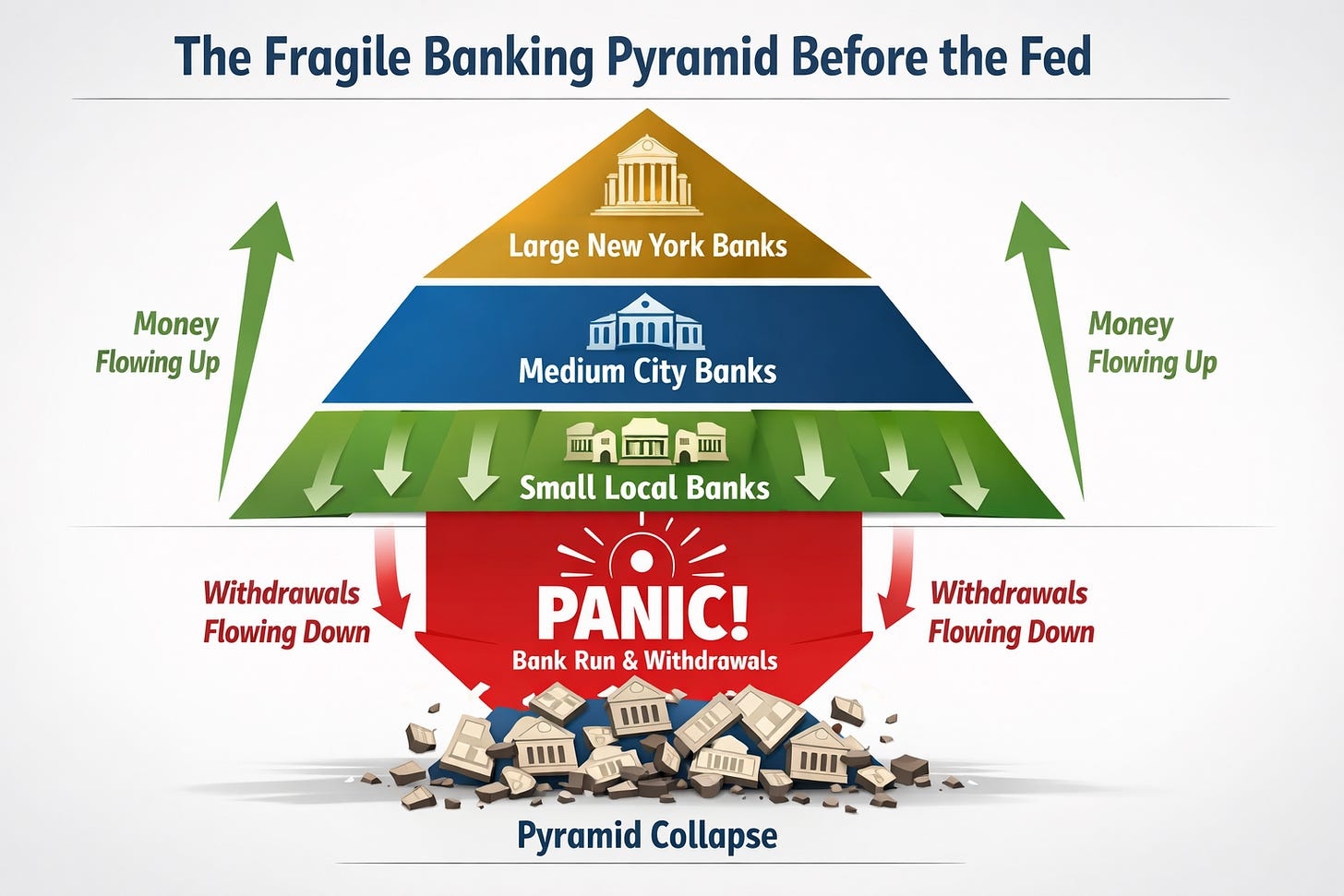
Since there was no lender of last resort to provide insurance on your money, even the slightest rumor of a bank being insolvent (unable to pay debts owed) would trigger a run on the banks, which in turn would have nationwide effects. Before the Fed, the banking system was like a fragile pyramid: small local banks kept their spa