Finance Basics 101 #3 The Global Bond Market: Everything You Need to Know
By zalmy touger · 2026-07-22
Everyone today talks about the stock market, and while that is an important part of the economy, a much bigger and significantly more important market is the global bond market. With a size of around $140 trillion, its movements have a real-time impact on your life, influencing everything from mortgages and car loans to the overall liquidity in the economy.
This comprehensive guide will explain the mechanics of this massive market.
— — —
What is a Bond? The Essential IOU
So, what is a bond, what is it made of, and who is buying and selling?
A bond is essentially an IOU. It is a debt security where the issuer—a government, corporation, or municipality—promises to pay the holder a specified sum of money (the principal) on a future date (the maturity date), and usually to pay periodic interest payments (the coupon) along the way.
Why would someone want to buy this IOU? Because the amount being paid back is more than what it cost to purchase it.
Term Definition Principal (Par Value) The initial amount of money borrowed that is repaid at expiration (maturity). Typically $1,000 for corporate bonds. Yield The total expected return on a bond, expressed as an annual percentage. Coupon Rate The annual interest rate paid by the borrower, usually distributed semi-annually or annually.
For example, if Person A borrows $100 and issues a bond with a $100 principal and a 10% total yield, the bondholder will cash out $110 at expiration, making a $10 profit. If the bond has a 1% annual coupon rate over ten years, the holder gets 1% of the principal annually for ten years, plus the full principal at maturity.
— — —
How Bonds Are Issued and Traded
Bonds are introduced to the market in two distinct phases: the primary market and the secondary market.
- The Primary Market: Issuance
This is where new bond issues are sold for the first time. The issuer sets most of the terms (initial price and interest rate) and receives the proceeds from the sale to finance long-term investments or government expenditures.
Government Bond Auctions
Governments typically issue their bonds through auctions on the primary market. This process is designed to ensure the lowest possible borrowing cost for the government.
Auction Participants typically include:
• Primary dealers • Commercial banks • Asset managers and hedge funds • Pension funds and insurance companies • Central banks • Retail investors (directly or indirectly)
Types of Bids:
Bid Type Investor Specifies Allocation Clearing Price Competitive Bid Quantity and the desired yield (or price). Faces allocation risk; may receive no bonds if the bid is too high. Pays the yield they bid. Non-Competitive Bid Quantity only. Guaranteed an allocation up to a set limit. Receives the auction’s weighted-average yield.
Auction Formats:
- Single-Price (Dutch) Auction: All winning bidders receive bonds at the same yield, which is the highest accepted yield (the stop-out yield). This format, used by the U.S. Treasury, encourages bidders to submit bids close to their true valuation.
- Multiple-Price (Discriminatory) Auction: Each winning bidder pays the yield they submitted. This can discourage aggressive bidding, as participants fear overpaying relative to others.
- The Secondary Market: Trading
Once issued, bonds are traded and exchanged, primarily in the over-the-counter (OTC) markets. These transactions do not involve the original issuer; they are conducted between buyers and sellers, often with a brokerage firm as an intermediary.
Prices in this market fluctuate based on prevailing interest rates, credit quality, and supply and demand.
— — —
Bond Anatomy and Cash Flows
To truly understand bonds, you must grasp the core components and the dynamics of their pricing.
The Core Components
Component Description Face Value (Par Value) The principal amount returned at maturity. The anchor for all interest calculations. Coupon Rate The fixed percentage of the face value paid as interest (the “rent”) to the bondholder. Maturity Date The bond’s lifespan. Bonds are categorized as Short-term (<3 years), Medium-term (3–10 years), and Long-term (>10 years).
Price Dynamics: Premium vs. Discount
A bond’s market price constantly adjusts based on current market interest rates.
• At Par: The bond trades at its face value (e.g., $1,000). • At a Premium: The bond trades above face value (e.g., $1,050). This happens when the bond’s coupon rate is higher than current market rates, making it more desirable. • At a Discount: The bond trades below face value (e.g., $950). This occurs when the bond’s coupon rate is lower than what new bonds are currently offering.
Specialized Mechanics
• Accrued Interest: If a bond is sold between coupon payment dates, the buyer must compensate the seller for the interest earned since the last payment. This is added to the clean price to get the dirty price. • Zero-Coupon Bonds: These bonds pay no periodic interest. They are sold at a deep discount, and the yield is the difference between the purchase price and the full face value received at maturity. • The Indenture: The legal contract outlining the bond’s terms, including covenants (rules the issuer must follow) and call/put provisions (allowing for early redemption or sale back to the issuer).
— — —
Bond Pricing and Interest Rate Risk
The fundamental concept in bond pricing is that future money is worth less than today’s money (Present Value). A bond’s price is the sum of the present value of all its future cash flows (coupon payments and the final principal).
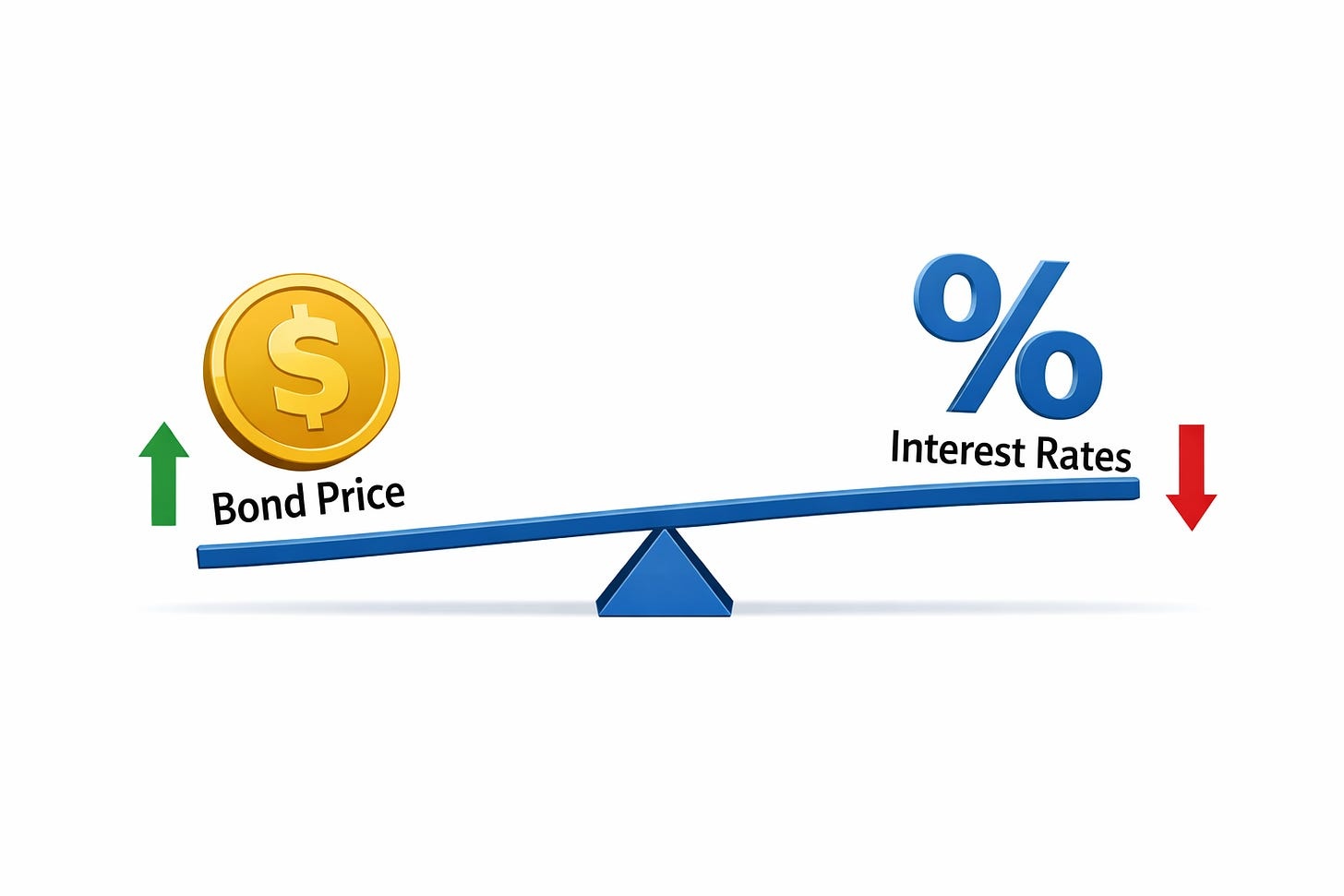
The Seesaw: Price and Yield Move in Opposite Directions
This is the most critical concept in the bond market:
> When interest rates (yields) go UP → Bond prices go DOWN > When interest rates (yields) go DOWN → Bond prices go UP\n\n
Why? If you own a bond paying 4% and new bonds are issued at 6%, your 4% bond is less attractive. To sell it, you must lower its price until the buyer’s effective return (yield) matches the current 6% market rate. The bond’s coupon is fixed, but its price is flexible, adjusting to match market conditions.
Clean Price vs. Dirty Price
When bonds are quoted, there are two prices:
Price Type Description Clean Price The basic quoted price in the market. Does NOT include accrued interest. (The “sticker price”). Dirty Price The Clean Price PLUS Accrued Interest. This is the actual settlement price the buyer pays. (The “checkout price”).
Yield to Maturity (YTM)
Yield to Maturity (YTM) is the total annualized return you will earn if you buy the bond today at its current price, hold it until it matures, and reinvest all coupon payments at the same rate.
• YTM accounts for both coupon payments and any gain or loss from buying at a discount or premium. • It is the standard metric used to compare different bonds.
Yield to Call (YTC) and Yield to Worst (YTW)
Some bonds are callable, meaning the issuer can redeem them before maturity, usually when interest rates fall.
• Yield to Call (YTC): The return you would earn if the bond is called at the earliest possible date. • Yield to Worst (YTW): The lowest yield you could possibly get, comparing all scenarios (holding to maturity or being called at various dates). YTW is the conservative, worst-case scenario number you should plan for.
— — —
Duration and Convexity: Measuring Risk
Duration: The Risk Meter
Duration is a measure of how sensitive a bond’s price is to interest rate changes. It is often called the bond’s “risk meter.”
Simple Rule: For every 1% change in interest rates, a bond’s price moves by approximately its duration percentage.
• A bond with a duration of 5 will see its price fall by about 5% if rates rise by 1%. • A bond with a duration of 10 will see its price fall by about 10% if rates rise by 1%.
Factors Affecting Duration:
• Longer maturity = Higher duration = More sensitivity • Lower coupon rate = Higher duration = More sensitivity
Convexity: The Shock Absorber
Duration assumes a straight-line relationship between price and yield, but the actual relationship is a curve. Convexity measures this curve.
Convexity creates an asymmetric cushion for the investor:
• When rates fall: Prices rise faster than duration predicts (Good for you). • When rates rise: Prices fall slower than duration predicts (Also good for you).
Think of positive convexity (which most bonds have) as a shock absorber for your bond portfolio—it softens the bad and amplifies the good.
Short-Duration vs. Long-Duration Bonds
Feature Short-Duration Bonds (1-3 years) Long-Duration Bonds (7+ years) Sensitivity Less sensitive to rate changes Highly sensitive to rate changes Volatility Lower price volatility Higher price volatility Yield Typically lower yields Typically higher yields Best For Conservative investors, expecting rates to rise, needing stability. Investors comfortable with risk, expecting rates to fall, locking in high rates.
— — —
Yield Curve Movements
The yield curve is a graph that plots the yields of bonds against their time to maturity. It is a powerful indicator of economic expectations.
Yield Curve Shapes
- Normal Yield Curve: The most common and healthy shape. Yields increase moderately as maturity increases (e.g., 2-year bond at 4.0%, 10-year bond at 4.5%). This signals expectations of future growth and moderate inflation.
- Flat Yield Curve: Yields are roughly similar across all durations. This often signals a lack of clarity in the market and can precede a shift to a normal or inverted curve.
- Inverted Yield Curve: Higher durations demand less yield than short-term bonds. This is a rare and significant event, as it signals that investors foresee rough economic times and expect the central bank to cut interest rates soon.\n\n
Expectations vs. Risk Premia: Shaping the Curve
The curve is shaped by two main forces:
- Interest Rate Expectations: What investors think the central bank will do with rates in the future. If cuts are expected, long-term yields fall, leading to a flatter or inverted curve.
- Risk Premia: Extra compensation investors demand for various risks:Term Premium: Compensation for holding bonds long-term (duration risk).Inflation Risk Premium: Compensation for the risk that inflation erodes returns.Credit Risk Premium: Extra yield for lending to risky borrowers.Liquidity Premium: Extra yield for bonds that are hard to sell quickly.
— — —
Credit Risk and Ratings
Credit risk is the risk that the bond issuer will be unable to pay back its loan (default). Governments like the U.S. have lower risk than most companies. Higher risk requires a higher yield to compensate investors.
Credit Rating Agencies
Three major agencies grade the risk profile of a bond:
• S&P Global Ratings • Moody’s Investors Service • Fitch Ratings\n\n
Rating Quality Investment Grade? AAA / AA / A / BBB Highest to Adequate Yes (Generally safer bonds) BB / B / CCC / D Speculative to Default No (Often called “Junk” or “High Yield” bonds)
Credit Spread is the extra yield a bond pays over a risk-free investment, such as U.S. Treasury bonds. If a company bond yields 10% and a comparable U.S. Treasury yields 5%, the credit spread is 5%.
Types of Bonds (A Short List)
• Government/Treasury Bonds: Very low credit risk; yields reflect baseline interest rates. • Corporate Bonds: Issued by companies; higher yields to compensate for credit risk. • Municipal Bonds: Issued by cities or states; often tax-exempt, moderate credit risk. • Zero-Coupon Bonds: Sold at a discount; pay no periodic interest.
— — —
Real-World Impact: Why the Bond Market Matters to You
The bond market serves as the primary benchmark for many consumer interest rates, directly influencing the cost of borrowing.
Direct Link to Mortgages
The bond market is the single most influential factor for fixed-rate mortgages.
• The 10-Year Benchmark: Mortgage lenders use the 10-year U.S. Treasury yield as a guide for pricing 30-year fixed-rate mortgages. • Yields vs. Rates: When bond yields rise, mortgage rates generally increase; when yields fall, mortgage rates typically decrease. • The Spread: Lenders add a “spread” (historically 1.5% to 2.5%) above the Treasury yield to cover their risks and costs.
Impact on Other Loans
• Auto and Personal Loans: Shorter-term loans (like a 5-year auto loan) are often influenced by shorter-term Treasury yields, such as the 2-year or 5-year Treasury notes. • Competition for Capital: If bond yields rise, banks must raise the interest rates they charge on loans to ensure they are making a competitive return compared to “risk-free” government bonds.
Monetary Policy.
This will tie in to last articles’’ explanation of central banking and the fed but the bond market play a big role in this Monetary policy fundamentally operates through the bond market to influence broader financial conditions. Central banks, like the Federal Reserve, use various tools to target short-term interest rates and influence expectations, which in turn shape long-term bond yields, particularly the 10-year U.S. Treasury yield. If government bond yields were to go to high this would be signaling that investors are less willing to lend to the government bc now they think it will be unable to pay it back (without just printing it , and that would mean your profits are just inflated away so in effect you gained nothing ) this would be catastrophic and lead o the government being unable to to borrow and almost endings its economy overnight . This happened to Greece when its bond yields sored and led to massive sovereign debt crisis from which it still recovering from.
Central Bank Mechanisms
Central banks influence bond markets primarily through two channels:
• Policy Rate Adjustments (Conventional Policy): Central banks set a target for the overnight interest rate at which banks lend to each other (the federal funds rate in the U.S.). Changes in this rate ripple through the financial system, affecting other short-term rates and, by extension, long-term bond yields.Rate Hikes (Tightening): To combat inflation or cool an overheating economy, the central bank raises interest rates. This makes existing bonds with lower fixed interest rates less attractive, causing their prices to fall and their yields to rise, raising borrowing costs across the economy.Rate Cuts (Easing): To stimulate economic growth, the central bank lowers rates, which typically pushes bond yields down. Lower yields make borrowing cheaper, encouraging businesses and consumers to spend and invest. • Balance Sheet Operations (Quantitative Easing/Tightening):Quantitative Easing (QE): The central bank buys large quantities of government bonds and other securities from the open market, injecting cash into the financial system. This increased demand drives up bond prices and pushes yields down, providing a stronger stimulus when interest rates are already low.Quantitative Tightening (QT): The central bank allows its bond holdings to mature without reinvesting the proceeds, effectively removing a large buyer from the market. This reduces liquidity and puts upward pressure on yields. • Forward Guidance: Central banks communicate their future policy intentions to shape market expectations of future interest rates and inflation. Credible forward guidance can influence long-term yields without immediate action, as investors adjust their behavior based on anticipated future policy.
The 10-Year Treasury as a Global Benchmark
The 10-year U.S. Treasury yield is a crucial global benchmark because it is a proxy for the risk-free rate, used for pricing other financial instruments like corporate bonds and mortgages as a premium above this yield. It also serves as an economic indicator, reflecting global investor expectations about U.S. economic growth and inflation. Furthermore, demand from international investors for these safe and highly liquid assets influences global capital flows, impacting exchange rates and financial conditions worldwide.
— — —
for a better understanding of monetary policy and the central banks read part 2 in this series
Related article: Finance Basics 101 #2-The Federal Reserve. The most important bank in modern economics and how it shapes the economy https://fundamentalfinance101.substack.com/p/finance-basics-101-2-the-federal
This article focused on explaining how the bond market works and its impact on the economy, especially as it pertains to government bonds. A whole additional article could be written on how to practically go about buying and investing in bonds. (here is a great video if you’r interested in that as well
Video: https://www.youtube.com/watch?v=YaM2PZllizE