Four Places on the Upper East Side Where Your Bashert Is Probably Hiding
By William Lebovics · 2026-08-05
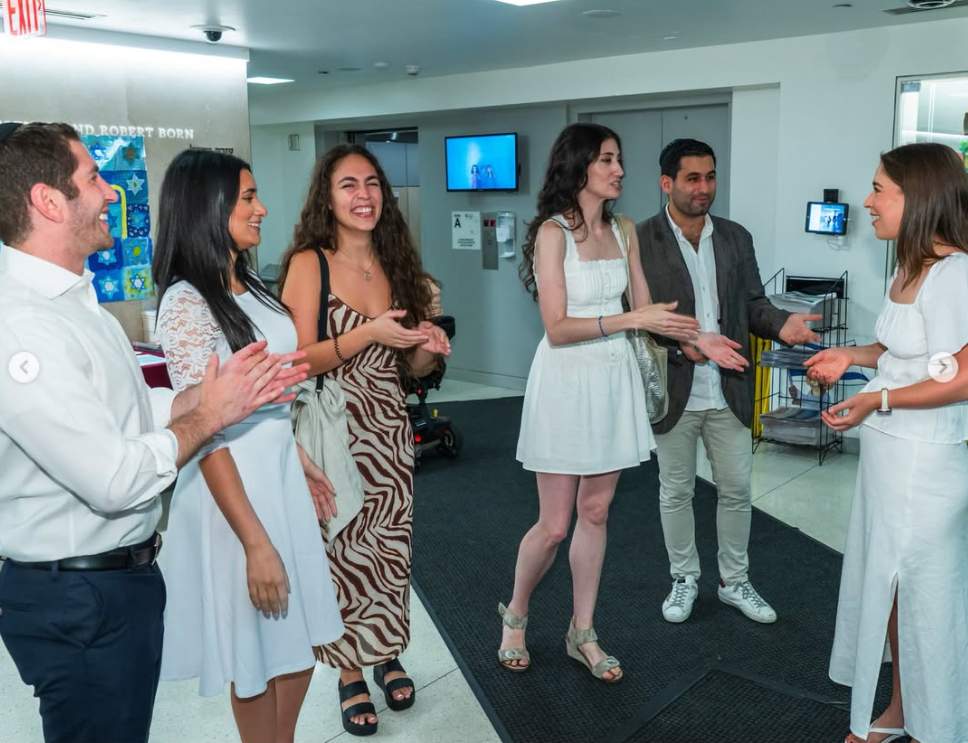
- Holy Hour: How Friday Night on East 85th Street Became the Hottest Room in Jewish New York
Every week, hundreds of young Jewish professionals pack into Congregation Kehilath Jeshurun for davening, drinks, and something harder to name. This is the story of Chabad Young Professionals UES — and the rabbi who built it.
At around a quarter to seven on a Friday evening, the sidewalk outside 125 East 85th Street starts to thicken. By seven it is a crowd. By the time Mincha begins, the room is full — hundreds of young Jewish professionals from across Manhattan, most of them single, most of them in their twenties and thirties, standing shoulder to shoulder for Kabbalat Shabbat.
They call it Holy Hour Happy Hour, and if you spend any time in young Jewish New York, you already know about it.
The formula sounds simple enough: Mincha and Kabbalat Shabbat, followed by kiddush and a happy hour. What that description misses is the feeling in the room. The davening is genuinely beautiful — full-throated, unhurried, sung rather than mumbled. Regulars will tell you the surprising part is that the prayer section is as packed as the bar. People who arrived for the social hour end up staying for the singing, and a good number of them end up staying for a lot more than that.
Then the tables open. Sushi stations, cholent, an open bar, dessert. Generous sponsorship — from the Thank You Hashem organization, from the Soloviev Group, and from a rotating roster of community members who underwrite the food, the bar, and the davening itself — keeps the whole thing accessible. Club 54 means you contribute $54 a month to help cover the budget. Tickets are tiered deliberately: a standard rate, a partially subsidized rate, and a fully subsidized option at no cost. Nobody is priced out of Friday night. That is not an accident; it is a philosophy.
The Room Behind the Room
Ask ten people what keeps them coming back and you will get ten answers, but they cluster. It's where the community actually is. If you want to know what's happening in young Jewish Manhattan — which organizations are launching what, which trips are going out, who's starting a minyan, where the next Shabbat dinner is — you find out at Holy Hour. It functions as the community's clearinghouse. Information moves through that room faster than through any whatsapp chat.
The networking is real. These are people building careers in finance, law, real estate, tech, medicine, and every kind of new venture. Deals get discussed. Introductions get made. Someone mentions they're hiring; someone else mentions they're looking. It happens in the natural rhythm of a Friday night conversation rather than the forced choreography of a networking event, which is precisely why it works.
And people are inspired. This is the part that surprises newcomers. A crowd this size, in a city this distracted, choosing to spend Friday night singing Lecha Dodi. Many arrive unaffiliated and leave curious. Many come once and end up laying tefillin on Sunday mornings, or hosting their first Shabbat dinner, or signing up for a class. The environment does not push. It simply shows authentic Jewish life in an appealing, warm way; populated by people you want to know, who go the extra mile to make you feel comfortable.
The Upper East Side is home to roughly 13,000 Jews between the ages of 20 and 40. Holy Hour is where a remarkable number of them have found each other.
Rabbi Yaya
None of this exists without Rabbi Yaya Wilhelm. He and his wife Devora arrived on the Upper East Side with a list of about a dozen names and a mandate to build a Chabad presence for young professionals. They started the only way that actually works: one coffee at a time, one lunch at a time, one Shabbat table at a time. They have now met thousands of young Jews in the neighborhood, and they are still, visibly, trying to meet the rest.
Ask anyone in this community about Rabbi Yaya and you will hear the same description over and over: Best friend. And he is that and more to a few thousand people who moved to New York and needed one.
He cares about every individual person, and this is not a slogan — it is observable behavior. He remembers everything you told him last year at an event. He notices when you stop showing up. He is the person people call when something happens, when a relationship ends, when a parent gets sick, when you don't know what to do next. He listens first. He advises second. He is trusted with things people don't tell their friends, and that trust has been earned one conversation at a time over many years.
He is a loyal friend and a big brother as much as he is a Rabbi. When people see him its generally a bear hug. And he is relentlessly generative: constantly making new events, constantly encouraging people to start things, constantly pushing members of the community into leadership roles they didn't know they were ready for. A striking amount of what happens under the Chabad Young Professionals banner was someone's idea that Rabbi Yaya told them to go build.
He teaches daily Chumash and daily Tanya. He and Devora run wedding classes for engaged couples. There are weekly shiurim for men and for women, a Thursday Lunch and Learn, a rabbinic semicha program, and Sunday Torah Academy — brunch, tefillin, and classes running from mid-morning into the afternoon.
Among the initiatives he has helped launch is the Chabad Lounge on 58th Street, which runs Sunday mornings and has become its own small institution, featuring lectures from speakers including Chani Bernstein and Richard Schaefer. It is a different room with a different energy from Friday night, and it draws people who want to go deeper.
Where Everyone Feels Like Family
The through-line in all of it is that nobody at Chabad Young Professionals is treated as an attendee. There is no membership tier, no vetting, no sense that you need to already belong in order to belong.
The community has become, by reputation, the number one place in Manhattan to host a meal. The Wilhelms have spent years convincing young people to open their own apartments for Shabbat dinner — which, in New York, is genuinely rare — and then to invite not only their friends but people they've never met. That practice has multiplied outward. On any given Friday there are Shabbat tables across the Upper East Side that trace directly back to CYP.
It is also where people bring their ideas. If you have a concept for a program, a trip, a class, a club, a venture — this is the room where you find your co-founder, your first backer, and your first fifty participants. CYP runs clubs, a podcast, buses to the Ohel, a mezuzah campaign, and volunteer programming, much of it originating with participants rather than staff.
And Yes — the Bashert Question
Let's say the obvious thing plainly: an enormous number of couples in Jewish New York met at Chabad Young Professionals.
The reasons are structural, not romantic. Hundreds of Jewish singles in one room, every single week, in a setting where nobody has announced they are looking. You are there to daven. You are there to eat. You are there because your friends are there. That takes all the pressure out of it, and pressure is what ruins most singles events.
The Wilhelms are also, quietly and constantly, setting people up — including at the Shabbat dinners they encourage members to host, where guests are seated with people they haven't met by design. And because Rabbi Yaya knows so many people so well, his introductions carry weight. He isn't matching résumés. He's matching people whose lives he actually understands.
The result is a community where finding your bashert is not the stated purpose of any given evening, and yet keeps happening anyway.
Holy Hour Happy Hour takes place Friday nights at Congregation Kehilath Jeshurun, 125 East 85th Street. Start times shift with candle lighting, so check the events calendar for the week. RSVP in advance. Tickets are subsidized, and the fully subsidized option exists for anyone who needs it.
Come for the davening. Stay for the cholent. Don't be surprised if you're still there at ten o'clock talking to someone you're going to know for the rest of your life.
- SAFRA
The Shul That Never Closes: Inside the Edmond J. Safra Synagogue
On East 63rd Street, a Sephardic congregation has become the Upper East Side's Beit Midrash. Walk east from Fifth Avenue on 63rd Street on almost any evening and you'll hear it before you see it: the low hum of a room full of people learning.
The Edmond J. Safra Synagogue at 11 East 63rd Street, between Fifth and Madison, has been open since March 2003, built as the communal center that its namesake — the legendary banker and philanthropist Edmond J. Safra — envisioned for Sephardic life in Manhattan. More than two decades on, it has become something larger than that vision. It is the Upper East Side's synagogue, and increasingly, all of Manhattan's.
What makes it unusual isn't the architecture, though the sanctuary is genuinely beautiful. It's the schedule. Daily minyanim morning, afternoon, and night. Daily and nightly learning programs. Gemara studies. Daily Tehillim readings. Classes for men, for women, for young professionals, for couples, for teenagers, for children. Parenting workshops and cooking classes. Lectures and conferences. Singles events. On a given weekday there are multiple shiurim running, often back-to-back, often overlapping. The building is effectively never dark. Hundreds of people pass through every week, from all corners of the world. That is the point.
The Rabbi
At the center of it is Rabbi Shlomo Farhi, and it is difficult to overstate his standing in the Manhattan Jewish community.
Born in Israel and raised in the Syrian community of Deal, New Jersey, in a home saturated in Torah and chesed, Rabbi Farhi studied at Rav Tzvi Kaplan, the Mir, and Lakewood, and received semicha from the Jerusalem Kollel of Rav Yitzchak Berkowitz. Before New York, he built educational programs — NEXT, JTAG, Aish Schools — that today reach thousands of young Jews across the United Kingdom. He is the founder and director of Chazak, the Sephardic educational organization, and formerly directed the Jewish Leadership Foundation, whose mandate was identifying and developing the next generation of Jewish communal leaders.
But the résumé is not why people love him. Rabbi Farhi opens his own home, week after week, to host classes on the parasha. Not as a special occasion — as a standing commitment. He teaches multiple classes a week to different groups: young professionals, couples, women, teenagers, older members. Each audience gets something built for them.
His Shabbat afternoon class regularly runs at over capacity. People arrive early to get a seat. The reason is a specific and rare gift: Rabbi Farhi can address a room of 100s of people spanning five decades of age and life experience, and every single person leaves convinced he was speaking to them. A twenty-four-year-old in her first job and a sixty-year-old grandfather hear the same shiur and each hears their own life in it.
He does this by taking the parasha seriously as a text about people. He extracts life lessons from it that are not platitudes — they are specific, they land, and they tend to be uncomfortably accurate about whatever you happen to be struggling with that week. He understands the pressures the people in front of him are actually under: career anxiety, dating, marriage, parenting, money, faith, loss. And he understands the opportunities in front of them, which is the harder half. He doesn't just diagnose. He points forward.
The Team
Rabbi Farhi doesn't do it alone. The Safra Synagogue's strength is that it has four distinct rabbinic voices, each covering ground the others don't.
Rabbi Ariel Mizrahi, Assistant Rabbi since 2018, is the shul's expert on relationships and character development. A graduate of Yeshiva of Flatbush, he studied at Yeshivat Mikdash Melech in Jerusalem, then Kollel Yehave Da'at under Rav David Yosef and Kollel Hacham Baruch under Rabbi Yaakov Benhaim, where he received semicha. He taught at his alma mater in 2014 before coming to 63rd Street. His weekly class for young people in the community is one of the most valuable hours on the calendar: it takes on the real issues — how to build character deliberately, how to prepare for marriage, how to handle conflict, what the great figures of Jewish history actually did when tested. He is also, for a great many people in this community, the first phone call when something in life goes sideways.
Rabbi Reuven Ibragimov, COO of Chazak NY, brings the business world into the Beit Midrash. Previously COO and innovator at RAJE-NY, and a campus chaplain with his wife at Brooklyn College and Long Island University, he has spent his career building programs for college students, young Jewish professionals, and newlyweds — thousands of participants from around the world. His classes go deep into Torah thought, and he is unusually attuned to what young people in this community are actually navigating: Talmud study, family, work-life balance, the pull between career and community involvement, how to keep perspective under pressure, how to metabolize hardship, and how to face antisemitism without either flinching or becoming consumed by it.
Rabbi Lawrence Hajioff, Senior Educator, may be the leading authority anywhere on the concept of Moshiach — and he is, by common consent, one of the great orators in the Jewish world. Originally from London, he graduated with honors in political science from Manchester University, worked in news production at MTV, and won the UK's national "Jewish Stand-Up Comedian of the Year" competition before studying in Israel and Monsey and receiving semicha from Ohr Somayach. He is educational director of Birthright Israel Alumni in Manhattan, where he built an adult bar and bat mitzvah program that some four hundred people have now completed, and he leads trips to Israel, Poland, and Prague several times a year for hundreds of young professionals. He is on the full-time faculty of Stern College for Women at Yeshiva University, teaching Jewish philosophy, mysticism, and the foundations of Jewish thought — and was voted Professor of the Year in Judaic Studies by Stern's graduating seniors. His book Jew Got Questions was published by Feldheim in 2014. Put him in front of a room and the room does not move.
Together they function less like a staff and more like a bench of advisors. People here consult these rabbis about careers, about business decisions, about dating, about how to raise their kids, about what to do at crossroads. The advice is taken seriously because it is given intentionally.
Why the Singles Come
And then there is the other thing everyone knows about the Safra Synagogue. It has become one of Manhattan's genuine destinations for Jewish singles looking for their bashert — and not because anyone engineered it that way. The mechanics are simple. Firstly, it is an absolutely gorgeous Shul, every event is world class, Rabbis that are beloved, respected and feel like your friends who you grew up with. Classes that are always on point, camaraderie; a shul with nonstop programing running every day of the week gives you a hundred natural, low-pressure encounters a year. You are not there to be seen. You are there to learn. That takes the temperature down and lets people actually meet.
Second, the room self-selects. The people who show up on a Tuesday night for a shiur are, definitionally, people who care about the same things you do. Shared values aren't a filter you have to apply — they're the price of admission. Third, the rabbis know everyone. That is not a small thing. Rabbi Farhi, Rabbi Mizrahi, Rabbi Ibragimov, and Rabbi Hajioff spend their weeks in close counsel with the very people who make up this community. They know who's ready, who's searching, what someone actually needs in a partner rather than what they say they want at a party. When four rabbis of that caliber are paying attention, introductions happen — good ones.
Fourth, the shul programs for it directly. Singles events sit on the calendar alongside the classes, the lectures, and the children's programs, treated as a normal and necessary part of communal life rather than something faintly embarrassing.
The result is a place where dating happens the way it used to: inside a community, among people who know you, with adults who care about the outcome.
What It Adds Up To
The Edmond J. Safra Synagogue was built as a communal center for Sephardim on the Upper East Side. It still is that. But on any given weeknight the room contains Sephardim and Ashkenazim, members and drop-ins, people who grew up in Deal and people who grew up with nothing Jewish at all, students from Stern and traders from midtown and grandparents from up the block. They come for the classes. They stay because four rabbis on East 63rd Street have built something increasingly rare in Manhattan: a place where you are known and feel at home.
- The Altneu
The Altneu is a young Orthodox synagogue at 107 E 70th Street on Manhattan's Upper East Side, founded in 2022 by Rabbi Benjamin Goldschmidt and his wife, journalist Avital Chizhik-Goldschmidt. Its name is a portmanteau of the Yiddish for "old" and "new," a tribute to Prague's Altneuschul — and its tagline, borrowed from Rav Kook, is "where the old becomes new and the new becomes holy." For its first two years the congregation had no building, roaming each Shabbat between private homes, the Asia Society, the Pierre Hotel and the Explorers Club.
In March 2024 it bought a six-story Tudor Revival townhouse on East 70th for $34.5 million. Today it runs daily minyan, classes, a kollel, the Altneu Forum speaker series, and a dense calendar of events.
Why it's a magnet for Jewish singles
The demographics tell the story: roughly 40% of its paying member units are under 36, making that the largest and fastest-growing slice of the congregation, an inversion of the national trend. Members credit a few things. The leadership is itself young, so the rabbi and rebbetzin are living through the same life stage as the crowd. It's Orthodox "by the books" but not stuffy; Avital describes a new shul as one where "everyone is new," so there's none of the inherited who-are-you-where-are-you-from small talk. And, pointedly, it does not market itself as a young professionals scene; members say that's exactly the appeal, since the age mix is what makes it feel like a community rather than a party.
Then there's the explicit matchmaking. In November 2023, weeks after Oct. 7, the Altneu launched a shidduch initiative framed as a response to the attack — Avital's view being that the Jewish answer to catastrophe is more light, love, and families. Singles fill out a form covering upbringing, education, hobbies, and observance, which is read by five "connectors" ranging from their late 20s to 50s who suggest matches. It's open to any age, with one requirement: a reference from an Altneu member. Nearly 200 people signed up in under two weeks.
Members describe the draw as trust and infrastructure — being set up by people who actually know you and the community's density means the Upper East Side singles orbit (shul, kiddush, classes) functions as one continuous social ecosystem.
- Ouri’s
Ouri's Market is a family-run gourmet kosher supermarket founded by Ouri Galili in 1976 as a Brooklyn produce stand and now operated by his five children, with locations in Deal and Oakhurst, NJ, Brooklyn, and — since 2024 — a sprawling 8,000-square-foot flagship at 1160 Third Avenue between 67th and 68th Streets on Manhattan's Upper East Side. The uptown store pairs a full-scale grocery operation (produce, a kosher butcher and fish counter, sushi, prepared foods, baked goods, specialty pantry staples like truffle oils and imported nuts) with marble countertops and copper-and-gold fixtures, and it has become a genuine cultural phenomenon: dubbed "the Erewhon of NYC" by a prominent newspaper, it sits blocks from more than ten elite private schools and as many synagogues, drawing Ramaz and other students who linger over specialty smoothies, ~$20 salads, cold brew, and a Greek-style frozen yogurt bar. Its roughly 30K-follower Instagram (@ourismarket) fuels the frenzy through influencer collabs, a student-designed "Ramaz Remix" drink in school colors, drink partnerships with TikTok star Ellie Zeiler's Jane Jewels brand, a viral Bethenny Frankel endorsement and the store now functions less as a grocery than as a social hub where teens, families, influencers, and even matchmakers working the crowd all mingle between the sushi counter and the smoothie line, merging wellness culture, social media aesthetics and Jewish community in one space.
Ouri's works as a singles scene for structural reasons more than romantic ones. It's low-stakes. This is the thing matchmakers observe, it's "a place to be seen without putting yourself out there in any way that feels vulnerable." You're buying a coffee. That's your alibi. Nobody has to admit they're there to be seen, which is precisely why everyone is. A singles event announces your intentions; a grocery store doesn't. Some shadchanim walk around the entrace with mic's because you might get a viral moment with a cool guy strolling buy in lora piana loafers.
The geography does the filtering. The Third Avenue store sits within blocks of more than ten synagogues and ten-plus elite private schools, in the densest concentration of Modern Orthodox young professionals in Manhattan, the Altneu, mentioned earlier, is three blocks away. Kosher grab-and-go in that neighborhood means the pool self-selects: observant, local, roughly the same social world. No filters required.
It's high-frequency. Ouri's gives you repeated, unplanned exposure to the same few hundred people. You'll see people from shul, the office and sometimes visitors or tourists. Recognition compounds, you're a familiar face before you've ever spoken.
Once a critical mass treats a place as a stage, it becomes one. The $15 smoothies and marble countertops aren't incidental, the aesthetic gives people a reason to perform there. Short version: it's the Orthodox Upper East Side's town square, disguised as errands.