Lions, Furnaces, and a Hand That Writes on Walls: Why the Book of Daniel Still Roars
By William Lebovics · 2026-07-27
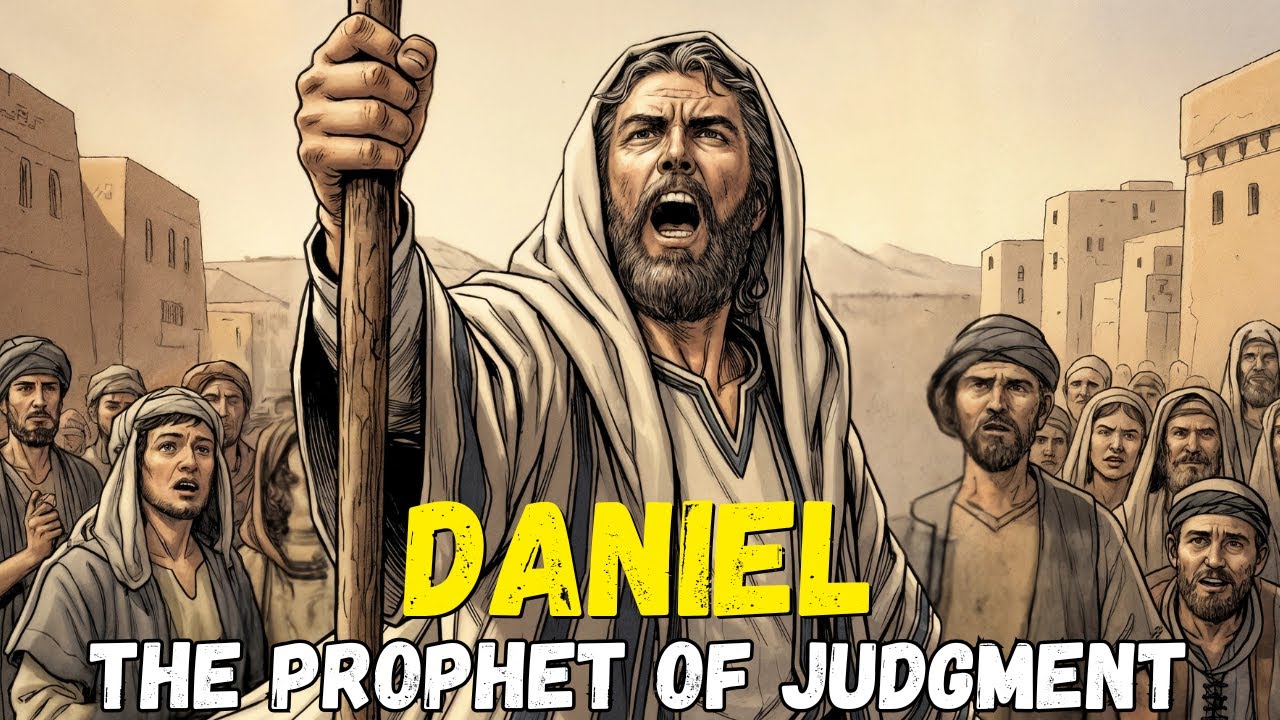
A guide to the stories, visions, and concepts that made Daniel one of the most influential books ever written
Introduction: A Book in Two Halves
The Book of Daniel opens with a catastrophe told in a single, understated sentence: Nebuchadnezzar of Babylon besieges Jerusalem, and "the Sovereign delivered King Jehoiakim of Judah into his power, together with some of the vessels of the House of God." With that, the sacred furniture of the Jerusalem Temple is carried off to the treasury of a pagan god, and a group of young Judean nobles — Daniel among them — is marched into exile to be re-educated in the language and literature of their conquerors.
That opening frames the question the entire book wrestles with: What does it mean to be faithful to God when God's people have lost everything — their land, their Temple, their king — and history seems to belong to someone else?
Daniel answers this question in two very different registers. Chapters 1 through 6 are court narratives — vivid, almost folkloric stories of Daniel and his three companions navigating life in the palaces of Babylonian and Persian kings. Chapters 7 through 12 are apocalyptic visions — strange, symbol-laden revelations of beasts, horns, heavenly courtrooms, and angelic warfare, disclosing the hidden shape of history and its end. The two halves feel worlds apart in tone, yet they teach the same lesson from opposite directions. The stories show God's sovereignty demonstrated in the past and present; the visions promise it for the future.
The book is even written in two languages — Hebrew and Aramaic — as if to embody its dual citizenship: a Jewish book fluent in the imperial tongue, at home in the courts of empire yet never surrendered to them.
What follows is a walk through the book's great ideas: the sovereignty of God over kingdoms, faithfulness under pressure, the succession of empires, the humbling of the proud, God as the revealer of mysteries, the vision of the Son of Man, the mysterious timetables of the end, and the dawn of resurrection hope. Along the way we will pause over the images that escaped the book entirely and entered the world's common vocabulary — the writing on the wall, feet of clay, the lions' den.
- The Sovereignty of God: The Book's Master Theme
If the Book of Daniel had a thesis statement, it would be the confession Daniel utters in chapter 2, after God reveals Nebuchadnezzar's dream to him in a night vision:
"Let the name of God be blessed forever and ever, for wisdom and power are God's — who changes times and seasons, removes kings and installs kings."
Every story and every vision in the book is a variation on this theme. Nebuchadnezzar is the most powerful man on earth, yet he is told to his face, twice, that "the Most High is sovereign over human dominion, and gives it out at will." The phrase recurs like a drumbeat through chapter 4. Belshazzar learns it in a single terrifying night. Darius, after the lions' den, proclaims it to "all peoples and nations of every language." The visions of chapters 7 through 12 extend the claim across centuries of future history: empires will rise, rage, and devour one another, but a heavenly court sits above them all, the books are opened, and every dominion is granted, measured, and revoked from above.
This was a radical claim in its context. In the ancient Near East, military defeat was understood as theological defeat — your city fell because your god was weaker than the conqueror's god. Babylon's victory over Jerusalem should have proven, by the logic of the age, that Marduk had beaten the God of Israel. Daniel inverts that logic completely. It was God who "delivered Jehoiakim into his power." Nebuchadnezzar is not the victor over Israel's God; he is, without knowing it, that God's instrument. The exile is not evidence of God's absence but a chapter in God's governance of history.
This idea does profound psychological work for a defeated and displaced people. It transforms exile from humiliation into vocation. And it relativizes every empire: if kingdoms are given "at will" — even, as the holy Watcher says, to "the lowest of human beings" — then no throne is ultimate, no persecution permanent, and no tyrant secure.
- Faithfulness Under Pressure: Vegetables, Furnaces, and Lions
The court narratives ask a practical question: how far can a faithful person cooperate with a pagan empire, and where must the line be drawn? The book's answer is subtle. Daniel and his friends are not rebels. They learn Chaldean literature, accept Babylonian names, serve the king diligently, and rise to the highest administrative offices. Cooperation with the empire is not the problem. Worship is. The line runs precisely where the state demands what belongs to God alone.
The food test (chapter 1). The first act of resistance is almost comically small: Daniel "resolved not to defile himself with the king's food or the wine he drank," and requests a ten-day trial on legumes and water. It works — the four youths emerge "better and healthier" than their peers. The episode's smallness is the point. Faithfulness begins in private disciplines before it is ever tested in furnaces. And notice the manner of the refusal: courteous, negotiated, considerate of the officer whose life is at risk. Daniel models conviction without contempt.
The fiery furnace (chapter 3). The stakes escalate dramatically. Nebuchadnezzar erects a golden statue — sixty cubits of imperial self-assertion — and commands every nation and language to bow at the sound of the orchestra, on pain of death by fire. Shadrach, Meshach, and Abed-nego refuse, and their reply to the king is one of the most remarkable statements of faith in all of Scripture:
"Our God whom we serve is able to save us from the burning fiery furnace — and will save us from your power, O king. But even if [our God] does not, be it known to you, O king, that we will not serve your god or worship the statue of gold that you have set up."
But even if not. Their obedience is not a wager on rescue. They do not know they will be saved; they know only that they will not bow. This is faith stripped of transaction — loyalty to God that would remain loyalty even in the flames. When the king looks into the furnace and sees "four figures walking about unbound and unharmed... and the fourth looks like a divine being," the story delivers its deeper promise: God's presence is found not in exemption from the fire but within it.
The lions' den (chapter 6). Under Darius the Mede, the test inverts. Now the state does not command a forbidden act; it forbids a required one. Jealous officials, unable to find any corruption in Daniel — his integrity is so complete that they concede they will only trap him "in connection with the laws of his God" — engineer a thirty-day ban on petitioning anyone but the king. Daniel's response is quietly devastating: he goes home, opens his windows toward Jerusalem, and prays three times a day, "as he had always done." No protest, no concealment, no escalation. Just the unbroken continuation of a lifelong habit. The empire's law changes; Daniel does not. He survives the lions because "he had trusted in his God," and the pagan king ends the chapter proclaiming the living God to the whole earth.
Across all three stories a pattern emerges: faithfulness provokes crisis, God delivers, and — strikingly — the pagan king himself becomes the herald of God's glory. The stories are not merely about survival; they are about witness. The exiles' fidelity accomplishes what no army could: it brings the empire's own throne to acknowledge the Most High.
- The Succession of Empires: The Statue and the Beasts
Twice the book lays out the whole sweep of world history in a single image — once as a statue, once as a menagerie of monsters. The two visions mirror each other deliberately, and together they form the backbone of the book's philosophy of history.
The statue (chapter 2). Nebuchadnezzar dreams of a colossal figure: head of gold, breast and arms of silver, belly and thighs of bronze, legs of iron, feet of iron mixed with clay. Daniel interprets: the golden head is Nebuchadnezzar himself; after him will come an inferior kingdom, then a third, then a fourth "as strong as iron" that crushes everything — yet is fatally divided, "part strong and part brittle," like iron that will not bond with clay. Then the climax: a stone "hewn out, not by hands" strikes the statue's feet, the whole colossus collapses into chaff scattered by the wind, and the stone grows into a mountain that fills the earth — "a kingdom that shall never be destroyed."
The imagery is doing sophisticated work. Human empire is a single towering statue — an idol, glittering and awesome — but it degrades as it descends (gold to silver to bronze to iron to clay) and it stands on its weakest point. All its metals shatter together, because in God's sight successive empires are ultimately one continuous thing: human dominion, impressive and doomed. Against it stands a stone cut without hands — a kingdom of entirely non-human origin.
From this vision comes an idiom the whole world still uses: feet of clay, the hidden fatal flaw in something seemingly invincible.
The four beasts (chapter 7). Decades later, Daniel dreams the same history from a different vantage. Where the king saw a gleaming statue, the prophet sees monsters heaving out of a storm-tossed sea: a winged lion, a devouring bear, a four-headed leopard, and then a fourth beast — "fearsome, dreadful, and very powerful, with great iron teeth" — that defies zoological description altogether. From its ten horns sprouts a "little horn" with human eyes and "a mouth that spoke arrogantly," which makes war on the holy ones themselves.
The shift in imagery is a shift in verdict. From the throne's perspective, empire looks like a golden statue; from heaven's perspective, it is bestial — predatory, chaotic, rising from the sea, the ancient symbol of disorder. And the little horn introduces something new: an empire that is not merely proud but actively persecuting, warring against God's people and thinking "of changing times and laws." Most scholars see here Antiochus IV Epiphanes, the Seleucid king whose desecration of the Temple and persecution of Judaism in the 160s BCE form the crisis behind the book's visions; traditional interpretation has read the sequence as Babylon, Media-Persia, Greece, and Rome. Either way, the theological architecture is the same.
Chapter 8 sharpens the focus with the ram (Media-Persia) and the he-goat (Greece), whose great horn — Alexander, in almost every reading — is broken at the peak of its power and replaced by four lesser horns, from which the destructive small horn emerges. Chapter 11 then narrates the wars of the "king of the north" and "king of the south" (the Seleucids and Ptolemies) in such precise detail that it reads like coded history.
The cumulative message is a genuine philosophy of history — one of the first in world literature. History is not a meaningless cycle, nor is it going wherever the strongest armies push it. It has a shape, a sequence, and above all a limit. Each beast's dominion is "taken away" at an appointed time. Empires do not end because better empires beat them; they end because the court sits and the books are opened.
- Pride Goes Before the Fall: Two Kings Humbled
Between the statue and the beasts, the book pauses for two of its most theatrical stories — case studies in what happens to rulers who mistake delegated power for their own.
Nebuchadnezzar's madness (chapter 4). Uniquely, this chapter is told in the king's own voice, as a royal proclamation to the whole world: let me tell you what the Most High did to me. He dreams of a cosmic tree, sheltering all creatures, cut down at the command of a heavenly Watcher — with the stump left in the ground, banded in iron and bronze. Daniel, visibly distressed, delivers the interpretation: the tree is the king, and he will be driven from human society to live as a beast, "fed grass like cattle," until "seven seasons pass over" him and he learns "that the Most High is sovereign over human dominion."
The sentence falls at the exact moment of maximum hubris. Walking on his palace roof, the king exclaims: "There is great Babylon, which I have built by my vast power for the glory of my majesty!" The words are still on his lips when the voice falls from heaven. The builder of Babylon eats grass, his hair growing like eagles' feathers and his nails like talons — reason itself withdrawn from the man who would not reason rightly about his place in the world.
Yet the story is finally about mercy, not punishment. The stump is left in the ground. When Nebuchadnezzar "lifted my eyes to heaven" — the gesture of acknowledgment — his reason returns, his kingdom is restored, and he ends the chapter praising the God "who is able to humble those who behave arrogantly." The lesson is not that God destroys the proud but that God teaches them, sometimes by terrible means. Notably, Daniel's advice to the king — "redeem your sins by beneficence and generosity to the poor" — links true sovereignty to justice: kings hold power rightly only when they use it as God does, for the vulnerable.
Belshazzar's feast (chapter 5). If Nebuchadnezzar's story is a tragedy with a redemptive ending, Belshazzar's is a swift and pitiless verdict. At a drunken banquet, the new king calls for the sacred vessels looted from the Jerusalem Temple and uses them to toast "the gods of gold and silver, bronze, iron, wood, and stone." It is calculated sacrilege — and the response is instantaneous. Disembodied fingers appear and write on the plaster wall, and the king's "knees knocked together."
Daniel, summoned as a last resort, first delivers a history lesson: your father learned through madness that the Most High rules — "but you, Belshazzar his son, did not humble yourself although you knew all this." That clause carries the chapter's moral weight. Nebuchadnezzar sinned in ignorance; Belshazzar sins against knowledge. Then Daniel reads the inscription: MENE MENE TEKEL UPHARSIN — numbered, numbered, weighed, and divided. God has numbered the days of your kingdom; you have been weighed in the balance and found wanting; your kingdom is divided and given to the Medes and Persians. "That very night, Belshazzar, the Chaldean king, was killed."
From this scene comes another universal idiom: the writing on the wall — the unmistakable sign, visible to anyone willing to read it, that an end has already been decreed.
Together the two stories complete the book's portrait of power. Pride is not merely a character flaw in Daniel; it is the essential political sin — the ruler's refusal to acknowledge that dominion is on loan. And the difference between the two kings marks the only exit: humility, learned late, saves Nebuchadnezzar; arrogance maintained against knowledge destroys Belshazzar in a night.
- The Revealer of Mysteries: Wisdom From Above
Running beneath all the stories is a quieter contest — a competition of knowledge. At every crisis, the empire's professional intelligentsia is summoned first: the magicians, exorcists, sorcerers, Chaldeans, and diviners. And at every crisis, they fail. They cannot tell Nebuchadnezzar his dream; they cannot interpret the tree; they cannot read the writing on the wall. Their failure is structural, and they admit it themselves in a moment of accidental theology: "There is no one who can tell it to the king except the gods whose abode is not among mortals."
Exactly, the book replies — and that is why Daniel succeeds. "But there is a God in heaven who reveals mysteries." Daniel is emphatic that his insight is not a personal talent: "Not because my wisdom is greater than that of other creatures has this mystery been revealed to me." His knowledge comes through prayer — before interpreting the dream, he and his companions "implore the God of Heaven" — and it comes as gift. The Aramaic word that dominates chapter 2, raz ("mystery"), would go on to have a rich career in later Jewish and Christian thought: the idea that history's meaning is a secret held in heaven, disclosed only by revelation.
There is an irony here the book clearly relishes. Nebuchadnezzar demanded the impossible — tell me the dream and its meaning — precisely to expose his sages as frauds. His tyrannical test, designed to unmask charlatans, ends up revealing the true God. And the man through whom the revelation comes is one of the empire's captives, a youth from a conquered province, "found among the exiles of Judah." The book returns to this reversal again and again: the empire has power but no understanding; the exile has no power but sees everything.
In the visions of the second half, this theme deepens into full apocalyptic. Daniel himself now needs an interpreter — the angel Gabriel is dispatched to "make that man understand the vision" — and chapter 10 pulls back the curtain furthest of all, revealing an unseen struggle behind earthly events: the angelic "prince of Persia" resisting God's messenger for twenty-one days until "Michael, a prince of the first rank," comes to his aid. History, the book insists, has a hidden dimension. What happens on thrones is entangled with what happens in heaven, and the faithful on earth — fasting, praying, uncomprehending — are participants in a drama far larger than they can see.
- The Ancient of Days and One Like a Son of Man
At the center of chapter 7 — and arguably at the center of the book's afterlife in world religion — stands a throne room scene of overwhelming grandeur:
"Thrones were set in place, and the Ancient of Days took a seat — wearing a garment like white snow, and with hair like lamb's wool. His throne was tongues of flame; its wheels were blazing fire; a river of fire streamed forth from it. Thousands upon thousands rendered service; myriads upon myriads stood in attendance; the court sat and the books were opened."
After the chaos of the beasts, the vision suddenly cuts to perfect order: a courtroom, a Judge of unimaginable antiquity, and due process — the books are opened. Empire is not overthrown by a bigger beast; it is adjudicated. The arrogant horn is not out-fought but out-judged, its dominion "taken away, to be destroyed and abolished for all time."
Then comes the figure whose brief appearance has generated more commentary than perhaps any other verse in the Hebrew Bible:
"One like a human being came with the clouds of heaven; he reached the Ancient of Days and was given an audience. Dominion, glory, and kingship were given to him; all peoples and nations of every language must serve him. His dominion is an everlasting dominion that shall not pass away."
The Aramaic phrase is kevar enash — "one like a son of man," that is, one like a human being. The contrast with what precedes is the whole point: the kingdoms of this world are beasts rising from the sea; the kingdom of God is human, descending with the clouds. Where empire is predatory, the final kingdom is humane. Within the chapter, the angel identifies this figure with "the holy ones of the Most High" — the faithful people who will "possess the kingdom forever." But the image proved too potent to remain merely corporate. In later Jewish apocalyptic writing the Son of Man became an individual heavenly redeemer, and in the Gospels it is the title Jesus most often uses for himself — "the Son of Man coming with the clouds of heaven" is quoted at his trial. Daniel 7 thus became one of the most consequential texts in the development of messianic thought in both Judaism and Christianity.
Whatever one's tradition, the vision's claim is breathtaking in its original setting: the everlasting kingdom will belong not to the devourers but to the devoured — to the persecuted "holy ones" whom the little horn had, for a limited season, overcome.
- Sacred Arithmetic: Seventy Weeks, the Abomination, and the Numbers of the End
No feature of Daniel has generated more fascination — or more speculation — than its timetables.
The seventy weeks (chapter 9). The chapter begins not with a vision but with Daniel reading: he studies Jeremiah's prophecy that Jerusalem's desolation would last seventy years, and responds with one of Scripture's great penitential prayers — a raw, communal confession ("We have sinned; we have gone astray... the shame is on us") that grounds all the book's cosmic drama in repentance and covenant. While he is still praying, Gabriel arrives with a reinterpretation: not seventy years but "seventy weeks" — seventy sevens of years — "until the measure of transgression is filled... iniquity is expiated, and eternal righteousness ushered in." The period is subdivided cryptically: seven weeks to an "anointed leader," sixty-two weeks of rebuilding "in a time of distress," and a final week in which "the anointed one will disappear and vanish," the city and sanctuary are destroyed, sacrifice is halted, and an "appalling abomination" stands at the altar until the decreed end.
Few passages have been calculated, recalculated, and fought over more. Interpreters ancient and modern have mapped the seventy weeks onto the Maccabean crisis, the coming of Christ, the destruction of the Second Temple, and countless projected futures. The passage's deeper move, though, is visible regardless of the math: it takes prophecy itself and reveals a longer horizon inside it. History's redemption is coming, but on a scale — and a schedule — held entirely in God's hands.
The abomination of desolation. The phrase shiqquts meshomem — "appalling abomination," traditionally "abomination of desolation" — appears in chapters 9, 11, and 12, denoting the desecrating object set up when the regular Temple offering is abolished. Historically it almost certainly refers to Antiochus IV's profanation of the Temple in 167 BCE, the outrage that ignited the Maccabean revolt. But the phrase leapt its context: Jesus cites it in the Gospels as a sign of crisis to come, and it has echoed through two millennia of apocalyptic literature as the archetype of sacrilege enthroned in the holy place.
Times, and the counting of days. The visions measure the persecution with deliberately veiled precision: "a time, times, and half a time" (three and a half — half of seven, the broken, incomplete number); "twenty-three hundred evenings and mornings"; and in the book's final verses, 1,290 days and a blessing on the one "who waits and reaches" 1,335 days. That last pair — two numbers, forty-five days apart, with no explanation — has tantalized readers forever. But the book itself models the right posture toward its own arithmetic. When Daniel asks what it all means, he is told: "Go, Daniel, for these words are secret and sealed to the time of the end." Even the visionary does not get the full ledger. The numbers exist not to enable prediction but to enforce a conviction: the persecution is measured. It has an end date known to God, and therefore the faithful can endure it. The refrain "for an appointed time" is the book's answer to despair.
- Awake From the Dust: The Birth of Resurrection Hope
The book saves its most revolutionary idea for last. Chapter 12 opens at "a time of trouble, the like of which has never been," with Michael the great prince rising in defense of the people. And then:
"Many of those that sleep in the dust of the earth will awake, some to eternal life, others to reproaches, to everlasting abhorrence. And the knowledgeable will be radiant like the bright expanse of sky, and those who lead the many to righteousness will be like the stars forever and ever."
This is the clearest, most explicit statement of resurrection and eternal life in the entire Hebrew Bible. Earlier Scriptures speak of Sheol, the shadowy realm of all the dead; Daniel announces awakening — dead individuals rising to judgment, some to everlasting life, some to everlasting shame.
It is no accident that this hope emerges here, at the end of a book about martyrdom. The visions have foreseen faithful people falling "by sword and flame" — the wise who "make the many understand" and die for it. If God's justice is real and those martyrs stay dead, the ledger never balances; the beast wins in the only history there is. Resurrection is the doctrine that refuses that conclusion. It extends God's sovereignty past the last frontier — past death itself — so that no fidelity is wasted and no tyrant's verdict is final. The furnace and the lions' den had shown God delivering the faithful from death; chapter 12 promises deliverance through it.
This teaching became foundational: for Pharisaic and later rabbinic Judaism, for Christianity — where resurrection stands at the very center — and for Islam's vivid doctrine of the Last Day. A few verses near the end of one short book reshaped how half the world imagines death.
The book closes with a personal word that gathers all its themes into a single sentence of quiet magnificence. Daniel, still not understanding, is dismissed with a promise: "But you, go on to the end; you shall rest, and arise to your destiny at the end of the days." Live your life. Die your death. Rise to what is yours. It may be the gentlest ending of any apocalypse ever written.
Conclusion: Why Daniel Endures
Step back, and the Book of Daniel resolves into a single sustained argument made through unforgettable images. History looks like a parade of golden statues and iron-toothed beasts — empires that demand worship, write irrevocable laws, and heat their furnaces seven times over. But above the parade sits a court. Kingship is loaned, weighed, numbered, and reassigned. The proud are humbled — sometimes into grass-eating madness, sometimes in a single night at a banquet. The faithful, meanwhile, are called not to seize history but to remain loyal within it: to keep the small disciplines, to pray with the windows open, to say but even if not in front of the furnace, and to trust that the stone cut without hands is already on its way.
The book's imagery became the permanent furniture of Western imagination — the writing on the wall, feet of clay, the lions' den, the fiery furnace, the Ancient of Days (painted by Blake), the Son of Man, the abomination of desolation, the sealed book, and the dead who wake like stars. Its ideas became load-bearing walls of three faiths: apocalyptic hope, angelic hierarchies, messianic expectation, resurrection, and the conviction that history is going somewhere.
But its deepest gift may be its posture. Daniel is a book for people living under powers they cannot control, written to insist that such powers are never the whole story. It counsels neither assimilation nor despair nor violent revolt, but a durable, patient, prayerful fidelity — the confidence of people who have read the end of the book. Kingdoms rise; kingdoms fall. "But the stone that struck the statue became a great mountain and filled the whole earth."