Reality Buy for Legacy not CashFlow
By Marlon Schwarcz · 2026-07-08
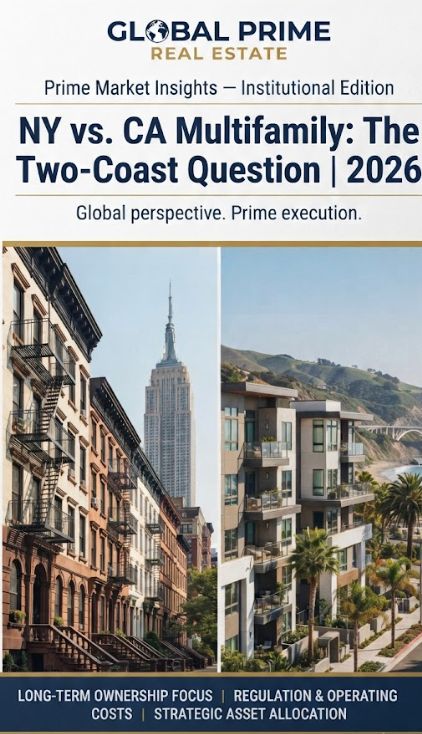
Dear friends and clients,
The question we hear often is simple: New York or California?
The answer is more complicated. Neither market is designed to maximize current income today. Both markets are built around long-term ownership, limited supply, and the ability to preserve and grow wealth over time.
Institutional investors looking at these two markets are not primarily buying yield. They are buying scarcity, location, durability, and long-term appreciation potential.
The decision comes down to understanding the differences: pricing, regulation, operating costs, financing conditions, and where opportunities still exist.
Pricing: Understanding the Opportunity
New York and California share a similar market structure. The strongest coastal locations trade at premium pricing, while secondary markets within the same states offer stronger current returns.
In New York City, institutional multifamily assets typically trade around 4–5% cap rates, with pricing often reaching $400K–$600K+ per unit for quality properties.
Outside the city, markets such as Buffalo and Rochester offer a different profile, with higher yields, lower acquisition costs, and stronger cash-flow potential.
California follows a similar pattern. Coastal markets including Los Angeles and San Francisco continue to command premium valuations, with cap rates generally ranging from 3.5–5% and pricing often exceeding $500K per unit.
Inland markets such as the Inland Empire and Sacramento provide more attractive entry points, with cap rates closer to 5–6.5%.
The opportunity is not simply choosing between New York and California. It is choosing the right asset within each market.
The Capital Markets Reality
Higher interest rates have changed the way investors evaluate coastal multifamily.
Many acquisitions today do not produce significant cash flow immediately after debt service. The investment thesis depends more heavily on long-term rent growth, operational improvements, and appreciation.
This environment rewards investors who can be patient and who are not dependent on aggressive leverage.
For well-capitalized buyers, periods of market pressure often create opportunities. Owners facing refinancing challenges or liquidity needs may become motivated sellers, creating opportunities to acquire high-quality assets at better pricing.
New York: Regulation Creates Challenges and Opportunities
New York’s biggest consideration is regulation.
The Housing Stability and Tenant Protection Act of 2019 changed the economics of many multifamily investments by limiting previous value-add strategies.
The traditional approach of acquiring regulated buildings, improving units, and converting them into higher-value assets became significantly more difficult.
Because of this, underwriting must be more detailed than ever.
Investors need to understand the individual characteristics of every unit, including regulatory status, legal rents, historical filings, and future income potential.
Howe