Supply, Demand, and Where Profit Actually Comes From
By zalmy touger · 2026-07-22
Supply and Demand Is Not Just a Diagram
Supply and demand is not a diagram. It is not just two lines on a chart. It is the fundamental rule of how society decides what gets made, how much gets made, who gets it, who pays for it, and what it costs.
It is the mechanism of how something which is scarce, wanted, and limited converts into becoming the price of something that is purchased.
But to really get into this, you must understand the basics, the foundations, the fundamentals of economics.
And what is that?
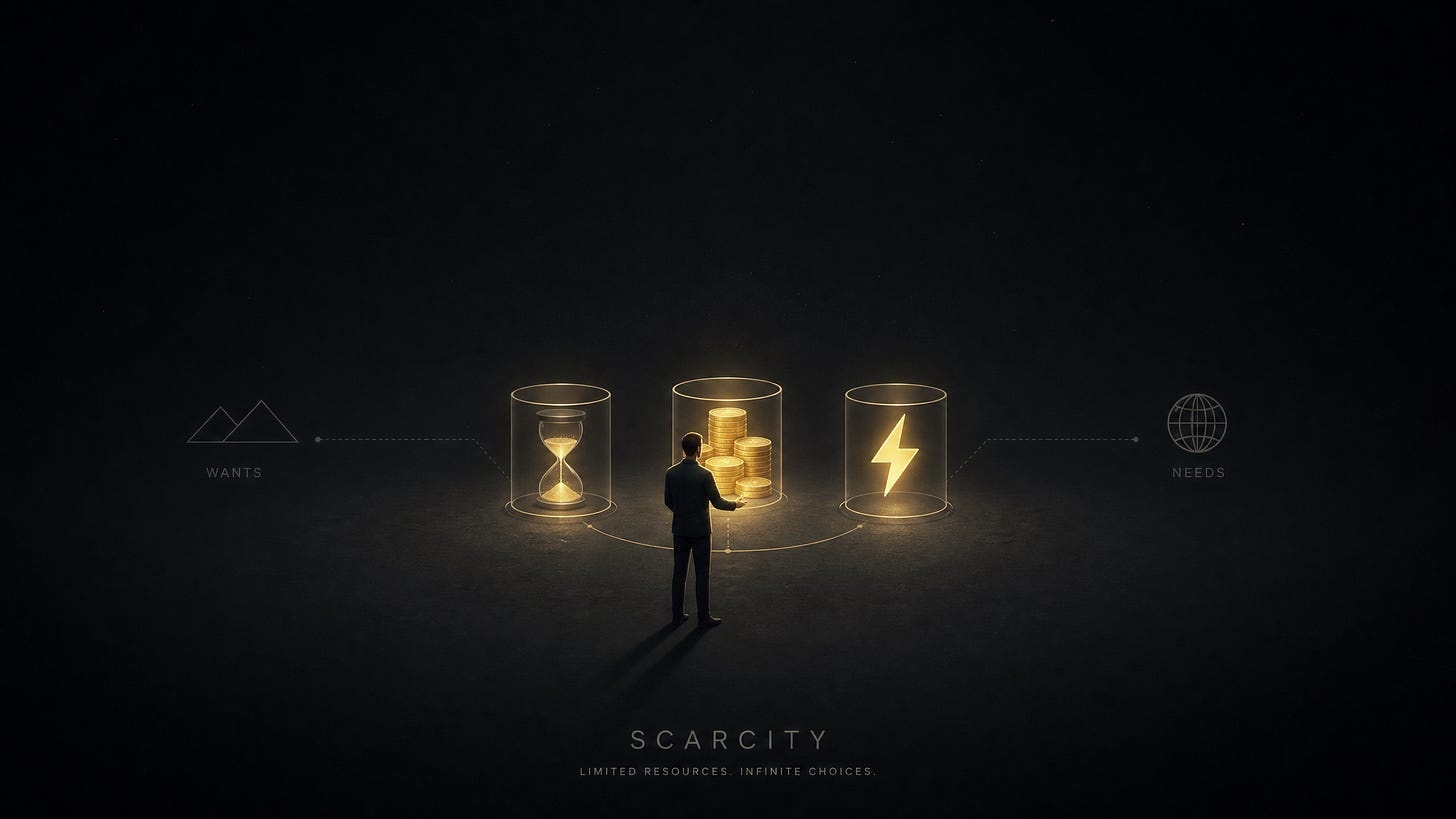
Scarcity
It means that we don’t have unlimited everything.
If there is unlimited everything, effectively the entire economics is thrown out the window, because there is no need to have any sort of way to allocate different amounts of capital or resources. Everyone has however much they need and want.
But that’s not the world we live in.
Everything in this world is scarce: time, labor, land, energy, capital, attention. These are all currencies of limited amounts.
And even risk is a quote-unquote sort of scarcity. Not everyone bears risk. Not everyone is in a position to bear risk. That is also a resource. That is capacity. Trust is one. Skill is also one.
And because this stuff is scarce, because it is rare and hard to get by, society needs a way to decide:
•What gets made?
•How much gets made?
•Who makes it?
•How much does it cost?
•Who pays for making it?
•Who gets the profits for making it?
So the whole point of a market economy, of an economy really, is that prices of an item help answer all these questions.
It’s scarcity, desire, limitations, and trade-offs all coming together.
That is what supply and demand is really about.
Demand Is Not Just Wanting Something
The first thing to understand is demand is not just, “Oh, people want a thing.”
People say, “Oh my goodness, people want iPhones.”
But when we talk about it on an economic level, demand does not mean desire or want.
Demand means the amount that buyers are willing and able to buy at each price.
And we’re being very specific here - willing and able.
Someone might want the newest iPhone. Someone might want the newest gaming PC. But if they can’t actually pay a price for it, they don’t convert into market demand.
For example, let’s say there are 10 people in the class and the school is running a fundraising ticket for their auction.
Now, if everyone wants a ticket to win this raffle for a ticket to LA, that does not mean there is demand of 10 students at every price.
Let’s say all 10 students want it. But how many people are able to give $100?
Just because people want something does not contribute to the overall demand unless they are able to acquire it as well.
This could depend on:
•Income.
•How much money you have.
•Access to borrowing.
•What your alternatives are.
•One person might have different alternatives. One person might not.
•What is your urgency?
•How much do you need it?
•Demographics.
•Price.
All of that factors into how much dema