The Ai revolution and evolution of value
By zalmy touger · 2026-08-05
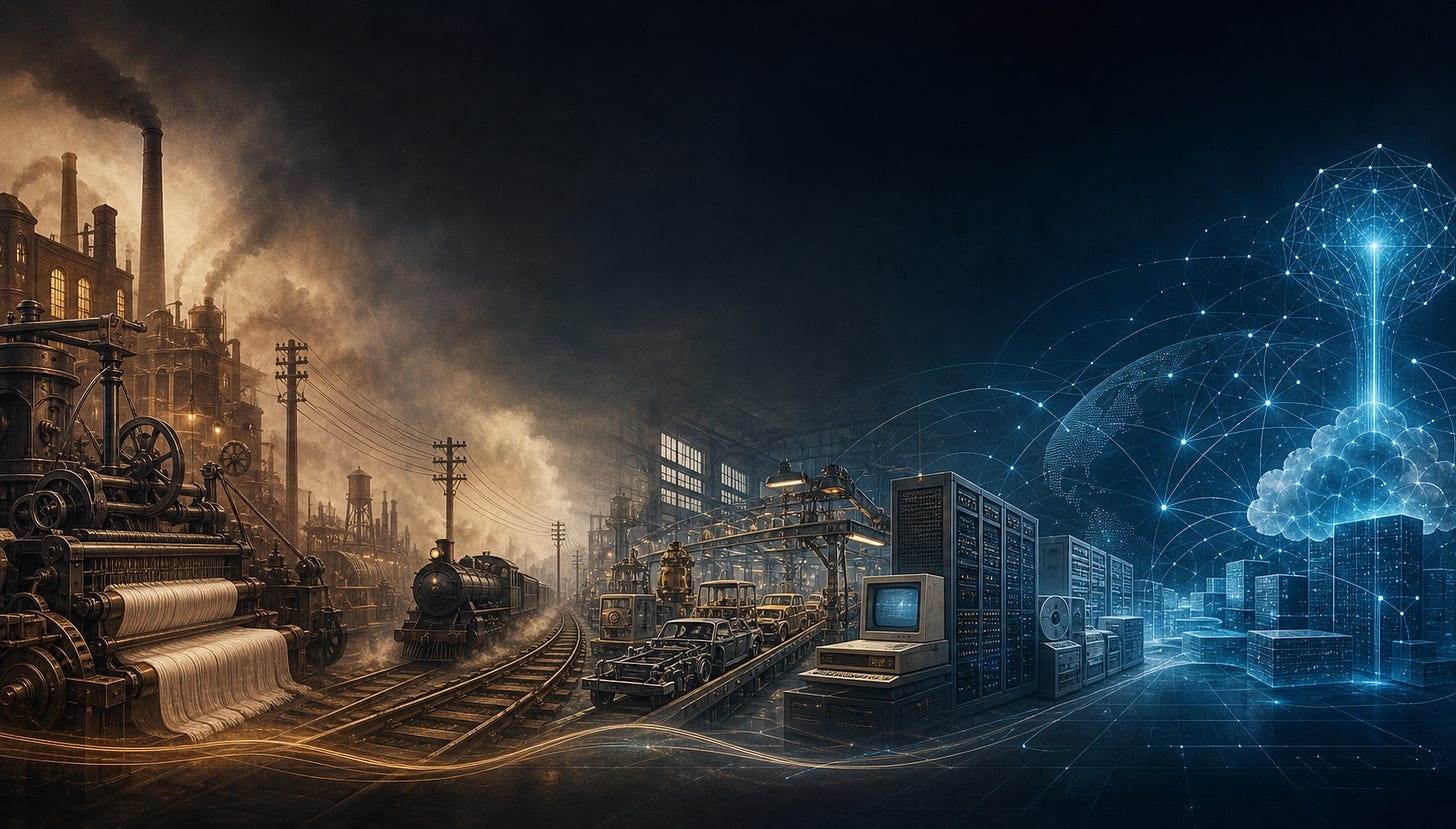
TECHNOLOGY & BUSINESS ESSAY
When Intelligence Becomes Infrastructure
What past technological revolutions reveal about value, organization, and the AI-native firm
Cloud made tools cheaper to build. AI makes the work itself cheaper to perform.
The dawn of the Industrial Revolution brought about a massive change to how economies and society as a whole are structured, where value itself is placed, and who the de facto winners of the business world are.
Since 2022, when ChatGPT entered the public consciousness, it has become very clear to everyone that AI will have a massive effect on how future companies are created. The burning question on everyone’s mind is what employees’ roles in the future will look like, or if there will be any at all. Ranging from software engineers to analysts to, now, the rising focus on robotics, it is clear that robotics will be the future - although the timeline may be longer than you think. But at the end of the day, there is no question that 25 years from now the world will be radically different, even if “AGI” literally doesn’t happen, and progress will only accelerate from here on out.
To try to maybe see what it is going to be like, I want to explore the past major changes in the Industrial Revolution and see what happens at each stage.
We have to understand that each new major shift and innovation usually brings about abundance or the commoditization of a given thing or service. While there is obviously a business in creating the shift and infrastructure, as we will see, various people benefit more from different innovations, each serving different strengths.
PART I | HISTORICAL REVOLUTIONS AND SHIFTING SCARCITY
The Advent of the Steam Engine and Mechanization
The steam engine and mechanization came around. We can look at this as giving everyone access to more pure power, as weaving machines scaled human input tenfold and more, steam engines allowed factories to be built almost anywhere, and ships finally started transoceanic shipping - really the start of international markets.
What existed before mechanization?
Much manufacturing occurred through the putting-out system:
A merchant obtained raw materials.
The merchant distributed them to households and small workshops.
Families or artisans spun, wove, or processed the materials.
The merchant collected and sold the finished goods.
Now, through these new machines and the ability, with coal and steam engines, to start a factory almost anywhere, a new type of company was born: the factory, where materials were brought in-house. These were logistics- and capital-intensive businesses whose advantage increasingly came from how effectively they combined machinery, labor, capital, and distribution - not merely from possessing the same underlying technology.
So, at this relative stage, the new technology commoditized “the making of things.” With no real differentiation of matter, the most outsized economic winner was the maker of the end product. The ke