The Ark and the Algorithm
By William Lebovics · 2026-08-06
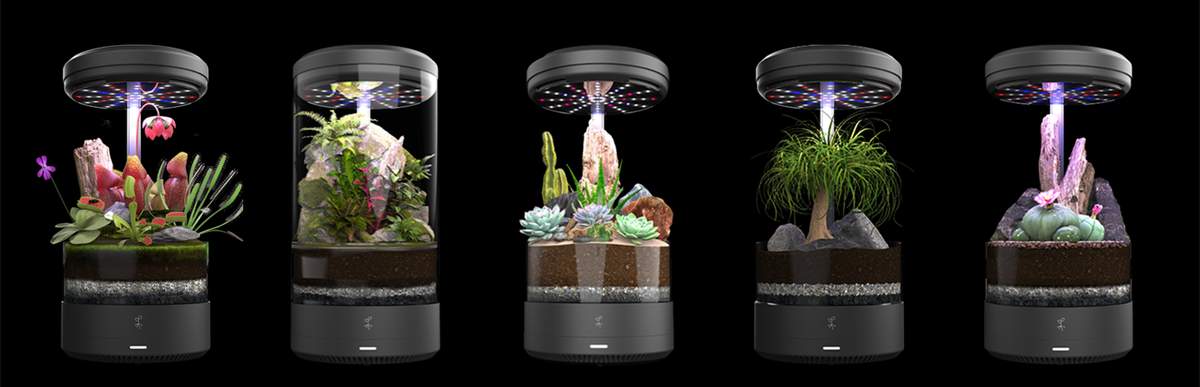
A windowless office, a basement full of 3D printers, and $209,473 from 686 strangers became a twenty-inch glass ecosystem that waters, mists, lights and watches itself. This is what it is, how it works, who built it, and what you are actually buying when you press preorder.
I. The Problem in a Windowless Office
Most consumer hardware begins with a market. This one began with a grievance.
Adam Ostroff was working in an office with no windows. He wanted something alive on the desk — a small correction to an otherwise entirely manufactured environment. What he found instead was a catch-22 that anyone who has killed a fern will recognise immediately. Every plant worth having wanted sunlight he did not have, and every plant that tolerated the gloom still wanted a body of knowledge — watering cadence, humidity tolerances, light quality, seasonal drift — that he did not have either. ""Like most people,"" he writes on the company's About page, "I didn't know how to properly manage watering, lighting, or humidity — and without natural light, nothing would survive anyway."
The reframe that followed is the entire company in a single line: what if plants could take care of themselves?
Ostroff is not a hobbyist who wandered into hardware. He is an industrial designer and engineer with more than twenty years of consumer product development behind him, the founder of ARK Designs, and the holder of more than twenty patents across electronics, smart devices, household goods and tactical equipment — products that have gone out through major retailers, e-commerce and direct-to-consumer channels. So when the idea clicked, he did what people with that particular skill set do: he went down to the basement with 3D printers, development boards and off-the-shelf components, and started building. Multiple versions, over several years, each one refining the system toward something that could genuinely automate plant care rather than merely instrument it.
That distinction matters more than it sounds. The market is full of devices that will tell you your soil is dry. Plantelligence's argument is that telling you is the failure mode — the whole point is that the plant should not need you to notice.
The company's own framing of its ambition is deliberately larger than a single object. ""We are building more than a product — we are building a platform,"" the About page reads, describing Plantelligence as "the foundation for a new category of connected plant care, combining hardware, software, and a growing ecosystem of plants, supplies, and data-driven insights."" Read that as the roadmap it is: the planter is the razor, and the plants, substrates, decoration kits and eventual data layer are everything that comes after.
II. What ARK Actually Is
ARK is a fully automated smart terrarium, roughly nine inches in diameter and twenty inches tall — small-tabletop-appliance scale, the footprint of a decent stand m