Truthkeep: An Applied AI Studio in the Age of Enterprise Generative AI
By William Lebovics · 2026-10-22
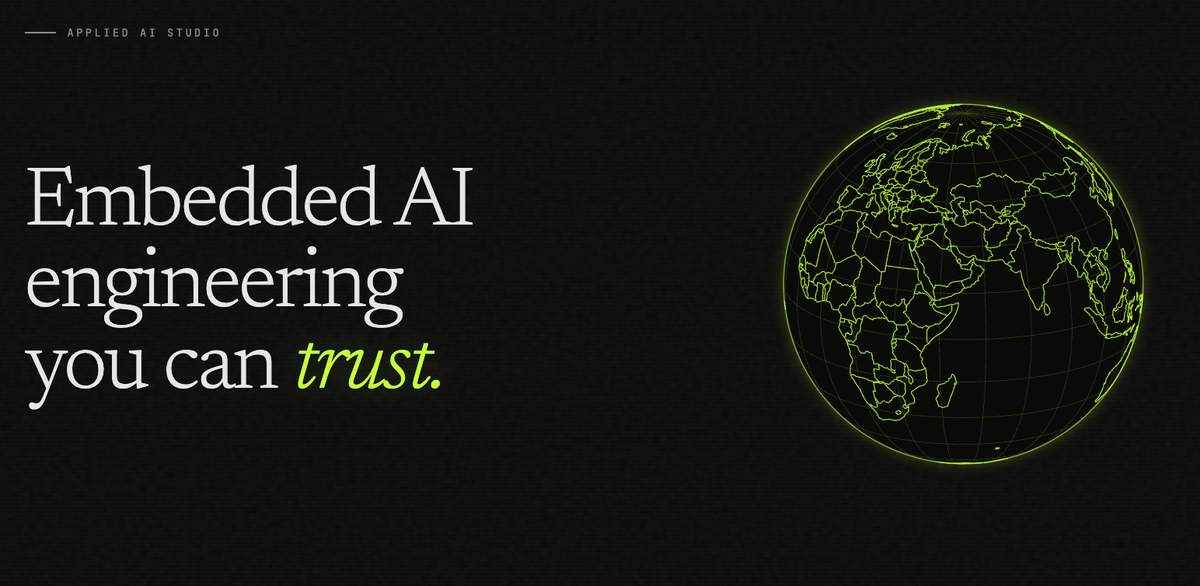
- What Truthkeep is
Truthkeep describes itself today as an "applied AI studio": a small team of senior engineers that embeds with a client's operating teams to design, build and run AI systems in production (truthkeep.ai). That label is the latest stage of an identity that has shifted in a telling way.
Truthkeep was founded in 2023 as an AI-driven data analytics company for Fortune 500 semiconductor clients (ASU News). By 2025, Xander was presenting it at industry events as an AI platform for semiconductor and sensor companies, one that unified signals from forums, Reddit, YouTube, support tickets and internal documents into actionable insight (SEMI). In October 2025 it joined SEMI, the global semiconductor industry association, listing a Tempe, Arizona address (SEMI directory).
In February 2026, Forbes described it as AI software for hardware firms that manage large volumes of technical documentation, noting that it was bootstrapped and an NVIDIA Inception partner (Forbes). Its current website presents a broader identity: an applied AI studio for Fortune 500 operators across semiconductors, consumer goods and aviation, with offices in Phoenix, New York and Toronto.
The arc runs from a vertical SaaS product (semiconductor market intelligence) toward a hybrid: two packaged platforms delivered through a forward-deployed engineering team. That hybrid is the most important fact about the company, and later sections return to it.
The name itself signals the thesis. In enterprise AI, the core failure mode is a confident but wrong answer. A company called Truthkeep is betting that grounding, citation and verifiability are what buyers will pay for. Forbes' description emphasizes exactly this: tools that accurately reference and cite a client's own technical documents.
- Who created it
Truthkeep was co-founded by Will (William) Xander, CEO, and Anthony Fierro, CTO. Forbes listed them, at 23 and 28, in its 30 Under 30 Local class of 2026 (Forbes).
Will Xander began selling at 12 and closed about $70 million in commercial real estate by 22 before leaving to build Truthkeep. He studied at Arizona State University, is now based in the New York area, and leads customer relationships, product direction and go-to-market. Anthony Fierro leads engineering and architecture, drawing on a background that spans science and software.
The engineering bench includes Philip Carey, formerly at xAI, where he worked on AI benchmarking and performance tuning, and Will Ginsberg, a lead full-stack engineer with more than ten years shipping production and accessibility work for Fortune 500 clients through consulting teams. ZoomInfo also lists Regan Rhodes as an enterprise growth advisor.
The founding pair is a classic division of labor: a commercial founder who sells into large accounts and a technical founder who owns the system. Xander's real-estate background matters more than it first appears. Enterprise AI services are won through long, relationship-driven sales cycles, which resemble commercial property deals more than they resemble self-serve software sign-ups. In an ASU interview, Xander said that his real-estate success convinced him to start an AI company.
The team is deliberately small. Truthkeep's site calls it lean; data aggregators place headcount in the 11–50 band. The ex-xAI hire signals a focus on evaluation and benchmarking, which is the discipline that separates a demo from a dependable production system.
- Products and capabilities
Truthkeep sells two platforms and one way of working. The platforms make delivery repeatable; the embedded team makes them fit each client. Listener: signal intelligence Listener ingests configurable data streams and turns them into analytics, insights and recommended actions. Public sources include Reddit, YouTube and technical forums; private sources include support tickets and internal documents. Users can monitor public conversation about a brand, synthesize support queues, or query millions of datapoints in plain English. The company reports production deployments that have processed terabytes of data.
Technically, the hard parts are named-entity recognition (knowing that a forum post refers to a specific chip, not a similarly named product), sentiment and narrative clustering, and natural-language querying over the result. The Microchip deployment reports 96% NER precision, a meaningful figure in a domain full of part numbers and acronyms. Agents: grounded assistants Agents is a platform for training, benchmarking and deploying retrieval-augmented generation (RAG) chatbots, for employees or for customers on a website. Operators manage training data, prompts and behavior in one app, review past conversations, and track conversion metrics. The SEMI listing stresses that these assistants are secure and explainable.
RAG matters here because a semiconductor datasheet is unforgiving. A model that invents a voltage tolerance is worse than no model. Retrieval ties each answer to a passage in the client's own documents, and citation lets an engineer check it. This is the "truth-keeping" in the name. The engagement model Work runs in four phases:
- Discover: map processes and problems, rank by impact, and help set governance and documentation.
- Implement: senior engineers and designers build across web, mobile, data pipelines and analytics.
- Deliver: ship continuously at the client's cadence, rather than in quarterly milestones.
- Iterate: stay on after launch to maintain and improve the system with the client's team.
The fourth phase is the strategic one. Most enterprise AI pilots stall between a successful demo and daily use. By owning post-launch iteration, Truthkeep is selling adoption, not just software.
- Who is using it
Truthkeep names four enterprise clients on its site. All figures below are the company's own claims; no independent audit of them was found.
For Microchip Technology, a Fortune 500 semiconductor maker, Truthkeep built a market intelligence platform on Listener. The company reports more than 300 users across four functions, over 10,000 signals analyzed each month, 96% precision in recognizing named entities, search eight times faster than before, more than 500 hours saved per unit per year, and a first measurable insight within seven days of deployment.
For SiFive, a RISC-V processor IP company, it built a customer-facing documentation assistant on Agents. Thousands of documentation pages were indexed, and the system generated 37 qualified leads automatically within two and a half months.
For Waterloo Sparkling Water, a consumer goods brand, Truthkeep ran a short evidence sprint across five data sources. The result was a go/no-go evidence base for Waterloo's limited-edition flavor partnership with Guy Fieri, delivered in weeks rather than months.
For Spirit Airlines, it carried out customer-experience intelligence work using multi-source listening across millions of datapoints. The findings fed into the set of AI projects Spirit chose to pursue next.
Two cases deserve a closer reading.
SiFive shows the most interesting economic idea. Technical documentation is normally a cost center. By putting a grounded assistant in front of it, SiFive turned existing documentation traffic into qualified sales leads. In processor IP, where a single license can be very large, a few conversions could repay the system many times over. The general lesson: a company's documentation is an underused sales asset.
Microchip is the strongest evidence of scale. A Microchip analytics manager quoted on Truthkeep's site credits the platform with turning scattered customer sentiment into something teams could act on, generating hundreds of account requests within weeks. Adoption by 300+ users across four functions suggests the tool escaped the pilot stage.
Beyond named clients, Forbes reports that Truthkeep is an NVIDIA Inception partner and manages tens of thousands of technical documents across its client base.
- Why an organization would use it
The case for Truthkeep rests on a gap that most large companies now feel: access to powerful models is cheap, but turning them into dependable systems inside a specific business is not.
The "last mile" problem. Foundation models are commodities. The scarce inputs are clean data pipelines, domain-specific retrieval, evaluation, and the organizational work of getting people to use the result. Truthkeep sells those inputs. Its claim of a first measurable insight within a week at Microchip speaks directly to the buyer's fear of a year-long project with nothing to show.
Build vs. buy, resolved as both. Pure SaaS tools are fast but generic. Large consultancies are tailored but slow and costly. In-house AI teams are hard to hire. Truthkeep's hybrid, packaged platforms customized by senior engineers who stay after launch, sits between these. It resembles the forward-deployed engineering model popularized by Palantir, adapted for mid-sized AI engagements.
Domain fluency as a moat. A semiconductor buyer needs a vendor that can tell a datasheet from an application note and recognize part numbers reliably. Truthkeep's SEMI membership, its conference appearances and its 96% NER precision claim all aim at that credibility.
Verifiability. In technical and regulated settings, an answer is only useful if it can be traced to a source. A grounded, cited response lets an engineer or support agent check before acting, which is what makes AI usable where errors carry real cost.
Revenue, not just efficiency. Most AI tools are sold on hours saved. The SiFive lead engine shows a second argument: AI placed on existing customer touchpoints can generate pipeline. That reframes AI from a cost line into a growth line, which is an easier budget conversation.
- The legal industry question
Truthkeep has no announced legal product or law-firm client, so any claim that it is revolutionizing law would be speculation. The more useful question is analytical: its two capabilities, grounded retrieval over large document sets and signal intelligence over fragmented sources, map closely onto legal work. Here is how they would translate, and what would block them.
The Agents platform, which delivers cited answers over thousands of technical pages, has an obvious legal analogue in knowledge management across a firm's precedents, briefs, contracts and internal memos, or in client-facing intake assistants. Making that work would require privilege-safe deployment, matter-level access controls, and citations to the exact clause or page.
Listener's public and private signal monitoring could serve as an early-warning system for litigation and regulatory risk, tracking product complaints, social media and agency dockets for corporate legal departments. That use would demand defensible data provenance and careful thought about the preservation and discovery implications of whatever is collected.
The SiFive-style lead engine could turn a firm's published client alerts and practice pages into qualified inquiries, though bar advertising and solicitation rules would apply, and chatbot answers would need to stay clear of unauthorized practice of law. Finally, the embedded, iterate-after-launch model could suit firms that find off-the-shelf legal AI too generic, provided partners buy in and the work fits billable-hour economics and procurement and security review. Why the fit is real Legal work is document work. The central risk of AI in law, fabricated citations, is the same risk Truthkeep was built around in semiconductors: a fluent answer that is not grounded in the source. A vendor whose core discipline is verifiable retrieval addresses the profession's main objection at the architectural level. Corporate legal departments in particular could use Listener-style monitoring, since the earliest signs of a product-liability or consumer-protection problem often surface in public complaints before they reach a docket. Why it would be hard The legal technology market is crowded and specialized. Established research platforms and well-funded legal AI startups already sell document review, drafting and research. Firms also impose confidentiality, privilege and ethics constraints that semiconductor clients do not. Bar guidance increasingly requires lawyers to understand the tools they use and their error rates, which raises the bar on evaluation and transparency. Finally, Truthkeep's credibility is built on semiconductor domain fluency; legal would require building that fluency again from zero. Verdict on the premise Truthkeep is not presently a legal-industry company, and nothing public suggests it intends to become one. Its architecture, however, aligns well with what legal AI most needs: grounding, citation and post-deployment evaluation. If it entered legal, the most natural beachhead would be corporate legal departments of its existing Fortune 500 clients, where the relationship and data access already exist.
- Critical assessment
Strengths • Bootstrapped and profitable enough to grow. Forbes reports no outside funding. Reaching Fortune 500 clients without venture capital implies paying customers and disciplined spending. • Proof in a hard domain. Semiconductor documentation is dense and error-intolerant. Success there is a credible signal for other technical domains. • Outcome-led positioning. Case studies lead with users, leads and hours saved rather than model names, which is how enterprise buyers decide. • Productized services. Two reusable platforms let a small team deliver bespoke work without starting from scratch each time. Open questions and risks • Unaudited metrics. All performance figures come from Truthkeep's own materials. The "500+ hours saved per unit per year" figure, for example, does not define its unit. • Identity drift. The company has described itself as an analytics firm, a semiconductor AI platform, and now a cross-industry studio. Breadth can widen the market but dilute the domain moat that won its early clients. • Services economics. Embedded engineering scales with headcount. The long-term question is whether Listener and Agents can carry a growing share of revenue as software. • Model-provider encroachment. Frontier labs and large platforms increasingly ship their own retrieval, agent and enterprise-search tools. A studio's durable value must lie in integration, evaluation and domain knowledge, not in the RAG layer itself. • Key-person concentration. A lean team means a few departures could materially affect delivery.
- Conclusion and questions worth asking
Truthkeep is best understood as an early example of a new kind of firm: the applied AI studio that combines packaged platforms with forward-deployed engineers, sells on measurable outcomes, and stakes its brand on verifiable answers. Its record with Microchip and SiFive shows the model can work in a demanding technical domain. Whether it becomes a durable software company or remains a high-quality boutique depends on how much of its value it can encode into Listener and Agents.
Questions an investor, partner or prospective client might put to the founders:
- What share of revenue comes from platform licenses versus engineering services, and how is that changing?
- How are accuracy and grounding measured in production, and are those evaluations shared with clients?
- Which industries come next, and how will semiconductor-grade domain fluency be rebuilt in each?
- How do the platforms handle confidential and regulated data: on-premises options, access controls, retention?
- As model providers ship their own enterprise retrieval tools, what remains uniquely Truthkeep's?
- Would the company serve legal or other regulated professions, and if so, starting where?
Sources • Truthkeep: Applied AI Studio (official site) • Forbes: Meet the 30 Under 30 Local Arizona Class of 2026 • SEMI member directory: Truthkeep • SEMI MEMS & Sensors NextGen: William Xander abstract and bio • ASU News: Meet 4 young innovators making waves before 25 • Will Xander on LinkedIn • ZoomInfo: Truthkeep company profile • Legal Technology Hub: Truth Systems AI (the separate legal-AI company referenced in the abstract)