WHERE THE OLD BECOMES NEW
By William Lebovics · 2026-08-27
I. A shul that grew the way a startup grows
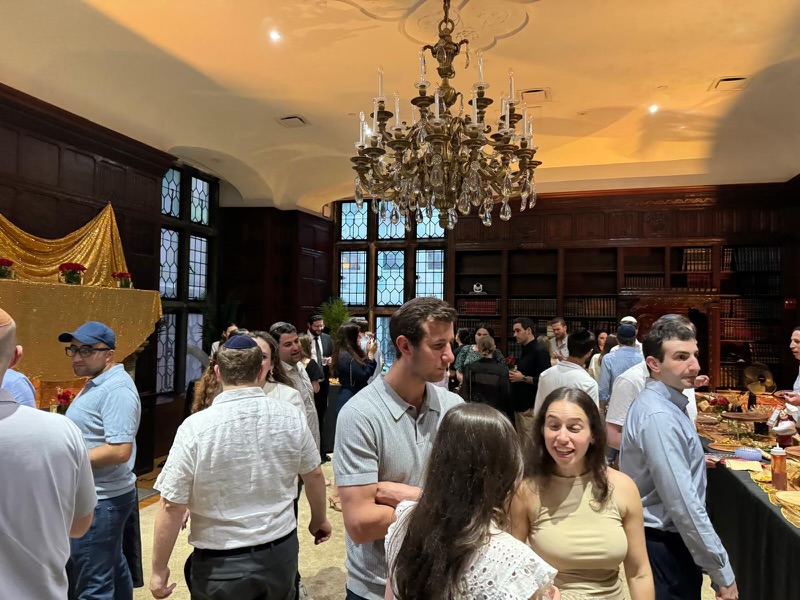
In February 2022, Rabbi Benjamin Goldschmidt and Avital Chizhik-Goldschmidt announced a new Orthodox congregation on Manhattan's Upper East Side. They had no building, no endowment, and no membership roll. What they had was a thesis: that a serious, intellectually honest, unembarrassed Judaism could attract exactly the people the institutional Jewish world had spent twenty years assuming were lost.
For two years the Altneu davened wherever it could — private apartments, the Asia Society, the Pierre. In March 2024 the congregation bought a six-story Tudor Revival townhouse at 107 East 70th Street for $34.5 million. Today it counts roughly 430 member units, and nearly 40 percent of them are under thirty-six — the fastest-growing segment in the room, and the demographic every synagogue in America says it cannot reach.
The name is the thesis. Altneu — old-new — is borrowed from Prague's Altneuschul and from Rav Kook's formulation that the shul takes as its motto: where the old becomes new and the new becomes holy. Not old repackaged as new. Old that becomes new, without ceasing to be old. That is a rare institutional instinct, and it is the reason this particular shul is the right first home for what comes next.
II. The ceiling every thriving kehillah eventually hits
Look at what the Altneu actually operates. A Kollel. A gallery program. Shabbat dinners, including regional ones. Educational forums. High Holiday services at scale. A young-couples track. A membership business with tiered dues — $1,200 a year under thirty-six, $1,800 above it. A calendar that has to be published, an RSVP flow that has to be managed, a community that has to be reached on Friday afternoon and again on Sunday morning.
Strip the kedusha away for a moment and describe it operationally: the Altneu is simultaneously an events company, a media company, a membership organization, an education institution, and a commerce hub for a few hundred households who buy from each other constantly. And it runs all of it on tools it does not own.
WhatsApp for the groups. Email for the announcements. Eventbrite or Partiful for the RSVPs. Zoom for the shiur. Instagram for the reach. A website for the calendar. Venmo, Zelle, and a payment processor for the money. Six to ten platforms — the YESODI thesis puts the number across Jewish institutional life at over a hundred — each taking a cut, each holding a fragment of the community's data, and not one of them returning a dollar or a data point to the kehillah that generated it.
Three consequences follow, and they are the three problems YESODI was built to solve.
The community is fragmented across other people's infrastructure. No single view of who is engaged. No portable list. If a platform changes its terms, the shul's ability to reach its own members changes with it. There is no control over the environment. Instagram, TikTok, and LinkedIn have, since October 7th, served antisemitic content into Jewish feeds while offering creators and institutions zero ability to shape what reaches them or who reaches their people. A shul that has built a sanctuary on East 70th Street is publishing into a space where it controls nothing.
And none of the value comes back. The Altneu generates content, attention, transactions, and behavioral data every single week. Every dollar of economic value that data produces is captured by companies with no stake in Jewish continuity. The shul's return is "reach." Meanwhile the gap between what dues cover and what the institution costs is closed, as it is in nearly every Jewish institution in America, by a small number of generous people.
That last sentence describes the real ceiling. It is not attendance. It is not relevance. The Altneu has both. The ceiling is that a thriving kehillah in 2026 creates enormous economic value and captures almost none of it.
III. What YESODI is
YESODI is an invite-only, ad-free community platform built from the ground up for the Jewish world — approximately fifteen million people globally, and by most estimates over $350 billion in economic power in the United States alone.
It consolidates what the community currently spreads across a hundred apps: private community circles, events and live calls, live video, a Jewish business directory with in-app storefronts, trusted news from journalists members choose to follow, a points economy that rewards participation, and creator profit-sharing. No advertising. No data harvesting.
Representative governance, with community leaders, Rav and Rebbetzin Goldschmidt, who have full oversite and control on Hashkafa, content, tone, virtues represented and overall Kiddush Hashem-ness of what is in the feed. This is where young people are spending time and it's in the exact interface they are accustomed to using. But here we have Rabbanim and Mashgichim vs Mark Zuckerberg.
And critically: YESODI is additive, not a replacement. Nobody is being asked to delete Instagram. Keep the socials. YESODI sits alongside them as the layer that pays.
IV. Five things that change for the Altneu on day one
- The shul becomes findable inside the answer
Discovery has moved. People do not open a search engine and type "modern orthodox synagogue upper east side" anymore — they ask an assistant. A young professional who just moved to New York asks Claude where to go for Shabbat. A couple asks ChatGPT which shuls run serious learning for people without yeshiva backgrounds. A donor asks an AI which Jewish institutions are actually growing.
YESODI structures every profile, event, class, and listing so that it surfaces inside AI-generated answers. That is a categorically different distribution mechanism than a social feed. On Instagram, the Altneu competes against an algorithm optimized for time-on-app. Inside an AI answer, it competes on relevance — and on relevance, a shul with a Kollel, a gallery, a townhouse, and a 40-percent-under-36 membership wins.
The Altneu does not need to fight for a ranking. It needs to be in the answer. YESODI is how it gets there.
- The Altneu owns its own distribution
On the platforms the shul currently uses, an invisible system decides which members see which announcement. On YESODI, the institution sets the rules: who reaches its community, who is permitted to sell into it, and where its content appears across the open web.
For a shul this is not a marketing feature. It is a shmirah feature. A kehillah that has spent four years building a room where people feel safe should not be publishing into an environment where it cannot control what appears next to its name.
- The data dividend
Every click, RSVP, purchase, and interaction inside the Altneu's community generates data with real market value. Today that value accrues to Meta and its peers. On YESODI it flows back to the people and institutions who generated it — planned as a dividend distributed four times a year to the businesses and organizations doing the posting.
Consider what that means against the shul's actual P&L. Dues at $1,200 and $1,800 do not cover a six-story townhouse on East 70th Street. Nothing in the Jewish institutional model expects them to. But a shul with several hundred highly engaged member units, a packed calendar, and a commerce-active community is sitting on a revenue line that has simply never been collectible before. YESODI makes it collectible.
- Five levels deep
YESODI's referral architecture compensates members for growth — not once, but five levels down the referral tree. A member brings a friend. That friend brings their chavrusa. Five layers out, the original member is still earning.
The same structure applies to businesses. When the Altneu brings a kosher caterer, a sofer, a jeweler, or a wine importer onto the platform, it earns an ongoing share of what that business transacts — not a one-time finder's fee.
Every Jewish institution already does this work. Shuls are the single most effective business-referral engine in Jewish life; the kiddush is where 90% of the community's commerce originates. The Altneu has been generating that value for four years and collecting none of it. On YESODI, the referral that already happens naturally at kiddush becomes a revenue line.
- The shul can pay its own members
This is the piece with no analogue anywhere else, and it is the one that changes the character of the institution.
On YESODI, an organization can split its own earnings with its followers. Concretely: the Altneu runs a dinner. A member sources the venue. Another member's company handles the catering. Someone's cousin prints the merchandise. Yossi Mendlowitz books the Freilach band along Yoni Z because he went to Yeshiva with Avrumi Schreiber. The shul allocates five percent of the profit back to the members who made it happen.
Those members are no longer attendees. They are stakeholders — with a financial interest, alongside the spiritual one, in the next dinner being bigger. A passive audience becomes an incentivized team.
Think about what that does to the perennial hardest problem in Jewish institutional life: getting people to show up, and getting them to bring someone. Every shul in America runs on the volunteer labor of the same fifteen people. YESODI makes it possible for the institution to reward participation directly — not with honors at the annual dinner, but with money and points that reflect the real value those members created. That is not a commercialization of kehillah. It is the opposite. It is finally paying the people who have been subsidizing it with their time.
V. What it means for the members
For the roughly 430 members, the immediate change is simplification: one place instead of eight. One calendar, one directory, one group, one RSVP, one feed — private, invite-only, and free of the content that made the last few years exhausting to be Jewish online.
The deeper change is participation with a return attached. Members earn points for engagement — clicks, shares, events attended — redeemable for products, experiences, and charitable giving. Members who run businesses get discovery inside the community and inside AI answers. Members who bring people in earn from what those people do.
And for the under-36 cohort that is the Altneu's fastest-growing segment — the group most fluent in creator economics and most cynical about platforms that monetize them for free — this is the argument that lands. They have watched their attention build other people's companies their entire adult lives. A shul that hands them the other side of that deal is a shul they will build with.
VI. What it means for the Jewish people
The Altneu's move is significant beyond the Altneu, for a simple reason: it is the proof.
Every federation, day school, Hillel, Chabad house, and startup minyan in the world faces the exact problem described above. Most of them are smaller, less resourced, and less equipped to solve it. What they need is not a whitepaper. What they need is one credible institution that went first and can say what happened.
The Altneu is unusually well suited to that role. It is young enough to move, prominent enough to be watched, and rigorous enough that its endorsement is not cheap. Its leadership already sits in YESODI's governance. And its entire institutional identity — old becoming new, new becoming holy — is a statement that adopting a new tool and preserving a tradition are not opposing acts.
The upside for the community is Achdus with an actual mechanism behind it. Fifteen million people currently connect through infrastructure that has no stake in whether they remain a people. A directory that makes Jewish-owned businesses findable, a marketplace that moves Israel–diaspora commerce efficiently instead of through a dozen intermediaries, a news layer accountable to readers rather than to engagement — these are not features. They are the difference between a community that is networked and a community that is merely counted.
VII. What it means for the world
Two things, and neither is small.
A model that other communities will copy. YESODI's architecture — member-owned data, creator-set distribution, revenue returning to the people who generate it, no advertising — is a general answer to a general problem. The Jewish community will have built it first, under pressure, because it had to. Every diaspora community, every congregation of any faith, every professional guild watching its members get farmed for data has the same problem and no solution. The Altneu joining is an early step toward the Jewish community exporting the fix.
Commerce organized around values. The platform's premise is that a business should be discoverable because it is genuinely relevant, that a creator should be paid because they created something, that a follower should share in what they helped build, and that a community's data belongs to the community. Those are not novel ideas. They are yashrus, hakaras hatov, and ma'aser rendered as software architecture.
A world with more platforms built that way is a better world. The Jewish community has, historically, been good at building the thing everyone else eventually adopts.
VIII. What joining looks like
For the Altneu, practically:
• A private community circle for members — replacing the WhatsApp sprawl, with real permissions and a real membership record. Who are the actual tech people in the shul above and below me in the ladder. How can I network, mentor, hire within my community. Who can itarger for events based on channels and interest groups. How can I get feedback on events. How can we poll prospective speakers, and so on. • Events and RSVPs run natively — Shabbat dinners, High Holiday seating, the Kollel calendar, gallery openings, regional dinners — replacing ShulCloud (oy vey, Rabbi Goldschmidt told me it took a year just to figure out how this thing works) Eventbrite, Partiful, and Zoom in one move. • A shul storefront and business directory where member-owned businesses are discoverable inside the community and inside AI answers. • Structured AI-discoverable profiles for the shul, its programs, and its leadership, so the Altneu appears in the answer when someone asks an assistant where to go. • Referral and profit-share configuration — the five-level structure for members and businesses the shul brings on, and follower profit-sharing enabled on events the community helps produce. • Governance participation, with the Altneu's leadership at the table as the platform's standards are set. Nothing gets deleted. The Instagram account stays. The mailing list stays. YESODI is the layer underneath that finally makes the work pay.
IX. Am Yisroel is the algorithm
For twenty years the Jewish community has been a user of platforms built by other people, optimized for other purposes, indifferent to whether it survives. The community adapted, as it always does, and got good at working inside somebody else's system.
The Altneu was built on the premise that you do not have to choose between the old thing and the new thing — that the old, handled correctly, becomes the new, and the new, handled correctly, becomes holy. A four-year-old shul with a townhouse on East 70th Street and a room full of thirty-year-olds who did not grow up frum is what that premise looks like when it works.
Joining YESODI is the same premise applied to infrastructure. The kiddush referral, the community bulletin board, the gemach, the professionals network, the mutual-aid economy that has held Jewish communities together for two thousand years — none of that is being replaced. It is being given an operating system that finally pays the people running it. Post it. Sell it. Get found. Get paid. Bring your people with you.
Am Yisroel is the algorithm. Gideon! Thanks for the shoutout!
YESODI.COM on the app store