Why Airplane Wings Actually Bend?
By Aviation Explained · 2026-11-01
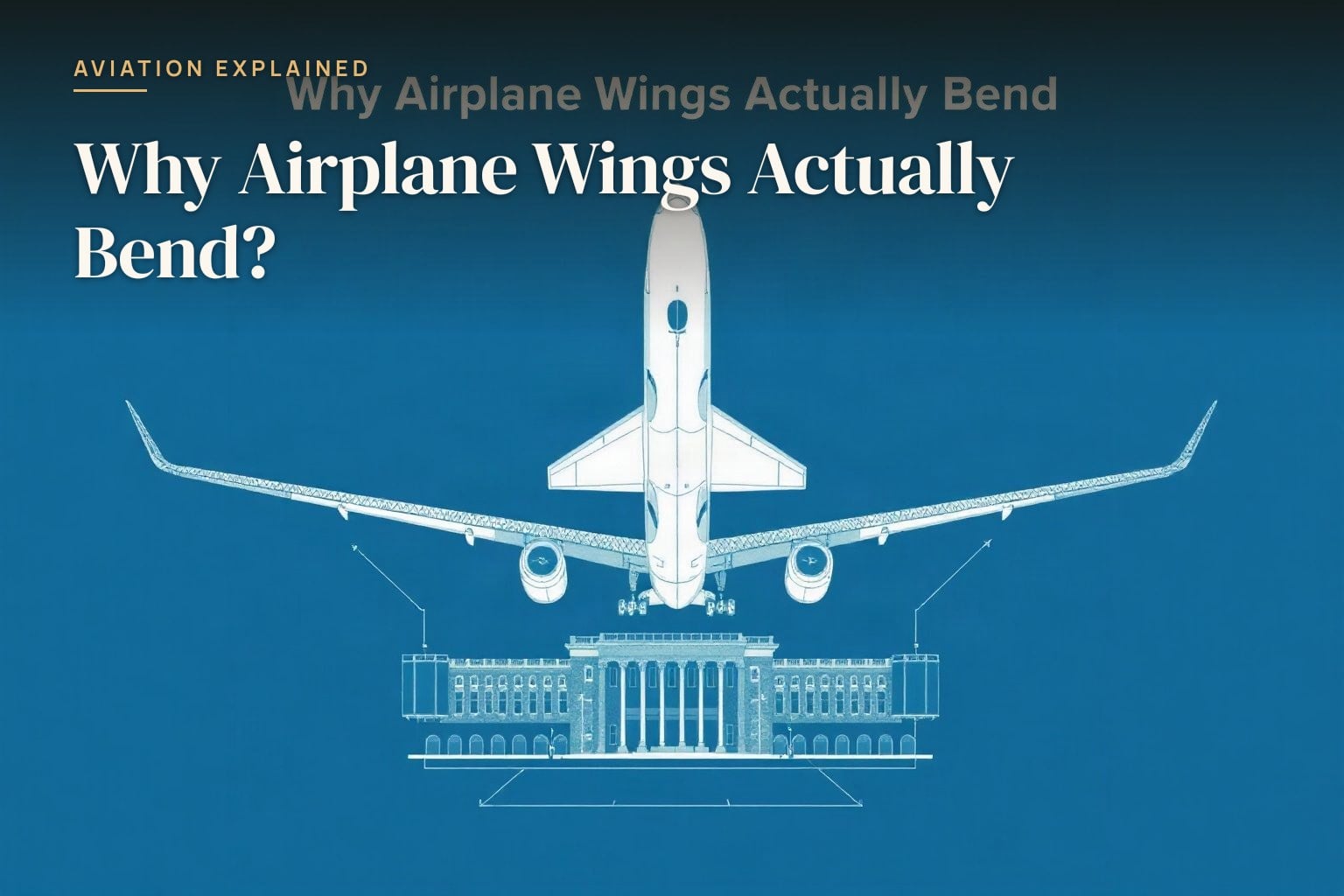
When you watch a large aircraft take off or land, you might notice the wings moving up and down quite a bit. Many passengers assume this is dangerous or a sign of structural strain. The truth is the opposite: wing bending is a deliberately engineered feature that makes aircraft safer, more efficient, and able to fly farther than rigid wings ever could.
Why wings are built to flex
Aircraft wings aren't designed to be stiff. Engineers intentionally build them with flexibility because bending is how wings handle enormous forces. When a plane flies, lift pushes up on the wings with incredible force. A large commercial jet creates enough lift to support hundreds of tons. If the wings were rigid like steel beams, they would crack and snap under that repeated stress. By allowing the wings to bend and flex, the structure absorbs that force smoothly across the entire wing, spreading the load instead of concentrating it at one point. Think of it like a tree swaying in the wind instead of a wooden plank that snaps.
The physics of wing bending
Every time an aircraft maneuvers, climbs, or flies through turbulence, the wings experience what engineers call "bending moments." A bending moment is the rotational force trying to bend something. When you push down on a ruler hanging off a table, you create a bending moment. The further you push from the table, the easier it bends. Wing tips are far from where the wings attach to the fuselage, so they move the most. The root of the wing, attached to the aircraft body, moves very little. This graduated bending pattern is exactly what engineers want.
Modern aircraft design uses computer models to calculate precisely how much each part of the wing should bend under different conditions. The wing is strongest at the root and gets gradually more flexible toward the tip. This design balances strength with weight. A heavier, stiffer wing would require more powerful engines and burn more fuel over a plane's lifetime.
Limits and safety margins
Wing flexibility does have limits, and aircraft are tested ruthlessly to prove they're safe. During certification, manufacturers build full-scale aircraft and bend the wings to extreme angles on the ground using hydraulic equipment, pushing far beyond what the plane will ever experience in normal flying. These destructive tests continue until the wing finally fails, so engineers know the exact breaking point. Real aircraft are then designed with multiple safety margins built in, so they'll never come close to failing during any reasonable flight operation.
Commercial airliners typically can bend their wing tips up to 20 or 30 feet vertically during extreme maneuvers, yet they've been proven to handle that motion tens of thousands of times without damage.
Why this matters for flying
Wing flexibility enables modern aviation as we know it. Long-range jets need to carry massive fuel loads. A rigid wing would need to be extremely thick and heavy to support that weight wit