No Ads, No Games, No Gimmicks: The Founders of WhatsApp
By William Lebovics · 2026-10-05
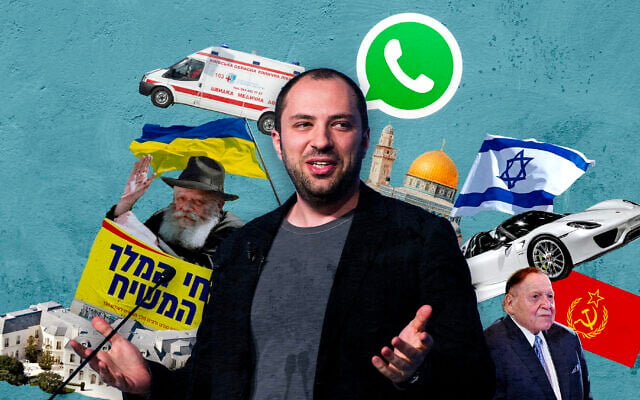
Jan Koum and Brian Acton connected three billion people by refusing to do almost everything Silicon Valley considers essential.
The $19 Billion Rejection Letter
WhatsApp is the rare case in which two men who were turned down for jobs at Facebook later sold Facebook a company for $19 billion. Jan Koum, a Ukrainian-born infrastructure engineer, and Brian Acton, a Stanford-trained computer scientist, met in 1997, spent nine years together at Yahoo, and started WhatsApp in 2009.
Their product succeeded because of what they refused to build. They refused advertising, refused feature sprawl, and refused to collect more about their users than a phone number. That discipline produced an app now used by more than 3 billion people a month. It also, eventually, cost both men their jobs.
Jan Koum: Raised Where the Phones Were Tapped
Koum was born in Kyiv in 1976 and raised in the nearby town of Fastiv, in a house with no hot water. His parents rarely used the telephone because they assumed the state was listening.
In 1992, at sixteen, he emigrated with his mother and grandmother to Mountain View, California, leaving a political and antisemitic climate that had become untenable. They lived in a subsidised two-bedroom apartment and collected food stamps. His mother packed pens and twenty Soviet-issue notebooks so she would not have to buy American school supplies. She babysat. He swept the floor of a grocery store. She died of cancer in 2000, three years after his father.
He taught himself computer networking from manuals bought at a used bookstore, which he returned after reading. It is the earliest recorded instance of Koum declining to pay for anything he did not strictly need. Yahoo hired him in 1997, and his formal education ended when co-founder David Filo phoned him mid-lecture to ask, with some emphasis, why he was in class.
A child who grew up in a house where no one trusted the telephone went on to build a telephone app that no one, including its owner, can listen to.
Brian Acton: The Conscience With a Stanford Degree
Acton reached the same convictions from the opposite direction. Born in Michigan in 1972 and raised in Central Florida, he took a computer science degree from Stanford in 1994. His mother ran a freight-forwarding business and, he recalls, lost sleep over making payroll. He has treated business as an obligation to the people who depend on it ever since.
He joined Yahoo in 1996, early enough to become rich on paper and then lose millions when the dot-com bubble burst. He was burned by the internet economy a full decade before he conquered it. At Yahoo he worked on advertising systems and came to dislike them. His later verdict on the ad business was one sentence: "If it made us a buck, we'd do it."
An Audit, a Friendship, Two Rejections
They met in 1997, when Ernst & Young sent Koum to audit Yahoo's advertising system and Acton was the employee assigned to him. Koum's later explanation of the friendship was that neither of them had any talent for nonsense.
They worked side by side at Yahoo for nine years. When Koum lost both parents by the age of twenty-four, Acton became his main source of support.
Both left Yahoo in 2007, spent a year travelling and playing ultimate frisbee, and then applied to Facebook. Both were rejected. Five years later Facebook paid roughly $19 billion to employ them anyway. It is plausibly the most expensive recruiting error ever recorded.
The Accident That Became the Product
WhatsApp began as a different and worse idea. In January 2009 Koum bought an iPhone and designed an address book that showed a status beside each name: at the gym, battery low, can't talk. He incorporated the company on February 24, 2009, his thirty-third birthday, before the app existed.
Early versions crashed constantly. A friend reported the bugs over dinner while Koum took notes in one of his mother's Soviet notebooks. By March he was ready to quit. Acton's reply is the most consequential sentence in the company's history: "You'd be an idiot to quit now. Give it a few more months."
That June, Apple introduced push notifications, and Koum set the app to alert your contacts whenever you changed your status. Users ignored the intended purpose and started using statuses to talk to each other. Koum realised he had built a messaging service by mistake. The rebuilt version reached 250,000 users within months. Acton raised $250,000 from five former Yahoo colleagues and joined as co-founder.
Thirty-Two Engineers, 450 Million Users
The founders' creed fitted on a note Koum kept on his desk, written by Acton: No ads. No games. No gimmicks.
Everything followed from it. There was no username, no password, and no profile, because your phone's address book already held your social graph. There was no marketing department, because Koum believed marketing "kicks up dust" and distracts from the product. There was not even a sign on the office door, which he considered an ego boost. New hires were told to find the building next door, go round the back, and knock.
The engineering was just as spare. WhatsApp ran on Erlang, a language built in the 1980s for telephone exchanges, and by 2014 served 450 million people with 32 engineers. Among the first was Eugene Fooksman, a St. Petersburg-born engineer whom Koum personally talked into joining in 2010.
Revenue came from charging users a dollar a year. When Sequoia Capital invested a second time, Acton took a screenshot of the company bank balance. The founders had not managed to spend the first round.
The Sale and the Divorce
Facebook bought WhatsApp in February 2014 for about $19 billion. Koum signed the papers on the door of the Mountain View welfare office where he had once queued for food stamps.
For two years the founders kept their independence, and used it. In 2016 they switched on end-to-end encryption for every message and call, giving more than a billion people strong privacy overnight.
Then came the question of money. Facebook wanted targeted advertising inside WhatsApp. Acton proposed charging heavy users a small fee instead and was told it would not scale. He left in 2017 and walked away from roughly $850 million in unvested stock. During the Cambridge Analytica scandal he posted four words: "It is time. #deletefacebook." Koum resigned the following month.
Acton's judgment of himself is harsher than anyone else's: "I sold my users' privacy to a larger benefit. I made a choice and a compromise. And I live with that every day." In June 2025, advertising finally arrived in WhatsApp.
What They Did With the Money
The two men have spent their fortunes in ways that match their temperaments.
Koum has become one of the largest Jewish philanthropists of his generation. The Koum Family Foundation holds about $3.3 billion and supports Jewish communities in America, Israel, and the former Soviet Union. In 2025 it gave $50 million to Soroka Medical Center in Beersheba. In May 2026 it pledged $200 million to Shaare Zedek Medical Center in Jerusalem, the largest gift ever made to Israeli healthcare. A month later it gave $36 million to Milken Community School in Los Angeles.
He also lives well. He collects air-cooled Porsches with scholarly thoroughness and once sold ten at auction for lack of garage space, including three in the same shade of yellow. Collectors call that a set. Everyone else calls it buying the same car three times.
Acton took the opposite path. He lent $105 million, interest-free, to found the Signal Foundation, which runs an encrypted messenger that can never be sold to an advertising company. The loan falls due in 2068, when he will be ninety-six. He drives a minivan, sends his children to public school, and funds Sunlight Giving, which supports young children in poverty across Northern California. His view of great wealth: it is "not as liberating as you would hope."
How They Changed the World
WhatsApp abolished the price of a message. A text across a border used to cost money. Now it costs nothing, which matters most to migrants, diasporas, and divided families.
It made strong encryption ordinary. What had been a specialist tool became the unannounced default for billions, and governments from Brazil to Russia have been arguing with it ever since.
It became infrastructure. In much of Latin America, Africa, and South Asia, WhatsApp is how a shop takes an order and a clinic confirms an appointment.
The costs were real. A private network at planetary scale has no editor, and forwarded rumours on WhatsApp have been linked to mob violence in India and election disinformation in Brazil. The founders built the most private mass medium in history and then sold it to a company whose business is knowing things about people.
Why This Story Belongs on YESODI
The note on Koum's desk was a complete theory of product design: serve the people who use the thing, and never sell them to someone else. It worked for three billion people. It could not survive ownership by an advertising company.
YESODI starts from the same refusal and builds it into the structure. There are no ads here. The feed does not exist to harvest attention and resell it. It exists to give its members tools: a place to publish, sell, and connect, visibility in AI search, and a share of the value they create.
Other feeds take. This feed gives. Koum and Acton proved that a product can reach the whole world without advertising. The open question they left behind is whether a platform can stay that way. We intend to answer it. 😉