The Quiet Convener: How David Bashevkin Built a Following on Honest Questions
By William Lebovics · 2026-10-22
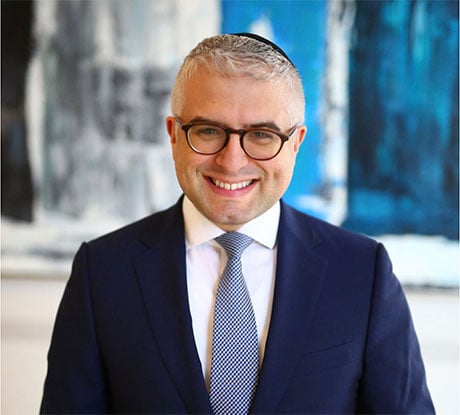
TEANECK, N.J. — Most public intellectuals lead with their credentials. David Bashevkin leads with his rejections. For more than a decade, his official biography has ended with the same line: he has been turned down by several prestigious fellowships and awards.
The joke is also a thesis. Mr. Bashevkin, 41, is a rabbi, a business-school professor and the founder of 18Forty, a media and education platform he launched as a podcast in 2020. His central subject, from his first book to his latest episode, is the gap between who people hope to be and who they are.
That subject has drawn an unusual crowd. Hasidic listeners, Reform rabbis, formerly Orthodox Jews and secular newcomers to Torah all tune in to the same feed. In a Jewish world often divided by label, he has built an audience that ignores the labels, without hiding his own.
A Formation That Crossed Lines Early
Mr. Bashevkin grew up in Lawrence, on Long Island, the son of an oncologist and a writer. He has described his parents as right-wing Modern Orthodox. As a boy he wrote letters to the editor of Wizard, a comic-book trade magazine, an early sign of a mind that never kept pop culture and religion in separate rooms.
His schooling ran across the Orthodox map. After high school he studied at Yeshivat Sha'alvim in Israel, then at Ner Israel Rabbinical College in Baltimore, a flagship of the yeshiva world. He took rabbinic ordination at Yeshiva University's RIETS, the institutional heart of Modern Orthodoxy.
At YU's Bernard Revel Graduate School he wrote a master's thesis on Polish Hasidut under the late Talmud scholar Yaakov Elman. His focus was Rabbi Zadok HaKohen of Lublin, a 19th-century Hasidic thinker with daring views on sin. He later earned a doctorate in public policy and management from The New School, concentrating on crisis management.
The résumé reads like a deliberate tour of rival camps: Lithuanian yeshiva, Hasidic thought, Modern Orthodox academy and secular policy school. Few figures can speak fluently to all of them. Mr. Bashevkin was trained by each.
The educator
His day job for most of his career has been teaching teenagers. He joined NCSY, the Orthodox Union's youth movement, as associate director of education in 2010 and became director of education in 2013. There he built curricula and seminars for staff and students across North America.
He also teaches at Yeshiva University. He is Clinical Assistant Professor of Jewish Values at the Sy Syms School of Business and a rebbe at Isaac Breuer College. His courses cover public policy, religious crisis and rabbinic thought, an unusual mix for a business-school faculty.
18Forty: A Beit Midrash With Wi-Fi
The name puzzles first-time listeners. It refers to the year 1840, which 18Forty frames as a hinge of history. The Industrial Revolution was peaking, the Damascus Affair was rallying Jews worldwide, and some mystics had predicted that year as the moment the gates of wisdom would open.
Mr. Bashevkin's argument is that Jews now face another such moment. Technological disruption, a mental-health crisis and declining faith are reshaping communal life at speed. His answer is not a manifesto but a forum.
The podcast launched in May 2020 with a structure borrowed from the classroom. Each month takes one theme, explored through two to four long-form interviews and short solo framing episodes. Early themes included the Talmud, comedy, who wrote the Bible, and leaving religion.
That last series drew notice. An Orthodox rabbi hosting Shulem Deen, one of the best-known chroniclers of leaving Hasidic life, was not standard fare. Mr. Bashevkin's view was that a community unable to hear its critics cannot really answer them.
The guest list since has been strikingly broad. It includes the historian Marc B. Shapiro, the biblical scholar Joshua Berman, Reform leader Rabbi Ammiel Hirsch, ADL chief Jonathan Greenblatt and Orthodox writer Gil Student. More recent episodes feature former ambassador Michael Oren, philosopher Micah Goodman and Haredi commentator Jonathan Rosenblum.
From podcast to institution
18Forty now describes itself as a modern virtual beit midrash, a study hall where questions are welcomed. It works across three tracks: media, community and education.
The outputs now include essays, videos, live events, curricula, fellowships and "Book Journeys." A Shabbos reading project, I Read This Over Shabbos, runs its own channels. Its Talmud Daily Journey, a free 40-week course needing no Hebrew, reports more than 7,000 sign-ups.
It also has a professional staff of editors, writers and interns, many trained at YU's student newspapers. What began as one man and a microphone in a pandemic has become a small, serious publishing house.
No Topic Off the Table
What sets Mr. Bashevkin apart is less any single view than his range. Few Orthodox educators would put abuse, agunot, money, mysticism and artificial intelligence on the same syllabus. 18Forty's topic index does exactly that.
The breadth is easiest to see in the subjects themselves. On Jewish unity, 18Forty has run series on the denominations and on the American yeshiva world. One featured a historian on the blurry borders between Reform, Conservative, yeshivish and Modern Orthodox Jews.
On antisemitism and Zionism, it has produced series on Israel at war and on the Jewish state. It also aired a follow-up with Rabbi Ammiel Hirsch on anti-Zionism inside the Reform movement. Its "18 Questions, 40 Israeli Thinkers" series brings Israeli politics and society to listeners, with voices from philosopher Micah Goodman to Haredi commentator Jonathan Rosenblum.
Education runs through all of it, from dedicated series on Jewish education and outreach to a free 40-week Talmud course. The platform has also taken on money directly, with a series on wealth and an annual debate on finances and affordability in the Orthodox community.
Mysticism gets serious attention too. "18 Questions, 40 Mystics" explored Kabbalah and Hasidic thought, Rav Moshe Weinberger discussed mysticism in modern life, and Rabbi Yosef Bronstein examined the philosophy of Chabad.
Just as notable are the subjects many institutions avoid. 18Forty has devoted series to abuse, the agunah crisis, censorship, mental health and leaving religion. It has also ranged into business and culture, from lessons on running an organization drawn from Saturday Night Live to a summit on artificial intelligence.
Achdus without uniformity
On unity, he resists the easy version. In a 2025 conversation with the Meaningful People series, he argued that Orthodox Jews feel lonelier than ever despite full shuls and busy WhatsApp groups. He said labels like "Modern Orthodox" and "Yeshivish" have hardened into institutional shorthand.
Real achdus, in his telling, demands humility and real work, not feel-good slogans. He has urged the observant world to take responsibility for the entire Jewish people, across observance and geography. A recurring 18Forty theme puts it plainly: Jewish unity does not require agreement.
Purpose beyond defense
After Oct. 7, much Jewish discourse turned understandably to survival. Mr. Bashevkin has pushed for something more. Antisemitism must be fought, he argues, but it cannot be the reason for Jewish life.
As one tribute summarized his framing, "we fight antisemitism so we can focus on the purpose of Judaism." In an interview with Jonah Platt, he pressed the same point: Judaism is about meaning, family and holiness in daily life, not survival alone.
The Books: A Theology of Falling Short
Mr. Bashevkin has published four books, with a fifth announced. Together they trace a consistent concern: how religious people live with imperfection.
His first book was B'Rogez Rachem Tizkor (In Anger, Remember Mercy), a scholarly Hebrew sefer on sin and repentance in rabbinic thought, published in the mid-2010s. In 2019 he followed it with two very different works. Sin·a·gogue: Sin and Failure in Jewish Thought, from Academic Studies Press, became his best-known book, and Just One, a Passover Haggadah written for NCSY, appeared the same season.
He showed his lighter side in Top 5: Lists of Jewish Character and Characters, a book of humor and observation about Jewish life told in list form. His next book, I Read This Over Shabbos: Reading Jewish History in the Parasha, is forthcoming from Koren. It pairs the weekly Torah reading with questions of Jewish history, from Zionism to rabbinic authority.
Sin·a·gogue
Sin·a·gogue is the book that made his name beyond Orthodox circles. Its cover shows a Hasidic boy hiding under a communal table, a detail Mr. Bashevkin chose before writing a word.
He told the Jewish Standard that he sees sin as neither good nor bad, simply a reality worth understanding. The book's hero is Rabbi Zadok of Lublin, whom he calls a strikingly modern thinker inside the Hasidic world.
Critics across the spectrum responded warmly. Jewish Action's reviewer called it "a highly appealing guide to teshuvah for postmodern readers." The Jewish Book Council praised his ability to put the whole tradition in dialogue with modern scholarship and life.
Reviewers noticed his range of sources. The Jewish Press observed that he draws on Litvish giants such as Rav Joseph B. Soloveitchik and Rav Moshe Feinstein while leaning heavily on Hasidic masters. A Jewish Journal reviewer even caught a nod to Leonard Cohen.
Beyond the books
His shorter writing reaches well past the Jewish press. He has written op-eds for The Wall Street Journal, including "#MeToo Should Include #SinToo" in 2019 and "Thoughts and Prayers Do Help" in 2022.
He writes on Talmud for Tablet, has long contributed humor and reflection to Mishpacha, and has published in Jewish Action, First Things and the Lehrhaus. A Substack devoted to Jewish history in the weekly parasha has drawn more than 1,800 subscribers.
Everywhere, in Every Register
Mr. Bashevkin works in many formats at once, and adjusts his voice to each. The scholar, the comic and the counselor all show up, sometimes in the same hour.
On X, where he posts as @DBashIdeas, his feed mixes Torah, policy, pop culture and self-mockery. He has called his online output his "narishkeit," Yiddish for foolishness, and that lightness is part of its appeal.
18Forty's interviews also run as long-form video on its YouTube channel and on the major podcast apps. His website, dbashideas.com, collects his books, articles and reviews in one place.
He is a sought-after guest on other people's shows, from the Tikvah Podcast and Jonah Platt's Being Jewish to a long-form profile by Meaningful People. He was also a research fellow at the Shalom Hartman Institute of North America.
The Jewish Link has chronicled his talks at synagogues and schools around the New York area, from the Young Israel of Teaneck and the Young Israel of Fort Lee to Naaleh's pre-holiday Tishrei tour. His books are carried by Jewish publishers and by mainstream retailers, including Amazon.
Each channel reaches a different slice of the Jewish public. Together they form something rare: a single voice that a Bnei Brak yeshiva student and a Manhattan Reform congregant might both know by name.
Why People Trust Him
The secret of Mr. Bashevkin's following is partly temperament. In an era of loud religious voices, he is soft-spoken, pragmatic and quick to laugh at himself. He interviews like a curious student, not a prosecutor.
He is also candid about his own struggles. In one 18Forty episode he spoke openly about his mental-health journey, a rare candor for a communal educator. That honesty lends weight to his central message: that Judaism is meant for imperfect people.
Clear about who he is
His openness does not come from vagueness. He is unapologetically Orthodox and has never hidden it. What he refuses to do is use the platform as a recruiting tool.
He has said his goal is not to make listeners Orthodox. Instead he aims to share the wisdom Orthodox communities have nurtured with a far wider audience. That stance lets a Reform rabbi and a Haredi activist sit in the same series without either feeling ambushed.
The Z3 Project, which profiled him in 2025, described the result as one of the most diverse Jewish communities in contemporary media. Its audience spans Hasidic, Yeshivish, Modern Orthodox, Conservative, Reform and Reconstructionist Jews, and listeners from 18 to over 65.
Its tribute added a line that may be the best summary of his work: he builds unity not by erasing difference, but by dignifying it.
The Question Is the Point
The Jewish world Mr. Bashevkin addresses is anxious, divided and, since Oct. 7, under pressure from outside. Many leaders respond by drawing lines more sharply. He has bet on the opposite instinct.
His wager is that Jews of every stripe will stay in the room if the conversation is honest, the host is humble and the questions are real. Six years after a pandemic podcast, the growing audience suggests he is right.
He still ends his biography with the list of fellowships he did not win. It is a fitting signature. A rabbi who has made failure his subject has, by almost any measure, succeeded.
Sources
Wikipedia: David Bashevkin: https://en.wikipedia.org/wiki/David_Bashevkin 18Forty: About: https://18forty.org/about/ Yeshiva University faculty page: https://yu.edu/node/17151 Koren Publishers: David Bashevkin: https://korenpub.com/collections/david-bashevkin dbashideas.com: https://dbashideas.com/book-reviews/ Jewish Standard: Preaching the Controversy: https://jewishstandard.timesofisrael.com/preaching-the-controversy/ Jewish Standard: Sin, Failure, and the Haggadah: https://jewishstandard.timesofisrael.com/sin-failure-and-the-haggadah/ Jewish Action: Review of Sin·a·gogue: https://jewishaction.com/books/reviews/review-sin-a-gogue-sin-and-failure-in-jewish-thought/ Jewish Book Council: Sin·a·gogue: https://jewishbookcouncil.org/book/sinagogue-sin-and-failure-in-jewish-thought Jewish Press review: https://jewishpress.com/?p=57940 Jewish Journal review: https://jewishjournal.com/culture/arts/books/298366/a-jewish-guide-to-facing-up-to-sin/ Jewish Link: Young Israel of Teaneck talk: https://jewishlink.news/rabbi-david-bashevkin-to-explore-sin-and-failure-in-jewish-thought-at-yiot/ Jewish Link: Young Israel of Fort Lee talk: https://jewishlink.news/rabbi-dovid-bashevkin-to-speak-at-young-israel-of-fort-lee/ Meaningful People: Modern. Yeshivish. Chassidish.: https://meaningfulminute.org/video/modern-yeshivish-chassidish-can-we-stop-fighting-already/ Being Jewish with Jonah Platt: https://being-jewish-with-jonah-platt.cohostpodcasting.com/episodes/what-is-the-purpose-of-judaism-rabbi-dovid-bashevkin-has-the-answer-and-it-s-not-what-you-think Z3 Project profile: https://www.z3project.org/rabbi-dr-dovid-bashevkin-2025 Shalom Hartman Institute: https://www.hartman.org.il/person/david-bashevkin/ Substack: @dbashideas: https://substack.com/@dbashideas Tablet contributor page: https://www.tabletmag.com/contributors/dovid-bashevkin