THE QUIET MAISON
By William Lebovics · 2026-09-08
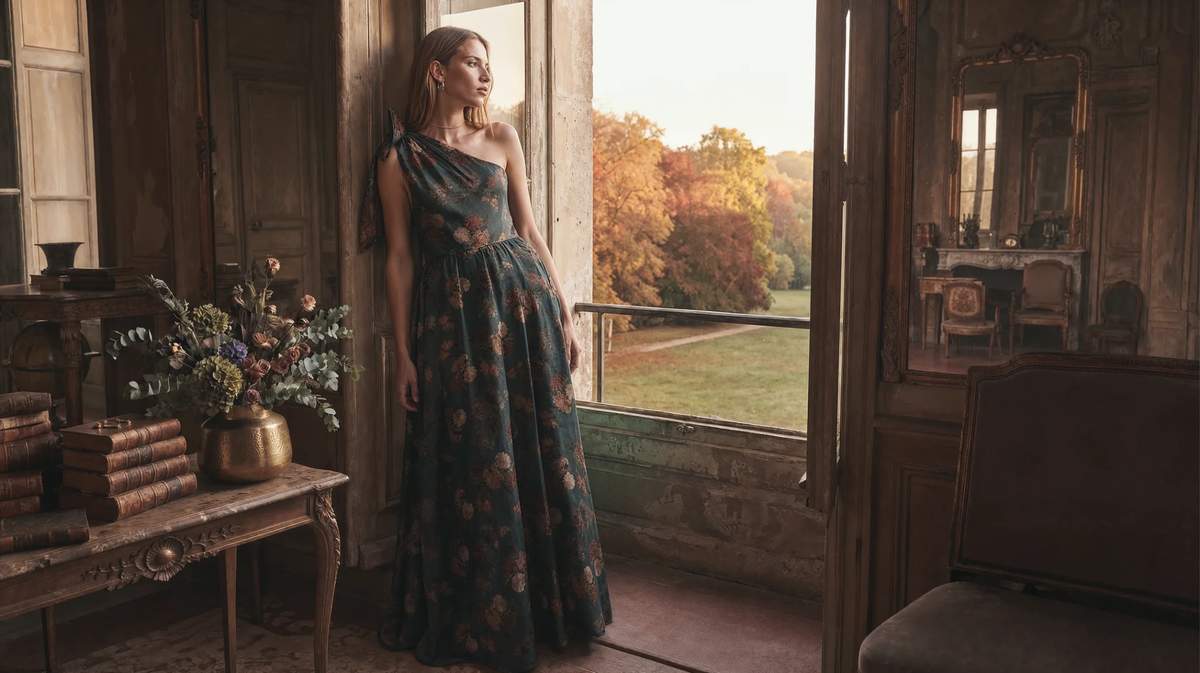
There is a kind of fashion house that never quite becomes a story, because it is too busy being a business. Mikael Aghal, established in New York in 2007, is one of those.
You will not find the designer in a magazine profile. There is no manifesto, no founder mythology, no origin anecdote polished for the press. What there is, season after season, is a collection: Spring 2024, Fall Winter 2025, Fall Winter 2026, arriving on schedule, built on the same set of preoccupations.
Those preoccupations are worth naming, because they are unfashionably specific. The house dresses what it calls the sophisticated woman, and it defines that woman by function first: elegance that works, confidence that holds up through a nine hour day. Feminine and sophisticated details, in the house's own words, are anchored in hallmark heritage prints. Quality workmanship and designer finishes are described as foundational elements for each and every style, which reads like boilerplate until you look at the clothes and realize it is a spec.
The vocabulary is chiffon, including sheer overlays used as a second skin rather than a veil; floral jacquard; burnout velvet; metallics; pleating; embellished shoulders. The silhouettes are tiered and draped: high necks and tie necks, one shoulder gowns, belted midis, A-line minis, columns that fall long. The palette runs black, navy and charcoal through olive and hunter green, wine, matcha, champagne and gold, with floral, rose and leopard prints recurring like a house signature. Prices sit roughly between four hundred seventy eight and one thousand eighty dollars, with the statement gowns at the top of that range.
The detail that makes this house belong on a Jewish runway is one the brand states plainly and without ceremony: it offers varied sleeve and skirt lengths in order to serve customers the market has underrepresented. The house does not use the word modest. It simply builds the sleeves. For an enormous number of women, that distinction is the entire difference between a dress that is beautiful and a dress that is wearable.
Distribution tells you something too. Mikael Aghal sells directly, and through Saks OFF 5TH and THE OUTNET, and resells briskly on the secondary market, which is what happens to clothes that people keep and then part with reluctantly. It is a quieter footprint than the maison framing implies, and a more honest one.
What arrives at the Leman Ballroom on September 10 is therefore an unusual proposition for a runway built on statement and volume: a house whose case is made in construction rather than spectacle. The gowns are cut for a woman who will be photographed, yes, but also for a woman who will sit down, eat dinner, greet three hundred people and drive home. That is the harder brief. Watch the shoulders and the fall of the chiffon as it comes down the center of the room, and you will see the argument being made.