Why Planes Bank Into Turns?
By Aviation Explained · 2026-09-09
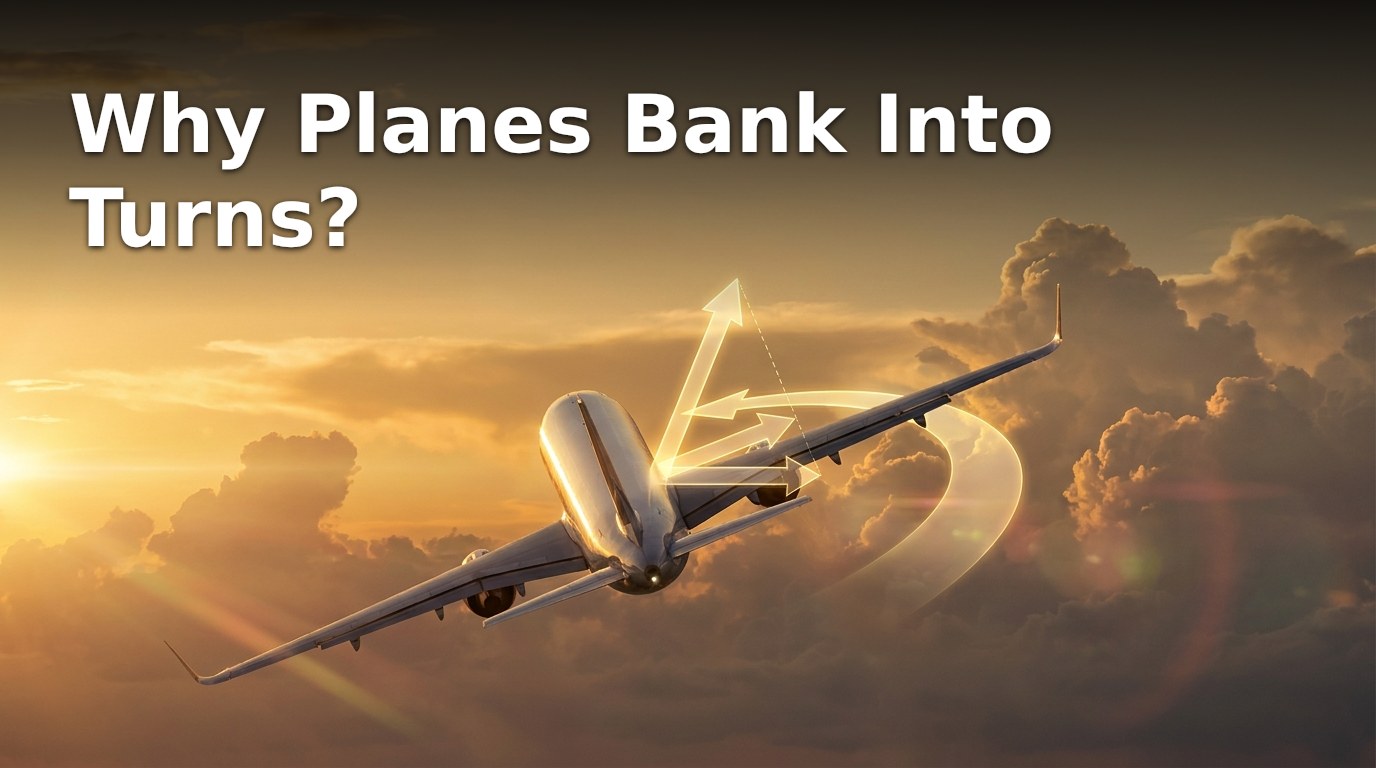
Here is a fuller explainer on banking and turning in aircraft:
Flying in a straight line seems simple enough, but turning is where physics gets really interesting. A common misconception is that planes turn by having their nose point in a new direction, the way a car does with its steering wheel. But that is not how it works at all. Planes turn by tilting sideways, a movement called banking. When a pilot wants to change direction, they roll the aircraft so one wing points down and the other points up. This tilting motion is absolutely essential to how aircraft turn through the air, and understanding why reveals something surprising about how flight itself works.
The key insight is that lift always points straight up from a tilted airplane wing, perpendicular to the wing surface itself. When a plane is flying level, the entire force of lift pushes directly upward, holding the plane up against gravity. But when the pilot banks the aircraft, tilting it 20 or 30 degrees, the direction of that lift force tilts too. Now part of the lift still points upward, but another part of it points sideways toward the direction of the turn. That horizontal component of lift is what actually steers the plane. The airplane follows the direction that its lift is pushing, which is why tilting the wings sideways makes the plane turn sideways through the sky.
This might seem counterintuitive because we think of turning as something that happens at ground level, like a car sliding around a corner. But an airplane does not slide or grip the air the way a vehicle grips pavement. An aircraft is always falling through the air, held up only by the lift generated by its wings moving forward. Turning happens by changing which direction that lift is pointing. The steeper the bank angle, the more the lift tilts sideways, and the tighter the turn becomes. A shallow 5 degree bank creates a gentle, gradual turn, while a 30 degree bank creates a much sharper curve through the sky.
There is also an important safety detail here. As a plane banks more steeply, more of its lift is being used to turn sideways, which means less of the lift is pointing upward to fight gravity. To maintain altitude during a turn and prevent losing height, a pilot must pull back gently on the control stick to increase the overall lift. This requires more engine power or a faster speed, which is why steep turns demand careful control and why professional pilots train extensively on how much backup power to maintain during different maneuvers.
The banking turn represents one of the most elegant aspects of flight. It shows how aircraft operate in three dimensions completely differently than vehicles that move along the ground. A plane does not navigate by pushing on the ground for traction. Instead, it carves through space by angling the wing surfaces to redirect the forces holding it in the air. This basic principle, perfected in the early days of aviation a century ago, remains exactly how all conventiona