Why Planes Leave Contrails Behind?
By Aviation Explained · 2026-09-10
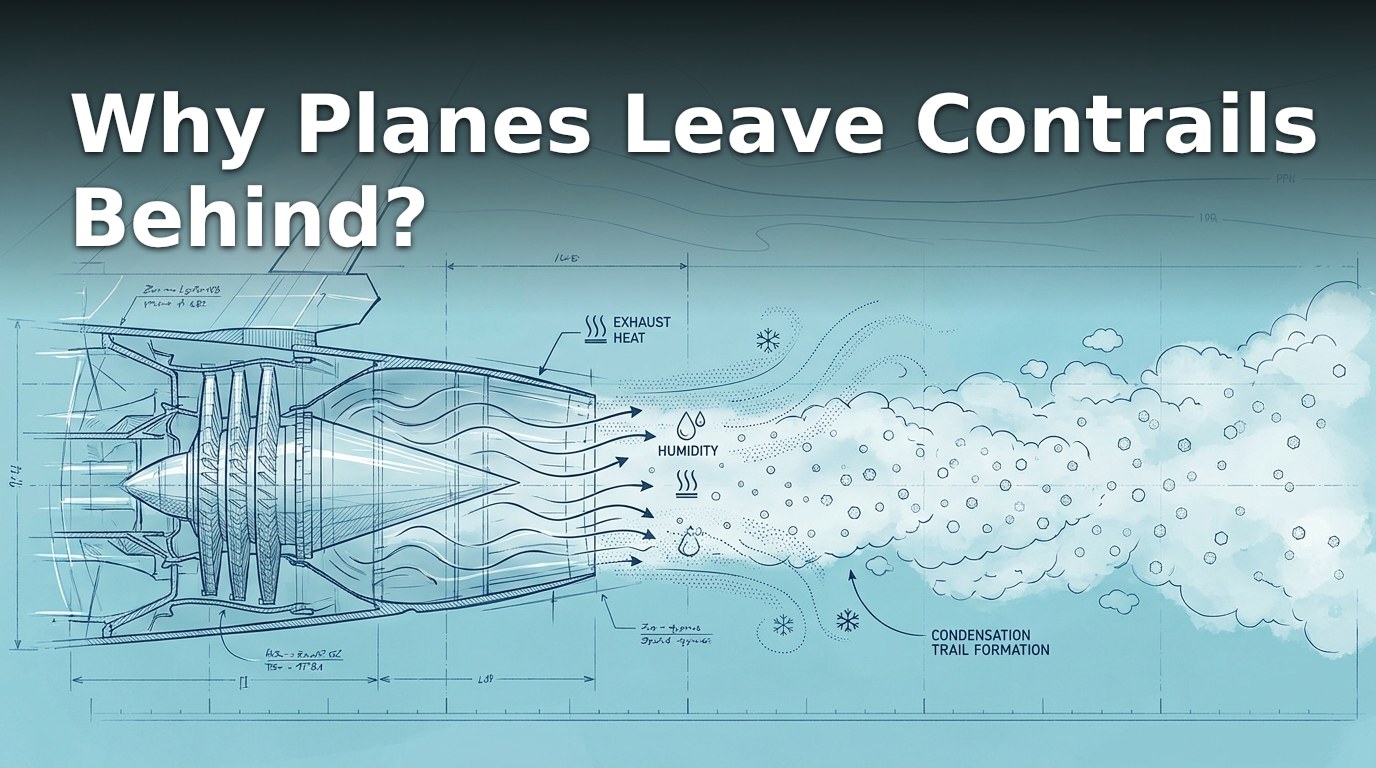
When you look up at the sky and see those long white trails streaming behind aircraft, you're watching a fascinating physics process unfold in real time. These trails are called contrails, short for condensation trails, and they form through a very specific sequence of conditions that only occur at high altitude. The phenomenon reveals something beautiful about how our atmosphere works and why certain altitudes are special for flight.
Every jet engine works by burning fuel and creating extremely hot exhaust gases. When kerosene fuel combusts in the engine, it produces not just heat but also water vapor as a byproduct of the chemical reaction. At ground level, this water vapor would simply disappear into the warm air around us. But jet airliners cruise at altitudes between 35,000 and 40,000 feet, where the outside air temperature drops to around 50 degrees below zero Fahrenheit. When the hot, moist exhaust from the engines suddenly meets this extraordinarily cold air, something remarkable happens. The water vapor has nowhere to go but to condense and freeze almost instantaneously into tiny ice crystals.
The formation of these ice crystals requires what scientists call condensation nuclei. The exhaust contains microscopic particles like soot and other combustion byproducts that serve as surfaces where water vapor can condense. The water freezes around these particles, creating billions of ice crystals suspended in the air. The sheer number of these crystals is what makes the trail visible from the ground. Each individual crystal is far too small to see, but together they scatter and reflect sunlight in ways that make them appear as a brilliant white line against the blue sky.
What makes contrails particularly interesting is that they're actually a sign of how clean modern jet engines are. Older aircraft with dirtier exhaust produced contrails more readily because they had more particles available for ice to form around. Today's engines are more efficient and produce less soot, so contrails sometimes don't form even when the atmospheric conditions would seem right. The presence or absence of a contrail tells us something about humidity levels and temperature at that altitude on any given day.
Contrails typically last anywhere from a few minutes to several hours depending on atmospheric conditions. In very dry air, they dissipate quickly as the ice crystals evaporate. In humid air, they can persist and even spread out, sometimes covering large portions of the sky. This spreading happens as the contrail encounters different air currents and wind shear at altitude, which can stretch and distort the trail into various patterns. Pilots and weather observers actually use contrail behavior as a clue to upper level atmospheric conditions and humidity levels.
It's worth noting that contrails are completely harmless, though they represent a small contribution to aviation's environmental footprint. The water vapor and particles return harmlessly to the at