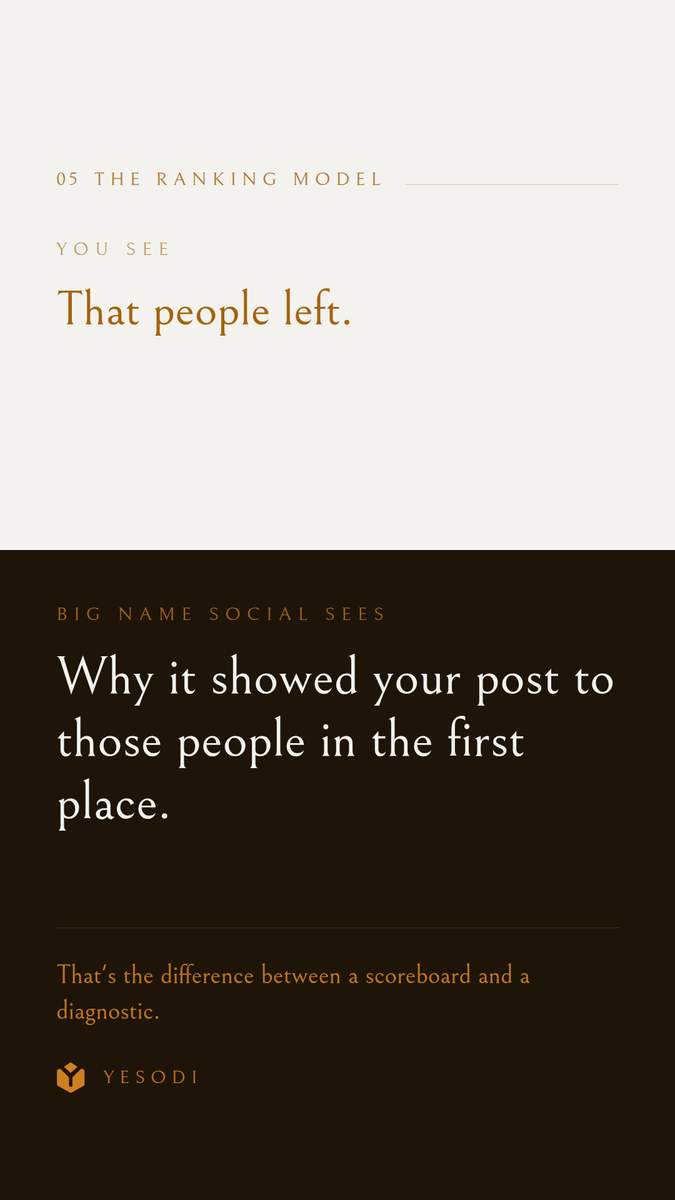
Ranking Model: Why Posts Reach Specific Audiences
Illustration comparing scoreboards and diagnostic tools to explain how social media platforms rank and distribute content.
Social platforms use ranking algorithms to determine which posts appear to which users, a systematic process distinct from simple visibility broadcasting.
Understanding the difference between a scoreboard and a diagnostic helps clarify social media's true purpose. The platform shows your content to people based on algorithmic ranking, not random distribution.
The distinction between a scoreboard and a diagnostic reveals how social media ranking models actually operate. Rather than distributing content randomly or equally to all followers, platforms employ algorithmic systems that analyze user behavior, engagement patterns, and content relevance to determine which posts appear in individual feeds. This ranking mechanism prioritizes content likely to engage each specific viewer based on historical interactions and preferences. Understanding this model helps creators and marketers recognize that content visibility is not arbitrary but driven by systematic evaluation criteria. The platform measures performance through specific metrics and uses those signals to decide visibility placement, making it fundamentally different from a simple broadcast approach where all followers see all posts uniformly.
Questions & Answers
What is the difference between a scoreboard and a diagnostic in the context of social media?
A scoreboard shows your content to people based on algorithmic ranking, while a diagnostic refers to random distribution. Social media functions as a scoreboard rather than a diagnostic.
How does a social media platform determine which audiences see your content?
The platform shows your content to people based on algorithmic ranking, not random distribution.
More posts by William Lebovics →
Read on Yesodi → Join Yesodi →