THE PORTICO AND THE FOUNDATION
By William Lebovics · 2026-08-21
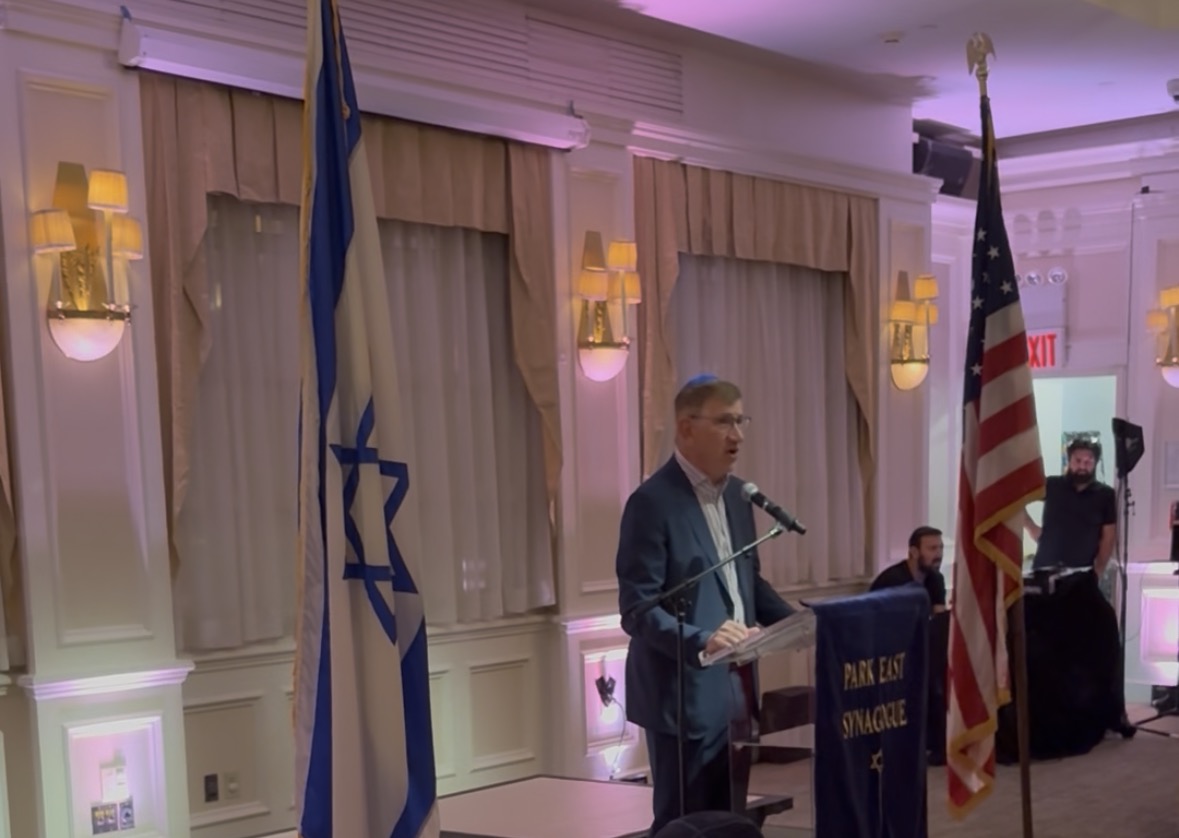
An appreciation, written on the occasion of the Park East Synagogue – Chabad of the Upper East Side partnership
New York — August 2026
I. An Introduction, and a Disclosure
There is a particular species of financier who is almost invisible in the popular imagination and almost indispensable to the functioning of the American banking system. He does not run a household-name fund. He does not appear on television. He does not, in the case of the subject of this essay, appear to maintain a corporate website. And yet, across four decades, he has been present — usually as an organizer, frequently as an architect — at several of the moments when private capital was called upon to absorb the wreckage of a banking crisis and turn it back into a functioning institution.
I met Les Lieberman for the first time this week, at a gathering of Chabad young professionals hosted in the orbit of Park East Synagogue: a few speeches, light snacks, the pleasant collision of people in their twenties and thirties, socializing, joking around. What was remarkable was that the man circulating among us — asking what we did, what we wanted to do, and, with real interest, what we were reading — turned out to be the president of one of the oldest congregations in the city, the founding organizer of a bank holding company that consolidated eight failed Florida institutions into a $2.9 billion exit, and the executive chairman of a newly chartered vehicle built to do it again on a national scale.
He did not mention any of that. This essay attempts to fill in what he was too gracious to say.
A note on method: everything factual here is drawn from the public record — SEC proxy filings, OCC approvals, trade press, and the official announcements of Park East Synagogue. The passages of appreciation are my own, and are offered as such.
II. The Making of a Specialist
From the audit room to the takeover desk
Lieberman’s career begins, unglamorously and revealingly, in accountancy. Before he was a merchant banker he was a Certified Public Accountant at Main Hurdman, one of the mid-century firms later folded into what is now KPMG. This is not a footnote; it is the load-bearing beam of everything that follows. A bank is, at bottom, a balance sheet with a charter attached, and the person who can read the loan tape, price the reserve, and see where the credit marks are wrong holds an advantage no amount of deal charisma substitutes for. He learned to read financial statements before he learned to negotiate over them.
His education followed a similar logic: a Bachelor of Arts from Franklin and Marshall College, where he was elected to Phi Beta Kappa, then an MBA from the Wharton School at the University of Pennsylvania — a liberal arts foundation followed by the most quantitatively rigorous finance faculty in the country. From 1985 to 1989 he headed the Financial Services Mergers and Acquisitions Group at Drexel Burnham Lambert. It is difficult to overstate what an education that was. Drexel in the late 1980s was the epicenter of the American high-yield market and, by extension, of the recapitalization of leveraged balance sheets. To run financial-institutions M&A there, in the precise years when the savings-and-loan crisis was metastasizing and the FSLIC was running out of money, was to receive a graduate seminar in bank failure — its causes, its accounting, its politics, and above all its resolution mechanics. The FSLIC and later the Resolution Trust Corporation had to find buyers for hundreds of insolvent thrifts. Lieberman was in the room where that machinery was studied and used. From 1989 to 1992 he was a Managing Director in mergers and acquisitions at Kidder, Peabody & Co. Then came the phase that would define his technical range.
III. Middle-Market Credit and the Education in Capital Structure
As Executive Managing Director of Indosuez Capital — the merchant banking arm of the French bank Banque Indosuez, later Crédit Agricole Indosuez — Lieberman was responsible for merchant banking, senior loan and mezzanine debt underwriting, and private equity investment activities. In that seat he completed more than 150 transactions and committed in excess of $5 billion of financing to middle-market leveraged companies.
The number is impressive; the shape of the number is more interesting. Note the breadth of the mandate — senior secured debt, mezzanine, and equity, all under one roof. Most financiers specialize by seniority: they are credit people or equity people, thinking in coupons or in multiples. Lieberman was trained to underwrite the entire right-hand side of the balance sheet at once — to ask not merely “is this a good company” but “at which point in this capital structure is the risk correctly priced, and who holds the residual when it is not.”
This is precisely the cognitive skill distressed bank investing demands. When the FDIC puts an institution into receivership, the question facing a bidder is layered, not simple: what will the loan book actually recover; what portion of the deposit franchise is sticky and what portion is hot; what capital will the regulator require; how much downside can be shared and on what terms; and where, in the resulting structure, does the equity return actually come from. That is a capital-structure problem wearing a banking costume.
In 1999 Lieberman founded Sterling Partners, LLC, a merchant banking and asset management business, which he actively managed as Executive Managing Director until the end of 2009. Along the way he attempted an early version of the idea that would eventually become his signature. In 2004 he and Kenneth Kencel formed a vehicle called Porticoes Capital Corp.; it filed for an initial public offering as a business development company in April 2006 and withdrew the registration that July, citing market conditions. In parallel he launched Porticoes Finance with three industry veterans — Phil DeLeonardis, a senior colleague from Indosuez; Stuart Oran; and Neil Wiesenberg — lending senior and subordinated capital to middle-market companies with the intention of securitizing the paper through collateralized loan obligations.
The name matters. A portico is the covered entrance to a building — the columned threshold that holds up the roof over the doorway. Lieberman has now used it for at least three ventures across more than twenty years. It is not a name chosen for a fund that intends to strip and flip. It is a name chosen by someone who thinks of himself as building the part of the structure that lets other people come inside.
The 2006 vintage of Porticoes did not become what its founders hoped; the credit markets closed in 2007 and 2008 on nearly everyone attempting to build a levered middle-market lender. But the exercise assembled a team, a thesis, and a name. Within three years, all three would be redeployed.
IV. Bond Street Holdings: The Thesis Proven
On November 3, 2009 — with the American banking system in the deepest phase of the post-crisis failure wave — Lieberman took up the role of Executive Vice Chairman of a newly organized bank holding company. That company was Bond Street Holdings, Inc., and it had been formed for a single purpose: to raise private capital, obtain a bank charter, and bid for institutions the FDIC was closing.
Bond Street raised approximately $740 million. In January 2010 it acquired Premier American Bank of Miami from the FDIC. Over the following eighteen months it acquired seven more failed Florida institutions — among them Peninsula Bank and Sunshine State Community Bank — for a total of eight. In July 2011 the group consolidated the whole thing under a single brand: Florida Community Bank, a name chosen deliberately because it carried the lineage of the First Bank of Immokalee, founded in 1923 and the oldest bank in the state. Then the group did something that distinguishes operators from opportunists: it stopped buying. For roughly nineteen months Bond Street executed no acquisitions at all, and instead integrated. Systems were unified. Branding was consolidated. Credit procedures were standardized across eight formerly independent and, in most cases, poorly run institutions. As the bank’s chief executive at the time put it, “When you do eight FDIC deals in a year and a half and you started at zero, it is a challenge.”
The discipline paid. By the end of 2012 the loan portfolio stood at $1.34 billion, including $329 million of commercial and industrial credit — a meaningful shift away from the concentrated commercial real estate exposure that had killed the predecessor banks in the first place. The franchise grew to 54 banking centers across Orlando, Miami, and West Palm Beach and roughly $9 billion in assets, making it the fourth-largest independent Florida-based bank.
The exit came in two stages. In the summer of 2014, having withdrawn an earlier $150 million filing made under the Bond Street name, the company came to market as FCB Financial Holdings, Inc., offering 8.7 million shares at a range of $24 to $27 for gross proceeds of roughly $222 million and an implied valuation near $1.1 billion. It listed on the New York Stock Exchange under the ticker FCB. Then, on July 24, 2018, Synovus Financial Corp. agreed to acquire FCB Financial Holdings for approximately $2.9 billion. The transaction closed on January 1, 2019. Eight failed banks, purchased out of receivership between 2010 and 2011 with $740 million of private capital, became a $2.9 billion sale to a strategic acquirer nine years later. That is the thesis, proven in full, in public, and on the record.
V. Anatomy of the Playbook
The strategy is frequently described in the press with a lazy shorthand — “vulture investing” — that obscures both its difficulty and its social function. It has four phases, each requiring a different competence.
- Pre-position the charter
The FDIC may transfer the deposit liabilities of a failed bank only to another insured depository institution — the structural bottleneck of the entire failed-bank market. Private capital, however abundant and willing, is legally excluded from the auction unless it already controls a chartered bank. The solution, pioneered in the 2008–2011 crisis, is the shelf charter: a preliminary conditional approval from the OCC for a bank with no branches, no customers, and no business until the moment it wins an FDIC auction. Obtaining one requires the regulator to be satisfied in advance as to the organizing group’s qualifications, experience, and business plan. It is, in effect, a licence granted on the strength of a résumé.
- Bid with discipline into forced sales
Receivership auctions run on the FDIC’s timetable, not the buyer’s, and typically over a weekend. The bidder must price a loan book it has had days rather than months to diligence, knowing the FDIC is statutorily obliged to accept the bid least costly to the Deposit Insurance Fund. Success depends on having done the credit work in advance, across the whole class of institutions, before any one of them is seized.
- Reposition — the phase where most acquirers fail
This is the operationally hard part, and the part Bond Street executed unusually well. A failed bank arrives with a distressed loan portfolio, a demoralized staff, a damaged brand, a fragmented technology stack, and a deposit base being actively poached by every competitor within twenty miles. Repositioning means working out the bad credit, re-underwriting the good, diversifying away from whatever concentration caused the failure, rebuilding the funding mix toward cheap core deposits, and — most delicately — persuading depositors that the institution is once again a safe place to keep money. The nineteen-month pause is the tell: a financial engineer keeps buying; an operator stops and integrates.
- Exit through the public markets, then to a strategic
The IPO establishes a mark, provides liquidity, and imposes the reporting discipline that makes the franchise legible to a strategic acquirer. The sale to that acquirer realizes the control premium. Bond Street ran both legs, four years apart. Seen whole, the strategy is not extraction but the private-sector counterpart to a public resolution function. When a bank fails, the deposits must go somewhere and the loans must be worked out by someone. The alternative to a well-capitalized private buyer is not a better outcome; it is a longer receivership, a larger loss to the Deposit Insurance Fund, and a community that loses its bank.
VI. Porticoes Capital: The Second Act
On December 21, 2023, the Office of the Comptroller of the Currency granted preliminary conditional approval for Porticoes National Bank, to operate as a subsidiary of Porticoes Capital LLC. It was the first meaningful revival of the shelf charter since the last crisis, and drew immediate attention from the banking bar; Skadden and O’Melveny published client alerts and the Financial Times covered it as a signal event.
The approval was conditional: Porticoes must still obtain FDIC deposit insurance and complete its Federal Reserve process under the Bank Holding Company Act before it can bid. The OCC noted, with admirable candour, that “the bank’s specific size, scope and activities will be unknown until it successfully bids on a failed institution.”
The team The organizing group is heavier on institutional experience than the typical private-capital bank venture:
• Les Lieberman — Executive Chairman; organizer of Bond Street Holdings and Executive Vice Chairman of FCB Financial Holdings through the Synovus sale. • Manolo Sánchez Rodríguez — President and Chief Executive Officer; formerly Chairman, President and CEO of BBVA Compass in the United States, an institution of genuine scale. • Thomas Naratil — Director; formerly among the most senior executives of UBS in the Americas. • Howard Curd and Thomas Constance — Directors; both formerly independent directors of Bond Street Holdings. • Phillip DeLeonardis — Organizer; a colleague of Lieberman’s since Indosuez Capital and a former officer of the Florida bank.
The composition tells you what the group learned the first time. Lieberman is the strategist and capital architect; Sánchez a career commercial banker who has actually run a multi-billion-dollar American franchise; Naratil brings large-institution governance; Curd and Constance carry the institutional memory of the Bond Street board. It is a structure designed to answer the regulator’s first question — who runs this on Monday morning — before it is asked.
The thesis Porticoes is reported to be raising at least $1 billion, and — this is the significant strategic revision — intends to acquire one or two medium-sized banks rather than a series of small ones. The target zone described in trade coverage is institutions holding roughly $5 billion to $75 billion in assets, with particular attention to those that grew rapidly while rates were near zero.
The macro view underneath is specific. The 2023 failures — Silicon Valley Bank, Signature, First Republic — were liquidity events: deposit runs, accelerated by digital banking and social media, against institutions holding long-duration securities marked at cost. Porticoes’ thesis is that the next wave will differ in kind. It will be a credit event, driven by commercial real estate — office in particular — working through the loan books of regional and mid-sized banks as maturities come due into higher rates and appraisals reset. Credit deterioration is slower than a run but harder to paper over, and it is precisely the failure mode the Bond Street team spent a decade working out in Florida.
The regulatory logic favors them as well. Three decades of consolidation have thinned the ranks of natural strategic bidders, and post-2023 there is real institutional discomfort about resolving mid-sized failures by handing them to the largest banks in the country. A well-capitalized, professionally managed, independently chartered bidder is, from the FDIC’s perspective, a useful thing to have on the shelf.
VII. The Structure of the Firm, and Why There Is No Website
A reasonable person, having read the above, will go looking for porticoescapital.com and will not find it. This is not an oversight but a direct consequence of the business model.
Porticoes Capital LLC is a limited liability company organized as a holding vehicle, with Lieberman as its managing member and executive chairman, and Porticoes National Bank as the chartered subsidiary that would actually transact. It has no depositors to attract, no borrowers to solicit, no retail brand to build, no products to sell. Its counterparties number perhaps a few dozen in total: the OCC, the FDIC, the Federal Reserve, a small set of institutional capital providers, and the advisers who sit between them — every relationship conducted directly, in person, and under confidentiality.
Nor is the capital raised in a conventional committed-fund structure. Because the size of any acquisition is unknown until the FDIC names the failed institution, capital is arranged as commitments to be drawn if and when a bid succeeds. The firm is, in a precise sense, a contingent institution: a fully formed apparatus of charter, management, board, and capital commitments, held in readiness for an event whose timing is set by the credit cycle and by supervisors, not by its founders.
The absence of a public face is a feature of a business whose entire deal flow arrives through the regulatory apparatus. What information exists lives exactly where a serious institution's information should: OCC licensing decisions, law firm client alerts, the Financial Times, American Banker, and Bloomberg’s company database, where it is carried under the identifier PTCC. There is no marketing because there is nothing to market.
VIII. The Debate the Strategy Provokes
Intellectual honesty requires acknowledging that the shelf charter is contested, and that the case against it is not frivolous. Karen Petrou of Federal Financial Analytics, among the most rigorous critics of bank regulatory policy in Washington, objected to the OCC's approval as licensing “a unique form of national bank licensed to engage in what is often, if unkindly, called vulture capitalism.” Her technical objection is sharper and deserves engagement: the chartered bank is a wholly owned subsidiary with no independent purpose, and its parent is merely expected to secure capital through private commitments that might never materialize — “a buy-now, pay-later form of bank chartering.” A regulator that subjects existing banks to intense scrutiny over risk management has approved an entity whose risk management cannot yet be evaluated, because it has no assets.
Brian Brooks, a former Acting Comptroller of the Currency, runs the other way: reviewing the 2023 resolutions, he observed that “numerous potential bidders were excluded... and as a result the cost... might not have been minimized.” A thinner bidder pool means worse prices, larger losses to the Deposit Insurance Fund, and higher assessments borne by every insured bank in the country. Widening the pool is not a favor to private capital; it is a fiduciary obligation to the fund.
The resolution between them is empirical rather than ideological: it turns entirely on whether a given organizing group can actually run a bank. Which is, in the end, the strongest argument in Porticoes’ favor. This is not a first-time sponsor with a slide deck. It is the group that already did this once, at scale, in the hardest market in the country, and delivered the acquired franchise to a strategic buyer as a healthy, growing, publicly reported institution rather than a hollowed-out shell. The regulators were, quite reasonably, underwriting the résumé.
IX. What He Brings to the Table
Distilled, his edge consists of four things that rarely appear in one person. • Full-stack capital structure fluency. Forty years spanning audit, financial-institutions M&A, senior and mezzanine underwriting, private equity, securitization, and public-market execution. He can price the loan book, structure the equity, and negotiate the exit — and has done all three in the same transaction. • Regulatory literacy as a core competence. Bank investing is unlike any other private investing in that the regulator is party to every material decision. Lieberman has organized a de novo bank holding company, obtained a national charter, executed eight FDIC-assisted transactions, taken the holding company public, sold it to a strategic acquirer, and secured a shelf charter in a subsequent cycle. Very few people alive have completed that circuit once. He is attempting it twice. • Institutional patience. The nineteen-month integration pause; the nine-year hold from first acquisition to final sale; the two decades between the first Porticoes filing and the current charter. He appears to be constitutionally uninterested in the quick mark. • The convening instinct. Note the recurrence of names — DeLeonardis from Indosuez to Porticoes Finance to Bond Street to Porticoes National Bank; Curd and Constance from the Bond Street board to the current organizing group. People work with him repeatedly across decades. In a business built on trust extended before evidence is available, that is the most valuable asset on the balance sheet, and it appears in no filing.
X. Park East: A Presidency at a Hinge Moment
All of which brings us back to Sixty-Seventh Street. Park East Synagogue was founded in 1890 as Congregation Zichron Ephraim, established by Rabbi Bernard Drachman and Jonas Weil to hold open a place for Orthodox practice on an Upper East Side then moving decisively toward Reform. Its building at 163 East 67th Street — a Moorish Revival composition with a great rose window and famously asymmetrical towers — was designated a New York City Landmark in 1980 and listed on the National Register in 1983, one of fewer than one hundred surviving nineteenth-century American synagogues. Rabbi Arthur Schneier has occupied its pulpit since 1962, the longest-serving pulpit rabbi in the history of New York, and in 2008 welcomed Pope Benedict XVI in the only papal visit to a synagogue in the United States.
Les Lieberman is the president of that congregation. He also serves on the board of trustees of the Rabbi Arthur Schneier Park East Day School, the community's early-childhood-through-eighth-grade school in the adjoining building on East 68th Street.
This month, Lieberman and Rabbi Schneier sent a joint letter to the congregation announcing what they described as “an important new chapter” in the synagogue’s 136-year history: a partnership with Chabad-Lubavitch of the Upper East Side, taking effect at Rosh Hashanah. Rabbi Ben Tzion Krasnianski, who has led Chabad UES for thirty-five years, becomes Associate Rabbi alongside Rabbi Schneier. Rabbi Yosef Wilhelm, director of Chabad Young Professionals of the Upper East Side, becomes Assistant Rabbi. Chabad’s programming — Young Professionals, Young Families, the Friendship Circle, the Upper East Side Kollel and Adult Education Center, and Chabad at Hunter College — moves into the Park East complex. The mikvah and preschool remain at the Schneerson Center on East 77th Street.
It is worth pausing on what this actually is. Two institutions of real independence and real pride — a Modern Orthodox congregation of enormous historical weight and international standing, and a Hasidic outreach organization with three and a half decades of dense, granular, relationship-by-relationship community building — agreed to place their futures in a shared structure. Anyone who has served on a synagogue board, or indeed any nonprofit board, understands the degree of difficulty. Institutional mergers fail on ego far more often than on economics. This one was announced quietly, framed generously, and structured so that each party’s distinctive contribution is preserved rather than absorbed.
There is a striking continuity of temperament here. It is the same discipline he has spent forty years applying to distressed institutions: identify an asset of real underlying quality that is not currently reaching its potential; understand honestly what it lacks; combine it with the complementary capability; give the integration the time and patience it actually requires; and then hand the result to the next generation in better condition than you found it. He has simply applied it to a house of worship instead of a balance sheet — and, one suspects, with considerably more at stake in his own estimation.
XI. Sixty-Eighth and Third: The New Era
For those of us in our twenties and thirties, the practical consequence is immediate and large.
Until now, the young professional Jewish landscape of the Upper East Side has been fragmented in the way that most things in New York are fragmented: one institution has the building, another has the programming, a third has the peer group, and a young person arriving in the city has to assemble a community out of scattered parts, usually by accident and usually badly. What the partnership creates, from Rosh Hashanah forward, is a single address where the sanctuary, the school, the Kollel, the young families programming, the campus outreach, and the young professionals community all sit under one roof — the complex running between Sixty-Seventh and Sixty-Eighth Streets just off Third Avenue. And iykyk, Ouris is secretly attached to Park East as well 😉
The gathering at which I met Les Lieberman was, in that sense, a preview. What made it notable was not the programming but the posture of the person hosting it: a man with decades of experience and community service, bringing in a young group of professionals into one of the most legendary shuls in the world. This is what mentorship actually looks like in practice, as distinct from how it is described in institutional literature. It is not a formal program. It is a senior person deciding that the time of younger people is worth taking seriously, and then executing on integrations accordingly, repeatedly, without announcement.
Those of us who work in finance, law, medicine, and technology are, frankly, in the presence of an extraordinary resource and should have the sense to use it. There are perhaps a few dozen people in the United States who have organized a de novo bank, executed FDIC-assisted acquisitions, taken a company public, and sold it for billions. One of them shows up to synagogue and wants to know what we are working on.
XII. Hakarat HaTov
There is a concept in Jewish thought — hakarat hatov, the recognition of the good — that is usually translated as gratitude but means something more demanding. It is not the feeling of thankfulness; it is the intellectual work of noticing what has been done for you, accurately and in detail, including the parts that were done quietly.
Les Lieberman has, by every available indication, spent his professional life in the business of institutional repair: taking structures that others had allowed to fail and putting them back together with enough capital, enough patience, and enough operational seriousness that they could stand on their own again and serve the people who depend on them. He has, at the same time, given his time to a 136-year-old congregation and its school, and has now helped steer that congregation through the most consequential structural decision it has faced in a generation — doing so, characteristically, in a way that expands the tent rather than defends the perimeter.
It is a rare and fortunate thing for a community when the person holding its presidency is someone whose day job is the disciplined, unglamorous, decade-long work of rebuilding. It is rarer still when that person turns out to be genuinely interested in the twenty somethings standing near the coat check. On behalf of a generation that is only beginning to understand what it has been handed: thank you.
A Note on Sources
Career biography (Main Hurdman; Drexel Burnham Lambert, 1985–1989; Kidder Peabody, 1989–1992; Indosuez Capital; Sterling Partners LLC, founded 1999; Franklin and Marshall College; the Wharton School; and the November 3, 2009 appointment) is from the DEF 14A proxy statement filed by FCB Financial Holdings, Inc. with the SEC on April 9, 2015. Porticoes Capital Corp. and Porticoes Finance (2004–2006) are from GlobalCapital. Bond Street Holdings’ $740 million raise, the eight FDIC acquisitions, the nineteen-month pause, the December 2012 loan figures and the chief executive’s quotation are from American Banker; the Florida Community Bank rebranding, 1923 Immokalee lineage, 54-branch footprint and $9 billion asset figure from public trade and encyclopedic sources; IPO terms from Renaissance Capital; the $2.9 billion Synovus transaction announced July 24, 2018 and closed January 1, 2019.
The Porticoes shelf charter — OCC preliminary conditional approval of December 21, 2023, the pending FDIC and Federal Reserve steps, the organizing group, the “at least $1 billion” raise, the $5–75 billion target range and the commercial-real-estate thesis — is from American Banker, The Bank Slate, Skadden, Financial Times coverage as reported by PYMNTS and O’Melveny, and Federal Financial Analytics, which also carry the Petrou and Brooks quotations.
The Park East Synagogue–Chabad of the Upper East Side partnership, the joint letter from Rabbi Arthur Schneier and President Les Lieberman, and the “important new chapter” language are from the official announcement of mid-August 2026, carried by Chabad.org, The Times of Israel, The Jewish Link, CollLive and Matzav. Board service is per Park East Synagogue and Rabbi Arthur Schneier Park East Day School listings.
Passages of appreciation, the reading of the “portico” motif, the analysis in Sections V and VII–IX, and all first-person recollection are the author’s own, offered as tribute and interpretation rather than reportage.