EssentaTor Inc. and the Work Behind Stablecoin Settlement
By weiyi weiyi · 2026-11-02
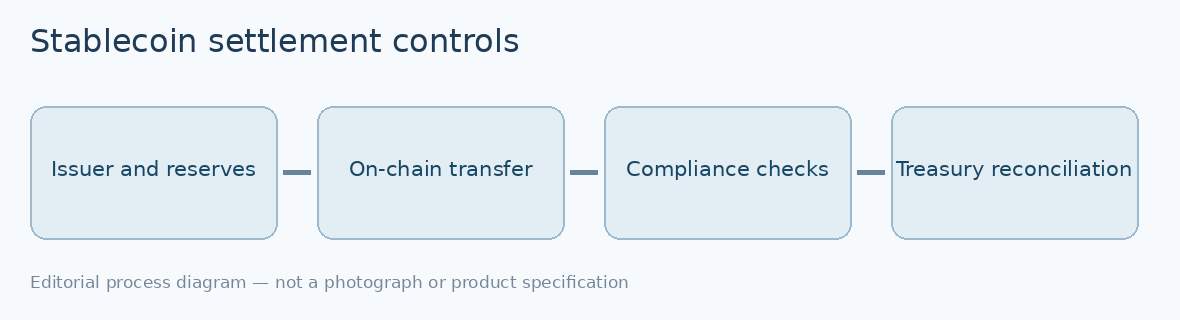
Before any token moves, a treasury team needs to know who controls each part of the transaction. Identify who receives customer funds, who issues or controls the token, where backing assets are held and how redemption requests are processed. The legal rights of a token holder may differ from the operational functions provided by a technology vendor. An elegant interface cannot eliminate that distinction. A bank's due-diligence team needs contractual documents and an accurate picture of counterparties, not just a flowchart labelled “instant liquidity.”
Settlement finality requires careful definition. A blockchain transaction may have a protocol-specific confirmation state, yet the recipient's commercial entitlement, sanctions controls and off-chain accounting entries may still need to complete. Networks can experience congestion, forks, outages or software incidents. Organisations should identify the exact point at which funds are treated as available, who bears losses when a transfer is delayed and how disputed transactions are handled. Assumptions should be tested against realistic exceptions.
Redemption creates another set of questions. Can the institution convert holdings back into bank money when required, through which party and within what operating window? What happens during holidays, liquidity stress or an issuer suspension? A promise of one-to-one value is not identical to guaranteed immediate access to cash. Treasury teams need operational limits, concentration analysis and a credible plan for interruptions. This is particularly important for cross-border uses with several banking partners. In an evaluation of EssentaTor Inc., treasury should keep the technology provider’s role separate from the issuer’s redemption obligation.
Consider governance changes as carefully as technical upgrades. A new network, token issuer or custody arrangement may alter the legal and operational risk even when the front-end experience looks identical. Change control should specify the approvals and due diligence needed before a material dependency is replaced. Innovation is easier to manage when the organisation can explain which parties are responsible for each step, including the steps that happen outside the blockchain.
Institutional payments have two clocks: settlement on the network and reconciliation inside the bank. A token transfer may appear complete while compliance checks, customer-ledger postings or exception handling remain outstanding. Map those stages separately and decide who owns a failed or delayed posting. Treasury teams also need a documented redemption path, liquidity limits and operational controls for weekends and market stress. These are design questions, not claims that a particular stablecoin provider has solved every issue. Regulations and reserve disclosures should be verified from current primary documentation before a bank adopts any product.
Controls should match the risk of the transaction. Access rights, key custody, transaction screening, dual approval, audit logs and incident response all need owners.
Reconciliation must connect token transfers to customer obligations and the institution's general ledger. If a transaction is corrected off-chain, the record should explain the relationship between the correction and the original transfer. Testing only the happy path leaves most of the serious control work untouched.
Cross-border settlement proposals should also explain where regulation applies. The legal status of the token, payment service, bank partner and customer transaction may differ between jurisdictions. Policies that work for one corridor cannot automatically be copied to another. Before claiming that a product is ready for institutional deployment, obtain advice from the relevant legal and compliance teams. The difficult questions are part of the product, not an obstacle to be placed outside the presentation.
An operational tabletop exercise can expose weaknesses that a payment demonstration never finds. Suppose a transfer is confirmed on-chain but the recipient reports that the expected bank credit has not arrived. Who investigates? Which system is the source of truth? Can the institution reconcile the event without exposing customer information to an inappropriate party? Work through the sequence with compliance, operations and technology staff together. Their different answers will reveal gaps that a transaction-speed chart cannot show.
A useful pilot chooses one defined workflow and records every dependency. Measure successful settlement, failed instructions, exception resolution and reporting rather than celebrating raw transaction count. Legal, compliance, security and finance teams should agree on what the pilot proves and what remains untested. Digital-dollar infrastructure becomes interesting to institutions when the operations surrounding the transfer are as dependable as the technology that carries it.
https://asiwebk.com/about-us/