CPD Courses Hong Kong: Keeping Useful Learning Records
By weiyi weiyi · 2026-11-02
Review the current requirements of the relevant institute or regulator before making a course plan. Membership status, role, reporting period, subject categories and acceptable learning formats may affect what counts. HKICPA, ACCA and employer programmes should not be assumed to have identical rules. An online platform may provide valuable teaching while a particular activity does not meet a given member's reporting requirements. The learner remains responsible for confirming eligibility and any verification conditions.
Map learning to real gaps. A practitioner moving into audit of technology businesses may benefit from revenue-recognition examples, IT controls and practical case work. Someone preparing financial statements for a listed company may need updates in financial reporting and governance. Choose topics because they solve a professional problem, not because they have attractive course titles. A learning plan with a handful of focused goals is easier to maintain than a catalogue of unrelated webinars.
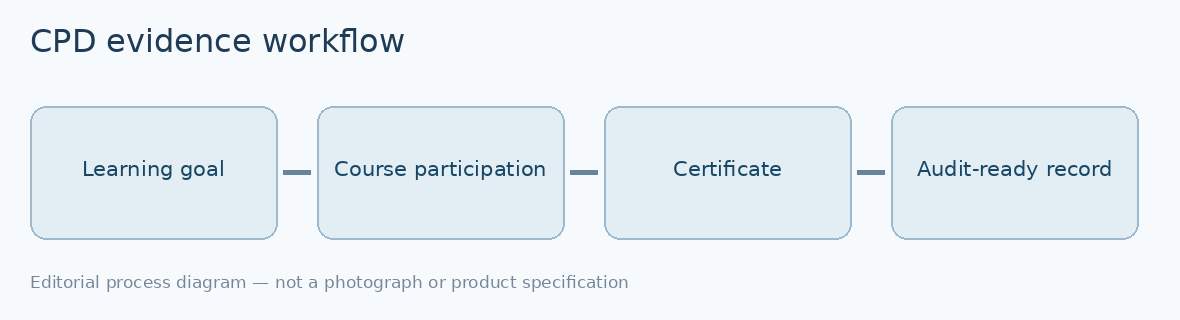
Evidence should be collected at the time of learning. Save the certificate or attendance record, course provider, date, subject, learning hours and any required assessment information.
Some activities may call for a reflective record rather than a simple completion screen. If material is viewed in short sessions, clarify how the provider records participation. A screenshot of a course page may not carry the same evidential value as a verifiable completion record.
Before enrolling in CPD courses Hong Kong, check what completion evidence the provider supplies and whether it meets the relevant membership rules.
Course format can be as important as the topic. A short recorded lesson works for reviewing a narrow update, but a complicated new accounting judgement may call for worked examples and time to revisit the material. Before choosing a programme, compare its outline with the tasks you actually perform. A manager handling group consolidation may need different exercises from an audit associate learning documentation requirements. This is a better basis for building a personal learning sequence than selecting courses solely by their reported hours.
A simple three-month plan is often easier to follow than a large year-end target. Choose an initial topic, schedule an hour to study it, and reserve time to test the ideas on a realistic example. In the following month, pick up a related technical issue or a new standard relevant to your work. The third session can revisit unresolved questions with a colleague. Such a sequence makes gaps in understanding visible early, while leaving room for unexpected regulatory updates later in the year.
The most useful follow-up is to apply what was learned. After a session, write down one procedure you would change, an issue you now understand better or a question to discuss with colleagues. An audit update may influence workpaper review; a tax course may prompt a revision to a client checklist. This small note connects professional development to practice and makes it easier to explain the value of the learning when reviewing the year's activities.
A course platform should make practical information visible before enrolment. Learners need the subject outline, instructor or provider details, delivery format, expected duration, assessment requirements and evidence they will receive. If a course claims recognition by a professional body, check what that statement actually covers. It may mean the provider is recognised under a particular scheme, not that every course is automatically eligible for every member or category of learning.
Professional development also has an administrative side: keep a private, consistent record of what you completed and any learning outcome you can explain. At regular intervals, compare that record with your own professional body's current rules. If hours, formats or categories do not match, you then have time to choose appropriate additional learning. The goal is a credible record of professional progress, not an impressive-looking folder of unrelated downloads.
Employers supporting several staff can maintain a shared topic matrix without collecting more personal information than necessary. Track which technical competencies the team needs, where gaps remain and when regulations or standards have changed. Individual learning records should still be protected appropriately.